
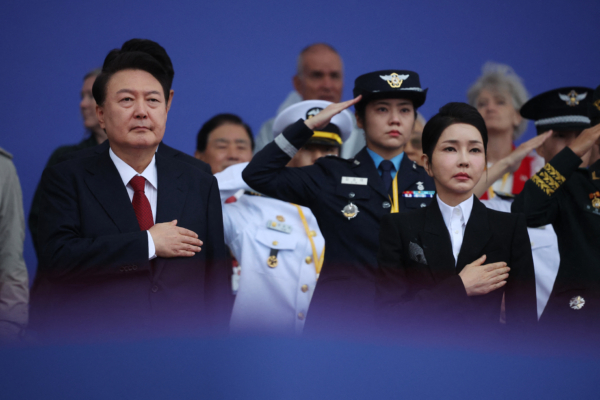
On Saturday, December 7th, the opposition party in South Korea’s parliament rejected a proposal for a special investigation into the First Lady. Later that day, South Korean President Yoon Seok-yul survived an impeachment vote triggered by the implementation of martial law.
The bill, which called for a special investigation into First Lady Kim Keon Hee, garnered 198 votes in favor and 102 votes against. As the threshold of two-thirds majority support was not reached, the “Kim Keon Hee Inspection Act” failed to pass.
Next, parliament proceeded to vote on whether to impeach President Yoon Seok-yul for implementing martial law, but the ruling party members boycotted the process. Several lawmakers left the parliament before casting their votes on the impeachment of President Yoon Seok-yul. Ultimately, the impeachment motion did not pass.
Under South Korean law, an impeachment motion must be initiated by over half of the sitting parliament members, with support from at least two-thirds of them to pass. With 300 parliament members in South Korea, the non-ruling party holds 192 seats, necessitating at least 8 ruling party members’ support for the impeachment motion to pass.
During the voting, only two lawmakers remained in the parliament, while a returning ruling party member voted against the motion. Another non-ruling party senator, upon returning to the chamber, also voted against the motion.
The Chairman of the main opposition party, the Democratic Party of Korea, Lee Jae-myung, previously mentioned that if this impeachment attempt failed, they would reintroduce the motion next Wednesday.
Martial law has left a scar on the South Korean people. Although South Korea is now widely regarded as a beacon of democracy and peace in Asia, the country endured decades of military dictatorship before winning the democratic struggle in the 1980s, with 16 instances of martial law implemented.
Earlier on Saturday, President Yoon Seok-yul issued a national apology. In his two-minute address, he stated, “This emergency martial law order stemmed from my despair as the ultimate responsible person for state affairs.”
“I deeply apologize and offer my sincere apologies to the citizens who must have felt extremely shocked,” he said.
President Yoon Seok-yul emphasized that he “will not avoid the legal and political responsibility related to this martial law order.”
“I will entrust my party to take measures to stabilize the political situation, including during my remaining term… I apologize to the people for the concerns I have caused,” President Yoon Seok-yul concluded.