
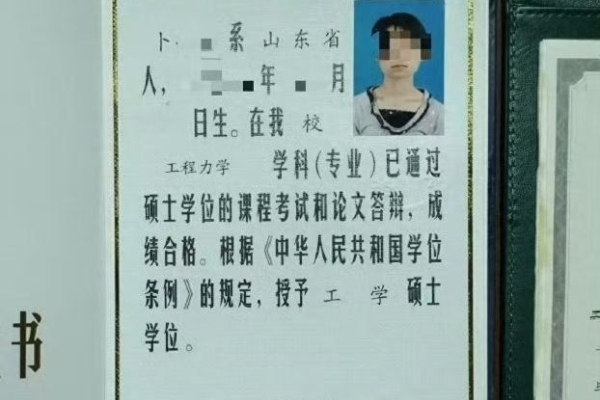
A female master’s student from China went missing in 2011 and had been unheard of until November 25th of this year when she was found in the home of a disabled man in a rural village in Shanxi. It was revealed that she had already given birth to a pair of children. Authorities reported that she was “lost and taken in by kind-hearted individuals,” but netizens questioned whether this female master’s student was a “version 2.0 of the Xu Zhou mother of eight incident.”
According to reports from the Chinese state media, the female master’s student, surnamed Bu, is 45 years old this year. She excelled academically from a young age and graduated with a master’s degree in engineering in 2008, intending to pursue a Ph.D.
Bu’s brother recalled that his sister failed to timely renew her second-generation ID card, leading to unsuccessful attempts to enroll in a Ph.D. program. Subsequently, she developed schizophrenia, received medical treatment for a period, and was discharged to recover at home. In May 2011, she suddenly went missing, prompting her family to search everywhere and report to the police, but no information was ever found.
It wasn’t until November 25th of this year when a Ms. Zhang in Heshun County, Jinzhong City, Shanxi sought help from volunteer searchers to locate her aunt. With the assistance of these volunteers, her aunt was finally reunited with her family, and it turned out her aunt was Bu. However, Bu already had two children, aged 12 and 8.
Ms. Zhang explained that her aunt wandered into their home over a decade ago and was taken in by their family, subsequently having two children with her uncle. “Their family conditions are poor, my aunt does not have household registration, so I wanted to help her find her family and get registered.”
As per Ms. Zhang and others, her uncle’s parents passed away, and the family struggled to make a living on two mu of land, earning less than twenty thousand yuan annually with no other source of income. Additionally, her uncle had poor health, having broken a leg in childhood and being blind in one eye.
After the news was made public online, mainland netizens began to question, “Xuzhou incident 2.0,” “Another iron chain woman,” and “A normal person encountering a missing person would report to the authorities immediately, not bring them home to have children.”
The incident continued to stir discussions online. On December 3rd, Heshun County Public Security Bureau issued a statement to dispel rumors, stating that Bu went missing from her home in 2011 and was subsequently “sheltered” by Zhang.
The announcement mentioned that following the discovery of Bu’s peculiar circumstances, the county police took the initiative to help her locate her family. However, given her inability to accurately provide her identity information, law enforcement had to conduct extensive verification and comparison work to find her father.
Contrary to the official report, based on state media reports, at the request of Ms. Zhang, the volunteer searchers arrived at her home and found that Bu could read. They gradually guided her to articulate her name, parents, brother’s name, and the school she had attended, among other information. After providing this information to the authorities, her family was located. Bu was taken to the hospital for treatment upon returning home, but when her “husband” went to visit her, he was denied access on the grounds of not being a legal guardian.
Moreover, sharp-eyed netizens noticed a handwritten note by the volunteer searchers for Bu, with the first line being the character “run.”
The police announcement once again sparked heated discussions online.
Mainland netizens expressed various sentiments, with comments like “Missing for 13 years, elder son is 12 years old, haha,” “The language used in the current report is so precise; a master’s graduate goes missing and ends up being a villager’s wife in a remote mountain valley,” “In Myanmar, this would be called trafficking; in the country, it’s called sheltering,” “Sanitizing a crime is still a crime,” and “It’s too disgusting. Women are not seen as human beings, but tools by these people.” Some expressed disbelief and cynicism, with others feeling devastated by the prevalence of such incidents.