
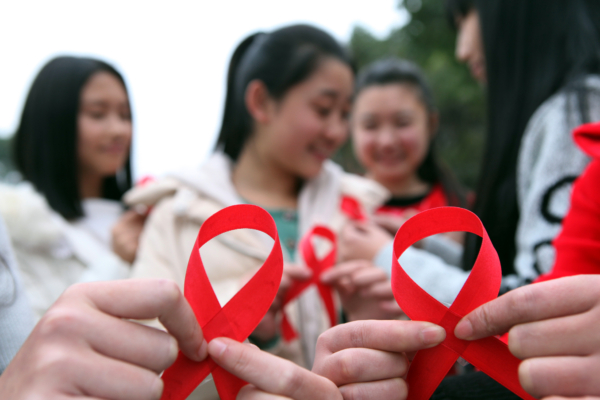
Over the course of four years, more than 12,000 Chinese university students have been infected with HIV, sparking widespread concern online and trending on social media. The number of HIV infections among mainland Chinese university students remains high, with a concerning trend of infections occurring at a younger age, including cases among middle and high school students.
December 1st marks World AIDS Day. The “China Youth Reproductive Health Blue Book” jointly released by the National Health Commission’s Health Development Research Center and other units in 2023 reported a total of 3,010 cases of students aged 15 to 24 in mainland China. The male-to-female ratio of reported cases among young students in 2023 was 34.4:1, with 84.7% attributed to same-sex transmission and 14.0% to heterosexual transmission. In recent years, the number of reported cases among young students aged 15 to 17 has consistently exceeded 400.
According to relevant data, between 2020 and 2023, the number of new reported cases among young students were: 2,977, 3,677, 2,733, and 3,010, totaling 12,397 cases of HIV infection over four years. The male-to-female ratio was 33.9:1, with an average age of 19.9 years.
Following the release of the above information, the topic of “12,000 HIV Infections Among University Students in Four Years” attracted widespread attention, with netizens actively discussing and commenting on the issue.
Some netizens suggested the reinstatement of premarital medical examinations as necessary, as some individuals may be unaware of their HIV status. This could potentially lead to more severe consequences if they engage in sexual activities or marriage without prior knowledge of their condition.
A report from the Chinese Center for Disease Control and Prevention revealed that from 2010 to 2019, a total of 141,557 cases of HIV infections were reported among individuals aged 15 to 24, including young students. Approximately 80% of newly diagnosed HIV cases within the 15 to 24 age group in China were among drop-out adolescents. Most HIV-infected adolescents in China are out-of-school youths, with many potentially contracting the virus before dropping out. Some students, upon testing positive for HIV, may choose to drop out or transfer to another school.
Why are university students experiencing such a high rate of HIV infections? According to Nature magazine, a lack of sexual knowledge among university students, uncertainty about HIV prevention, inability to manage risky sexual behaviors, engaging in multiple sexual partnerships, and encounters with potential HIV carriers through online “male-male dating” contribute to the increasing HIV infection rate among university students. In recent years, young students have gradually become a key focus group for HIV prevention and control in China.
The trend of HIV infections among youth is shifting towards younger ages, with cases emerging among middle and high school students, some as young as under 13 years old. In cities with university clusters such as Shanghai, Changsha, Xi’an, Nanchang, Nanjing, and Beijing, approximately 60% of students infected with HIV engage in risky behaviors through social networking platforms.
There have been reports of alarming cases, like a 19-year-old sophomore who tested positive for HIV after seeking medical attention for rectal bleeding at a hospital in northern China. Epidemiological investigations found that this student, after a night of drinking at a bar with classmates, woke up alone the next day with rectal pain and bleeding, leading to the HIV diagnosis. This case is one of ten reported instances of young students contracting HIV in a city in North China.
Professor Cheng Feng from Tsinghua University’s School of Public Health and Health Sciences emphasized that the current number of infections should not be underestimated, and the HIV prevention and control situation on campuses remains severe.
Epidemiological surveys indicate that among key populations, 86.8% of newly reported student cases this year engaged in social networking for friendships, 71.7% had sexual relations with individuals in the community, 66.0% engaged in two or more multi-partner behaviors, and 11.3% had used new psychoactive substances. Social networking for friendships, multiple sexual partners, and unprotected “male-male sexual activities” through online platforms are identified as major risk factors for HIV infection and transmission.
In a certain region in Northwest China, a ranking system for HIV infections among local schools has been introduced, revealing distressing statistics. The detection rate of HIV infections among primary and secondary students remains unacceptably high.
In May 2019, an article published in the journal Science by Chinese disease control experts and Tsinghua University School of Medicine highlighted the escalating trend of HIV infections among students in China. The article noted, “A contributing factor to the escalating severity of HIV infection may be the limited sexual education before university. As only one-third of China’s top-performing youth can enter university, pre-university education mainly focuses on academic research. A recent survey shows that roughly half of university students have received some form of sexual education, which is often minimal (lacking preventive measures for HIV and sexually transmitted diseases) and conservative.”
The rate of premarital sexual activities among university students continues to rise, with approximately 60% to 80% engaging in such activities and having multiple sexual partners. Coupled with the lack of sexual education, the risk of HIV and STD transmission increases.