
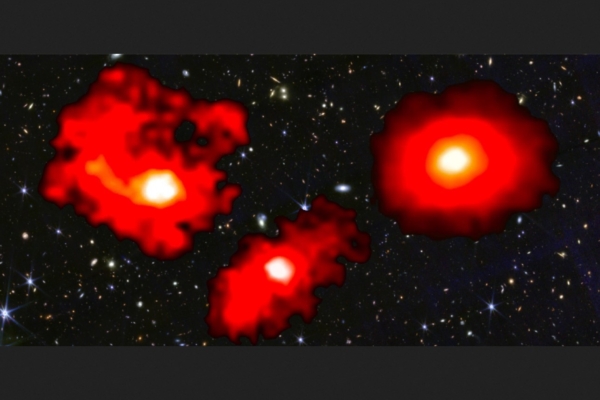
Astronomers have long believed that the formation of star clusters, galaxies, and stars in the universe generally follows a standard “model”. However, the recent discovery of three “red monsters” similar in size to the Milky Way has shattered this theory.
An international team composed of the University of Geneva in Switzerland (UNIGE) and NASA used the James Webb Space Telescope (JWST) to observe the current edge of human understanding of the universe. They aimed to measure the precise distances and stellar masses of galaxies using the near infrared camera and grism (NIRCam/grism), while analyzing the appearance of the universe one billion years after its birth.
The research team selected 36 galaxies composed of large amounts of dust for analysis. These galaxies were chosen for their unique red colors and prominent emission lines, indicating their massive size and significant dust obscuration. Most of the galaxies conform to the theoretical model of galaxy formation (Lambda Cold Dark Matter model).
However, the images of three “red monsters” galaxies caught the attention of researchers. They are not only mature galaxies but also massive in terms of mass and volume, with high dust content and abnormally high star formation rates, up to two to three times that of galaxies formed later in the universe.
Furthermore, these three massive galaxies convert 50% of their gas (hydrogen and other substances) into stars, whereas most observed galaxies today typically only convert around 20% of their gas into stars.
The observations from this study can be said to break the previous models of galaxy formation, leading astronomers to briefly believe that these three “red monsters” should not exist.
Previously, astronomers based on theoretical models believed that early-formed galaxies could not rapidly produce large galaxies in a short period of time because their stellar formation rates were much lower than those of younger galaxies. Thus, these elderly galaxies should not be comparable in terms of volume and mass to the Milky Way.
Although the exact reasons for the accelerated growth of the “red monsters” remain a mystery, astronomers speculate that they may be due to factors such as richer gas environments, faster gas cooling rates, or other factors not yet understood.
Researchers have stated that in the future, they will use JWST and the Atacama Large Millimeter/submillimeter Array (ALMA), the Northern Extended Millimeter Array (NOEMA), and deep JWST spectroscopy to observe these supermassive “red monsters” for a more in-depth understanding. The research paper was published on November 13th in the journal Nature and received coverage by 107 media outlets.
Mengyuan Xiao, a postdoctoral researcher in the Department of Astronomy at the University of Geneva and the main author of the paper, said to the university press office, “Our findings are reshaping our understanding of galaxy formation in the early universe. These research results now show that galaxies in the early universe can form stars with unexpected efficiency. The ‘red monsters’ are just the beginning of a new era in exploring the early universe.”
Dr. David Elbaz, research director at CEA in Paris Saclay, explained, “The massive nature of these ‘red monsters’ was almost impossible to confirm before the observations with the Webb telescope because they were heavily obscured by dust, making them almost invisible optically.”
Co-author and professor of extragalactic astronomy at the University of Bath, Stijn Wuyts, stated in a release, “The existence of these three such huge monsters has created a fascinating puzzle. While normal galaxies were previously thought to undergo a limiting step during their evolution, allowing only some of the gas to convert into stars, these red monsters seem to bypass this restriction.”