
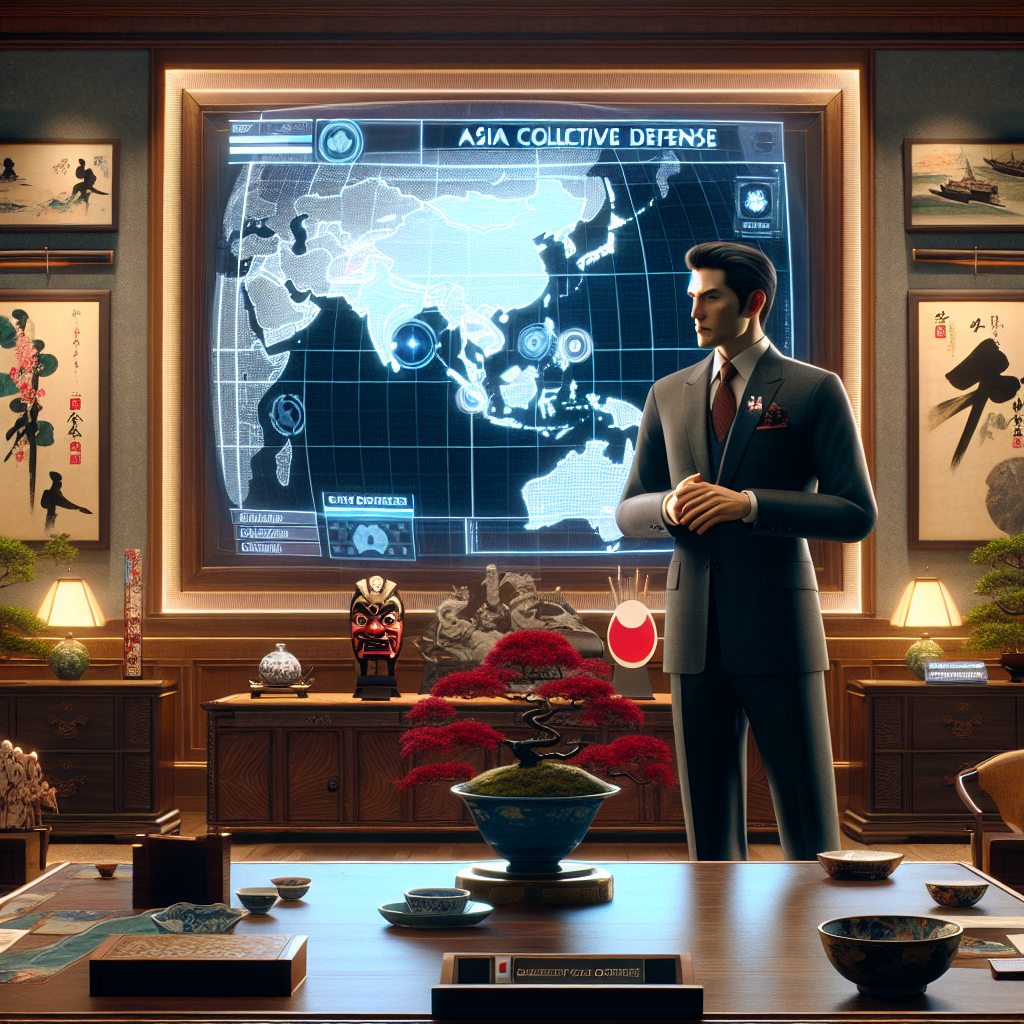
Japan’s Prime Minister, Shigeru Ishiba, has long advocated for the establishment of an “Asian version of NATO,” aimed at collectively defending against threats from China, North Korea, and Russia. He has instructed the establishment of the “Asia Security Special Committee” within the Liberal Democratic Party to discuss and promote the construction of the “Asian version of NATO.” Experts believe that this idea is practical but also challenging.
On November 28th, the Liberal Democratic Party of Japan held its first meeting of the “Asia Security Special Committee” to discuss matters relating to the creation of the “Asian version of NATO.” Itsunori Onodera, the chairman of the party’s Policy Research Council, stated during the meeting that “this is not a task that can be completed overnight; the important thing is to engage in thorough discussions on this issue.”
The committee, chaired by Itsunori Onodera, aims to initiate discussions within the Liberal Democratic Party, gather expert opinions, and present relevant recommendations to the Prime Minister.
Shigeru Ishiba has been advocating for the creation of an “Asian version of NATO” for the past 20 years, considering it a key policy for Japan’s security and defense. During the party leadership election in September, he emphasized the urgency of establishing a collective security mechanism in Asia.
However, this concept has yet to gain consensus within the Liberal Democratic Party, with some expressing doubts. Some believe that achieving this goal would require amending Japan’s constitution to allow the Self-Defense Forces to fully exercise collective self-defense rights, a move that could provoke China.
He Sishen, a visiting professor at Fu Jen Catholic University’s Department of Japanese Language and Literature, stated to Epoch Times that Japan aims to implement mutual access security cooperation with Indo-Pacific countries and even cross-regional countries, connecting various multilateral relationships. Shigeru Ishiba envisions this as the ideal solution for addressing Indo-Pacific security in the future.
Su Ziyun, Director of the Strategic and Resource Division at the Taiwan Institute for National Defense and Security Studies, told Epoch Times that Shigeru Ishiba’s proposal to create an “Asian version of NATO” is an ideal security framework but comes with challenges in response to the threat posed by China.
During the 70th-anniversary ceremony of the establishment of the Japan Self-Defense Forces on November 9th, Shigeru Ishiba stated that military aircraft from China and Russia had repeatedly violated Japanese airspace this year. He emphasized that these actions not only undermined Japan’s sovereignty but also posed a serious threat to its security, which is unacceptable. Additionally, he highlighted unprecedented instances of North Korea repeatedly launching ballistic missiles at a high frequency.
He stated, “Japan is facing the most severe and complex security environment since World War II. In order to protect the lives and livelihoods of the Japanese people, Japan will strengthen its diplomatic and defense capabilities in a balanced manner.”
He emphasized that the Japan-U.S. alliance is the cornerstone of Japan’s diplomacy and security, as well as the foundation for peace and prosperity in the Indo-Pacific region and the international community. To further enhance the deterrence and response capabilities of this alliance, he recently spoke with President-elect Donald Trump, confirming mutual cooperation to elevate the Japan-U.S. alliance to new heights and strengthen bilateral relations.
He also stressed that in order to realize a free and open Indo-Pacific region, Japan will establish a network among allies and like-minded countries in a multilayered manner to enhance deterrence and lead efforts to ensure the region’s security and stability.
Su Ziyun stated, “The security architecture in the Asia-Pacific region currently exists as a ‘two-three-four-five’ structure, with Japan’s proposed ‘Asia-Pacific version of NATO’ likely taking the form of a multilateral agreement.”
The “two” refers to bilateral defense cooperation, such as between the U.S. and Japan, U.S. and South Korea, U.S. and the Philippines, and so on. The “three” includes trilateral defense cooperation, such as AUKUS between the U.S., the UK, and Australia, Japan-U.S.-South Korea collaboration, and Japan-U.S.-Philippines cooperation. The “four” refers to the Quad Security Dialogue of the U.S., Japan, India, and Australia, while the “five” denotes the Five Eyes intelligence alliance. The strategic triangular containment of China is a major focus within this structure.
Su Ziyun emphasized that China not only rapidly expands its military capabilities but also exhibits high levels of aggression. Aligning Asian countries in a united front would provide a more visible deterrent effect and help maintain peace through strength.
Hiroyasu Izumi, a senior researcher at the Sasakawa Peace Foundation, believes that as authoritarianism grows and China, North Korea, and Russia form a new international axis to challenge the West, democracy faces a threat. Therefore, in order to counter China’s hegemony, an effective international security system is needed to defend democracy. Japan should lead in creating an “Asian version of NATO” to establish a new international security framework.
NATO, a military alliance composed of the U.S., Europe, and other countries, allows member states to exercise collective self-defense rights. However, under Japan’s current constitution, the full exercise of collective self-defense rights by the Japan Self-Defense Forces is deemed unconstitutional. Therefore, to construct a system similar to NATO as proposed by Shigeru Ishiba, constitutional amendments or changes in the government’s interpretation of relevant clauses would be necessary.
Moreover, China strongly opposes this concept, with concerns from some countries within the Association of Southeast Asian Nations (ASEAN) that such actions could lead to regional instability. The U.S. has shown skepticism towards Ishiba’s proposal and his advocacy for modifying the Japan-U.S. Status of Forces Agreement. Achieving this concept is believed to require significant time and political effort.
In light of various voices, Shigeru Ishiba has tasked the Liberal Democratic Party with handling this matter since taking office and has maintained a cautious stance on the issue during his official visits, refraining from mentioning the “Asian version of NATO.”
The “Asia Security Special Committee,” entrusted with this important task, closely monitors the upcoming presidency of Donald Trump in January, considering Trump’s past skepticism towards multilateral cooperation, having hinted at a potential withdrawal from NATO during his first term.
At the inaugural meeting, Japan’s Ministry of Foreign Affairs and Ministry of Defense briefed attendees on the current international security defense environment and Japan’s diplomatic policies in Asia. Participants did not directly address opinions on the “Asian version of NATO.” Following the next meeting, the committee is expected to gather expert insights and propose recommendations during the summer elections for the House of Representatives next year.
Itsunori Onodera stated that the “Special Committee is a platform for significant discussions on Shigeru Ishiba’s government security policies,” aiming to minimize domestic and international backlash while discussing these issues. However, some LDP officials feel that engaging in this discussion now may lead to internal division.
Onodera further expressed a desire to identify a direction regarding the case, emphasizing the importance of determining what kind of security is essential.
He Sishen stated that, “Currently, Shigeru Ishiba is only engaging in discussions and deliberations on this issue through the party’s mechanism, not yet translating into Japan’s security policy. In his previous policy speech to the Diet, he did not include the ‘Asian version of NATO’ as a concrete goal for future security policy, indicating that it is still in a policy incubation stage.”
Japan’s aspiration to construct an “Asian version of NATO” mirrors the NATO model. Su Ziyun pointed out that geopolitically, Europe is connected by land, with the battlefield primarily on land, whereas the Indo-Pacific region mainly features maritime conflict.
He noted that the second challenge lies in political and economic situations. Unlike the former Soviet Union, present-day China operates a robust market economy that attracts some Southeast Asian countries for economic collaboration while maintaining political and security leanings towards the West. Therefore, linking these Asian maritime countries together to confront China poses a primary difficulty.
Su Ziyun hopes that the “Asian version of NATO” can be realized to ensure peace and stability. However, there is a long road ahead, and timing is crucial. He also hopes that Japan, like in the past with its Indo-Pacific strategy, will continue advocating to gain broader consensus.
He Sishen also acknowledges that the “Asian version of NATO” will face significant challenges and a long path ahead. Apart from constraints imposed by the U.S. Indo-Pacific security strategy and Japan’s constitution, a crucial issue lies in whether relevant countries share common strategic goals concerning the current security landscape and threats.