
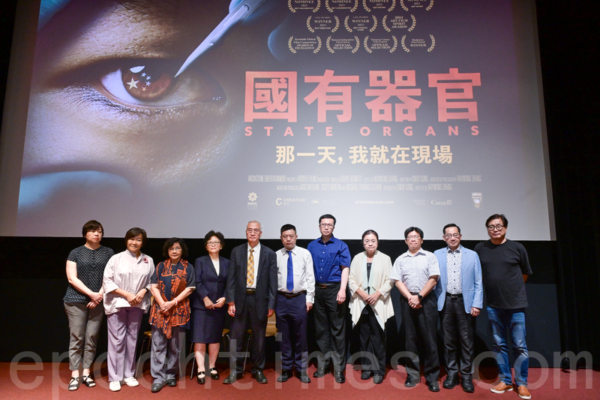
The award-winning documentary “State Organs” that exposes the evil practice of forced organ harvesting by the Chinese Communist Party has been receiving threatening emails from overseas after its broadcast in Taiwan. The National Security Bureau, Ministry of Culture, National Police Agency, and Mainland Affairs Council of the Republic of China reported to the Legislative Yuan today (27th) and proposed various countermeasures in response to these threats.
The Foreign Affairs and National Defense Committee of the Legislative Yuan of the Republic of China invited the National Security Bureau, Ministry of Culture, National Police Agency, and Mainland Affairs Council to report on “Strategies of PRC’s Long-arm Jurisdiction over Taiwan as Seen from the Challenges Faced by ‘State Organs’ in Taiwan’s Broadcast, and Our Country’s Response Measures,” and to answer questions. Deputy Director of the National Security Bureau, Zhang Yuanbin, pointed out in the report that the recent screening of the documentary “State Organs” in Taiwan exposed the illegal practices of “high-ranking Chinese officials harvesting human organs to extend life.” From October to November 22nd this year, Taiwan’s cinemas, government agencies, parliament, schools, and media received a total of 28 threats.
Zhang Yuanbin stated that the Criminal Investigation Bureau of the National Police Agency traced the IP locations of the threatening emails, with the highest number originating from France with 8 cases, followed by 6 from Poland, 5 each from the United States and China, 2 each from Germany, Hong Kong, and the United Kingdom, and 1 each from Thailand, Vietnam, Turkey, Japan, Spain, and Russia. It is suspected that the suspects sent the threatening emails through Virtual Private Network (VPN) proxy programs. Currently, there have been no threats of explosives or actual harm as stated in the threatening content. Local government police departments have strengthened patrols around cinemas and maintained security within their jurisdictions.
Zhang Yuanbin mentioned that the National Security Bureau’s response plan includes “closely monitoring PRC’s network threats to Taiwan,” “raising awareness of personal safety among the people,” and “enhancing international intelligence cooperation.” He emphasized that the PRC’s long-arm jurisdiction over Taiwan is a multidimensional united front strategy, aiming to weaken Taiwan’s sovereignty through infiltration, intimidation, and manipulation. The national security team continues to strengthen international intelligence cooperation and domestic security protection to prevent PRC’s interference in Taiwan.
Deputy Minister of the Mainland Affairs Council of the Republic of China, Shen Youzhong, pointed out in the report that the documentary “State Organs” focuses on exposing the PRC’s suspected forced organ harvesting and human rights violations, stirring concern and discussion from various sectors. The government attaches great importance to the global fight against and prevention of the inhumane crime of forced organ harvesting and will continue to closely monitor it.
Shen Youzhong mentioned that the Mainland Affairs Council’s response measures include “mutual non-subordination across the straits, strict investigation against malicious actions that disrupt social stability in accordance with the law,” “countering PRC’s malicious operations and threats towards Taiwan, promptly clarifying and containing the spread of misinformation,” “strengthening media literacy and raising awareness of risks when traveling to the mainland, enhancing the democratic defense capabilities of the people,” and “enhancing cooperation with the international community, timely revealing the internal truth of mainland China’s society.” He stressed that the obstruction of the screening of “State Organs” in Taiwan is akin to the PRC’s deliberate attempt to cover up the truth, which will only deepen the negative impression of mainland China among the Taiwanese people.
Deputy Director of the National Police Agency of the Republic of China, Li Zhengxiao, indicated, “The incidents disturbing the screening of ‘State Organs’ have been reported by police stations throughout Taiwan recently, with a total of 30 cases of threats against cinemas showing the film within their jurisdiction. Upon investigation, it was determined that the modus operandi of these threats is similar to the harassment tactics targeting our national representatives in October 2023, originating from the mainland region. The suspects are accustomed to using harassment methods and deliberately sending threats to media operators, intending to create panic among the public and thus drain our country’s administrative resources.”
Li Zhengxiao stated that the response measures of the National Police Agency include “continuously promoting multi-factor authentication in the reporting mailbox to prevent harassment by malicious individuals,” “raising public awareness on handling online comments correctly,” “advocating for mechanisms of international and cross-strait cooperation for joint investigation,” and “establishing project teams nationwide for joint defense to safeguard people’s lives and properties.” He emphasized that the Criminal Investigation Bureau is actively investigating the recent nationwide threats of bomb placement cases and as of now, has not discovered any explosives or actual harm incidents. The police have established communication channels with all those who reported incidents while intensifying patrols and security maintenance.
Wang Dingyu, a legislator from the Democratic Progressive Party, stated that the threatening emails related to the documentary “State Organs” were not only sent to the Ministry of Culture, the National Police Agency, Changhua County, and Kaohsiung City Council but also to cinemas in Taoyuan and Taipei. While government agencies may not be intimidated by these threats, civil organizations could potentially fear them, leading to self-censorship. He pointed out that “China through various forms of long-arm jurisdiction infringes upon our judicial jurisdiction and internal sovereignty, which is why we are focusing on this topic today.”
Legislator Shen Boyang from the Democratic Progressive Party questioned the National Security Bureau on “the response time following receipt of threatening messages and the assessment of whether the threats were issued by hostile foreign powers.” Zhang Yuanbin responded that they promptly respond upon receiving reports from the public and investigate with the assistance of the National Police Agency. Li Zhengxiao mentioned that police units in their jurisdiction responding to reports have been handling the cases on-site immediately. Analyzing the initial nine cases received took approximately a week to understand how the threats entered Taiwan originating from overseas. The PRC used 14 countries as proxies before reaching Taiwan.
Legislator Ma Wenjun from the Kuomintang inquired, “We have seen the screening of the film ‘State Organs’ receive threatening emails, which is something we do not wish to happen in Taiwan and cannot allow, whether it’s forced organ harvesting or such threatening behavior. Does the National Security Bureau encounter any difficulties in their investigations?”
Li Zhengxiao responded, “Due to involving many countries, we establish cybersecurity cooperation agreements with some friendly allied countries to assist in investigations. We also conduct comprehensive assessments based on digital evidence. If there are countries without such cooperation, indeed, tracking the IP addresses can be challenging.”
Legislator Yang Chiung-yin from the Kuomintang queried the National Security Bureau, “Do you have control over the messages threatening the screening of ‘State Organs’?” Li Zhengxiao answered, “The National Security Bureau is in contact with the National Police Agency and related units, and we have been in control of this case.” Yang Chiung-yin emphasized that the National Security Bureau must continue to investigate the masterminds behind the scenes, stating, “Taiwan does not tolerate this. The National Security Bureau must thoroughly investigate to reassure the people.”
Yang Chiung-yin questioned the Ministry of Culture, “How do you safeguard the people’s freedom to watch movies?” Deputy Minister Wang Shishi responded, “We will continue to safeguard the screening rights of these cinemas and the right to show movies. So far, the film ‘State Organs’ is still being screened normally.” Yang Chiung-yin expressed concern about the numerous threatening incidents against the screening of “State Organs” and suggested, “In response to such incidents, the Ministry of Culture can also review how to reassure the people.”