
In the 2024 election, the number of registered voters in California exceeded 22.59 million, with Los Angeles accounting for over a quarter (25.4%, 5.74 million people), playing a crucial role in shaping the outcome of the entire California election.
Among the 52 congressional districts in California, either wholly or partially located in Los Angeles County, there are 17 seats, with the Democratic Party winning 16 seats. Out of the 20 California state senators, 5 are from Los Angeles County, with the Democratic Party securing 4 seats. Furthermore, out of the 80 California Assembly members, 24 are from Los Angeles County, with the Democratic Party winning 23 seats – the Republican Party only won one seat in each of these three categories in Los Angeles County elections. The results of this year’s 10 California ballot measures also mostly align with the voting tendencies in Los Angeles County.
Compared to the primary election in March, Los Angeles County saw an increase of over 90,000 voters in the general election. The number of registered voters in the county is equivalent to the combined total of the populations with fewer voters in 45 out of the 52 counties in California.
As of November 20th, nearly 3.776 million votes were counted in Los Angeles County, with a voter turnout rate of 65.7% (based on registered voters). Of these, 72.29% of the votes were from mail-in ballots, while approximately 1.046 million people (27.71%) voted at the polling stations.
According to the Los Angeles County Registrar-Recorder’s office, on election night, a total of 80,941 ballots were counted. As of November 6th, including ballots returned by mail and dropped off at the polls on election day, a total of 2,696,482 votes were tallied (representing 47% of registered voters). The outstanding ballots as of the 6th include about 1 million mail-in ballots, 100,000 Conditional Voter ballots, and over 10,000 Provisional ballots.
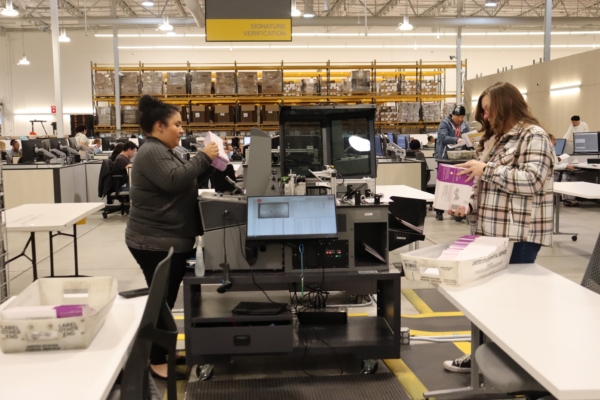
On the 18th, reporters visited the counting center and saw workers handling provisional ballots in pink envelopes. They randomly selected 1% for manual counting to verify the accuracy of machine counting, and most of the ballots had already been tallied. According to the Los Angeles County election center on the 19th, there are still around 32,300 unprocessed ballots county-wide, including those awaiting voter responses and signature verification, as well as Conditional Voter and Provisional ballots. The Registrar-Recorder’s office reported on the 21st that there are still 14,300 unresolved ballots.
“Conditional Voter” ballots refer to those voters who missed the voter registration deadline in California or failed to update their registration information before the deadline, while “Provisional ballots” are cast by voters whose eligibility couldn’t be immediately verified but are permitted to vote and will be counted once their eligibility is confirmed.
The ballot processing procedures and equipment used in each county may vary, and the level of openness to observers also differs. Los Angeles County used 644 digital “voting centers” to accept voter ballots, with the majority opened on November 2nd.
A Chinese-American voter mentioned that she voted at the polling center for both the primary and general elections without waiting in line. After providing her name and address, the staff confirmed her details, and she could then proceed to the voting machine. She could choose a Chinese language page, the instructions were detailed and easy to understand. Having observed the handling of mail-in ballots post-election, she recommended people vote at the polling centers. This year, the voting centers provided 18 language options, making voting easy, yet 70% of Los Angeles voters still opted for mail-in ballots.
On election night, the voter ballots and all equipment at the polling centers were sent back to the counting center. According to the center’s workers, mail-in ballots and those from polling centers enter the warehouse through different gates, first checked by police dogs for explosives or drugs.
Mail-in ballots are sorted using high-speed sorting machines, processing 40,000 letters per hour. They then move to the “signature verification area,” where staff scan the envelopes and verify signatures. If passed, they are cut open; otherwise, they undergo manual verification: cross-referencing with voter registration databases and marking as necessary. Envelopes with unverifiable signatures are handled by managers contacting the voters for clarification.
In the extraction area, workers remove ballots from envelopes and categorize them. Error-free ballots are placed in green boxes for scanning, while ballots with issues or unreadable by machines are put in yellow boxes for manual duplication – such as marking an ‘X’ instead of filling in the bubble. Problematic ballots are placed in red boxes for managerial review, while the envelopes go into blue boxes.
For Provisional ballots, workers first confirm the voter’s residency in Los Angeles County and whether they’ve already voted using a mail-in ballot, ensuring accurate counting.
The final step is the 1% manual ballot counting. Ballots from the election center are placed in white boxes, and mail-in ballots in brown boxes.
Observers can register at the entrance to enter, permitted to observe the ballot processing but not allowed access to confidential information such as names, addresses, or election statuses. Workers stated, “Signature verification is not the observer’s role, they can watch under the supervision of staff but not view people’s confidential information”. ◇