
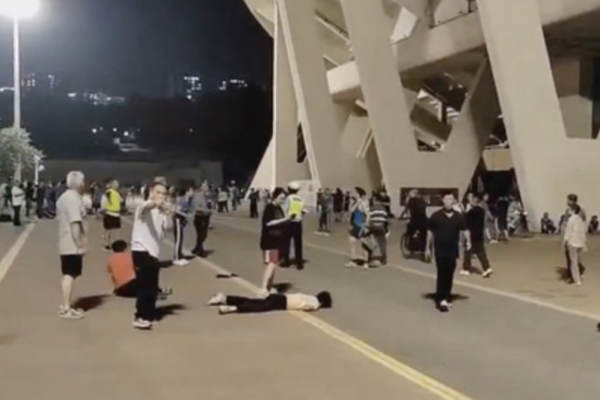
The China Zhuhai Airshow opened on Tuesday (12th) with a dark cloud hanging over the city following a tragic retaliatory incident on the eve, resulting in the largest death toll and injuries in recent years, raising questions about the official handling of the situation. Chinese Communist Party leader Xi Jinping, in a rare move, instructed to strengthen the prevention and control at the source, emphasizing the management of key individuals and conducting risk assessments in the area. Some analysts believe that the CCP may exploit such incidents to strengthen control over the people, yet the roots of such crimes ultimately lie within the regime itself.
On the night of November 11th, a major vehicular attack occurred in Zhuhai, Guangdong Province, leaving 35 dead and 43 injured, as reported by the authorities. The scene was marked by a large number of casualties lying motionless on the ground, leaving behind pools of blood and severed limbs.
The Zhuhai car ramming incident has caught the attention of top CCP leaders Xi Jinping and Li Qiang. According to state media reports, Xi instructed to “draw inferences from one instance to strengthen risk prevention and control at the source, resolve conflicts promptly, and guard against extreme cases,” underscoring the importance of safeguarding lives and maintaining social stability. Li Qiang emphasized the need for integrated prevention and control measures to effectively address risks and social conflicts, ensuring overall social stability.
The directives from Xi and Li highlight the CCP’s emphasis on social stability and the need for source prevention and control measures. Guangdong province and Zhuhai local officials also convened a meeting on the 12th, pledging to conduct a comprehensive assessment and rectification of public safety risks, enhance management services for key individuals, and strengthen social security and public order in the region.
China has seen a surge in retaliatory violent incidents in society this year, including two deliberately orchestrated vehicular attacks in Liaoning and Zhejiang on the same day on March 19th, followed by a series of violent incidents from June to October in Changchun, Suzhou, Shenzhen, and Shanghai involving car ramming and knife attacks. The indiscriminate targeting and harm inflicted on vulnerable groups, especially students, have sparked widespread social anxiety.
Veteran media personality and current affairs commentator Sheng Xue told the Epoch Times that the CCP is highly repressive, controlling people’s thoughts, speech, and behavior. Amid rapid economic decline, the crumbling of the CCP regime has led to societal unrest, leading more and more individuals to feel a lack of future, hope, dignity, and even a sense of security in life. Combined with various dissatisfactions in daily life, work, and society, people are left with no avenues to address these issues, driving them to express violence and resentment towards the more vulnerable in society.
French current affairs commentator and independent filmmaker Wang Longmeng directly pointed to the CCP as the source of the rampant violence in Chinese society. In an interview with Radio Free Asia, Wang criticized Xi Jinping’s directives as being hypocritical, indicating that the source of the issue ultimately stems from his own actions. By stifling private enterprises, driving away foreign companies, causing the collapse of the Chinese economy, and making life unbearable for the common people, the CCP has triggered a series of violent acts.
Zhang Xianzhong, a leader of a peasant uprising during the late Ming dynasty, now symbolizes those who resort to indiscriminate violence in society in contemporary references on the internet.
Regarding the authorities’ emphasis on preventing and controlling risks at the source and targeting key individuals, Wang Longmeng expressed to Radio Free Asia that the CCP may exploit the current “Xianzhong incident” to initiate a thorough social cleansing, but such actions would likely lead to the emergence of more acts of violent retribution.
Wang Longmeng remarked, “After Xi Jinping’s directives this time, I believe the CCP authorities will launch a broad campaign to identify new social instabilities and subject them to strict control. The more severe the CCP’s societal control, the more ‘Xianzhong’ figures will emerge.”
With China’s economy deteriorating, the population facing what is termed as the “Five Losses” (failed investments, disgruntlement in life, faltering relationships, mental imbalance, and spiritual disturbance) is rapidly increasing, becoming the target of the authorities’ stringent controls.
Current affairs commentator Li Lin pointed out to the Epoch Times that the CCP governs not just people’s actions but their thoughts as well. Following Xi’s directives, everyone, including the so-called “Five Loss individuals,” becomes a variable subject to surveillance and reporting at the slightest signs of dissatisfaction, whether they are ordinary citizens or high-ranking officials. With the establishment of the Central Department of Social Work, the use of big data, health codes, grid personnel, etc., the CCP may leverage recent violent incidents to launch a sweeping campaign of surveillance and control, creating a society of even harsher authoritarianism where resentment grows but cannot be alleviated, further victimizing the weakest members of society.
He added, “Protecting people’s lives is crucial, but the problem lies in how the CCP’s priorities always favor regime stability, crackdowns, and maintenance of control, rather than addressing systemic issues such as judicial injustice that trigger public grievances.”
Li Qiang, founder and executive director of China Labor Watch, recently spoke to Voice of America, emphasizing the need for genuine religious freedom in China. He highlighted the benefits of private belief systems, stating, “Few people have faith in communism; neither the Communist Party nor Xi Jinping can soothe people’s hearts.”
In response to the recent malicious car ramming incident in Zhuhai, doubts have been raised regarding the official handling of the situation, including the immediate suppression of information and allegations by some netizens that the local government intentionally shifted blame to “foreign forces” disrupting the airshow.
Serial announcements issued by the public security agencies stated that the suspect, Fan Mou, committed the crime out of dissatisfaction with the financial settlement following his divorce. However, the second version of the announcement removed the details about Fan Mou filing a complaint with the court from the first version. Netizens raised concerns about potential judicial injustice in this case.
According to local sources, the Zhuhai Sports Center and the Zhuhai Intermediate People’s Court are located across the street from each other. The alteration of the official announcements has fueled suspicions about whether Fan Mou acted out of anger due to an unfair court judgment.
The official communication regarding the number of fatalities in this incident not exceeding 35 has sparked discussions. An informant revealed that in mainland China, if the death toll of an incident surpasses 35, the top local official will be removed from office, prompting authorities to swiftly cover up such events to avoid repercussions.