
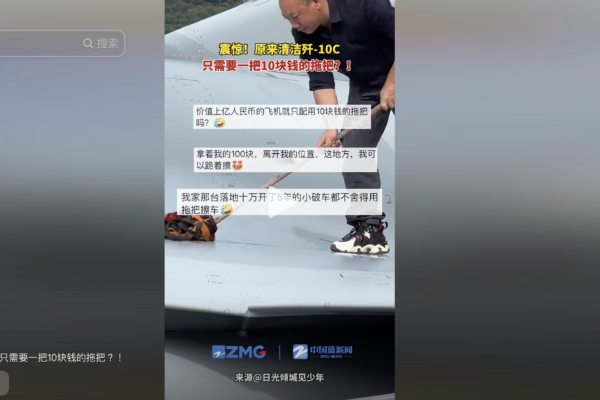
The 15th China Airshow was held in Zhuhai from November 12th to 17th. While the official Chinese Communist Party (CCP) propaganda praised the various exhibits showcased by China, this year’s airshow was actually rife with questions of mockery and imitation. Netizens exposed some ridiculous details, including workers “roughly” manually assembling airplanes and using a regular mop to clean the aircraft body.
A viral video online shows several individuals dressed in casual attire resembling ordinary laborers, climbing on the airplane. Some are even wearing leather shoes as they manually install the wings, roughly shaking the aircraft.
On overseas platforms, netizens commented:
“Haha, indeed quite funny.”
“It doesn’t look very sturdy, will it fall apart while flying?”
“So this is how airplanes are made!”
“This doesn’t match the grand image of CCP’s propaganda warplanes.”
“Why does the appearance have a touch of anime vibe?”
“In the antique shop, machine-made products are fake, handmade ones are real.”
“They can handcraft microchips below and assemble warplanes above. These are hands covered with calluses!”
“Is this for real? Handcrafted wings poked out.”
“If I say this is the real Chinese military industry, would you believe it? The equipment inside tanks, if they don’t fit, they use hammers to get them in due to large tolerances, you get it!”
Another video shared by mainland Chinese netizens shows a worker saying, “Shocking! Turns out, cleaning the J-10C only requires a $10 mop?” The video displays a staff member wearing sneakers climbing on the plane and using a regular mop to clean the aircraft body.
On mainland social media, many netizens discussed:
“If there are stones inside the mop, will it leave scratches? Over time, will the stress concentrate and cause the aircraft shell to crack?”
“Shouldn’t they be wiping gently without using much force?”
“My old car, worth a hundred thousand, after five years, I’m reluctant to use a mop on it.”
“Let me go, I have a factory that produces cleaning cloths; I’ll supply the lifelong maintenance cloths for airplanes. Even a squadron’s worth.”
“The J-20 nearby thinking about its own state in ten years, starts trembling.”
Some netizens also shared a video saying, “The H-6K participating in the airshow has a shiny U-shaped lock hanging on its cabin door, a familiar sight, a familiar formula, a familiar taste!”
This time, the Russian Su-57 made its first appearance in China.
The latest Russian Su-57 fighter jet, also known by its NATO reporting name “FELON,” arrived at Zhuhai Jinwan Airport in China on November 3rd. The Kremlin hails it as the “most advanced fifth-generation stealth fighter jet in the world.”
Aviation enthusiasts visiting the airshow used their mobile phones to capture never-before-seen details of the Su-57, with the most striking being the hundreds of screws on the fuselage and wings instead of the usual rivets used in stealth aircraft design. This compromises the jet’s radar stealth capabilities. The rough appearance and assembly quality of the Su-57 parked at Zhuhai Airport faced criticism and mockery from some netizens.
“BulgarianMilitary.com” pointed out on November 4th that the latest unveiling of the Su-57 further damages its reputation as it is nearly confirmed that it lacks stealth capabilities.
In June of this year, Ukrainian officials claimed that two of Russia’s most advanced Su-57 fighters were damaged by drones.
The newly showcased stealth fighter J-35A, touted by the CCP as having “world-leading stealth performance,” has been met with skepticism by experts who believe that such boasts are typical of the CCP, known for exaggeration and self-aggrandizement. Not only does the CCP exhibit a history of copying, but its production enterprises also suffer from corruption and internal struggles, posing potential safety hazards in their aircrafts.