
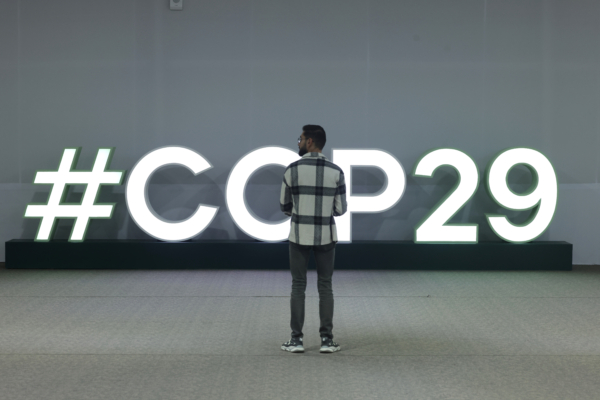
The 29th United Nations Climate Change Conference (COP29) opened on Monday, November 11th, in Baku, Azerbaijan. As the world’s largest carbon dioxide emitter, the Chinese Communist regime continues to evade its responsibility to provide funding for energy transition in developing countries.
This year’s conference focuses mainly on climate financing – developed countries compensating poor nations for the losses caused by extreme weather due to climate change, helping them cover the costs of transitioning from fossil fuels, and assisting them in adaptive measures.
At the same time, developed countries are working to expand the list of contributing countries, hoping to include China, Russia, Saudi Arabia, the United Arab Emirates, Brazil, India, and others.
Countries are negotiating over significant funding, ranging from $100 billion to $1.3 trillion annually. UN Secretary-General Antonio Guterres stated, “This money is not charity, it is an investment.”
He also said, “Developing countries should not leave the Baku meeting empty-handed.”
Rachel Cleetus from the Union of Concerned Scientists stated, “It’s not surprising that wealthy countries are trying to downplay the importance of this key financial issue, attempting to avoid fulfilling their payment obligations.”
The Chinese Communist regime is expected to bear part of the responsibility for climate financing according to the Paris Agreement. However, China, self-styled as the “world’s second-largest economy,” has been treated as a developing country in the UN climate accord.
Climate analysts welcomed an announcement from a group comprising 11 multilateral development banks, including the World Bank and the Asian Development Bank. This group pledged to provide $120 billion in climate financing annually from now until the end of this decade, by the close of the 2020s.
Behind the scenes of climate negotiations, China, along with the G77 (Group of 77), for the first time put forward a demand for developed countries to provide $1.3 trillion in climate compensation annually.
Iskander Erzini Vernoit, Director of the Moroccan climate think tank Imal Initiative for Climate and Development, stated, “If the negotiation framework does not adjust in a manner that respects the G77’s position, we will not be able to achieve a strong new goal in Baku.”
Vernoit also added, “The G77 and China (CCP) are setting the agenda for this.”
(Adapted from relevant reports by the Associated Press)