
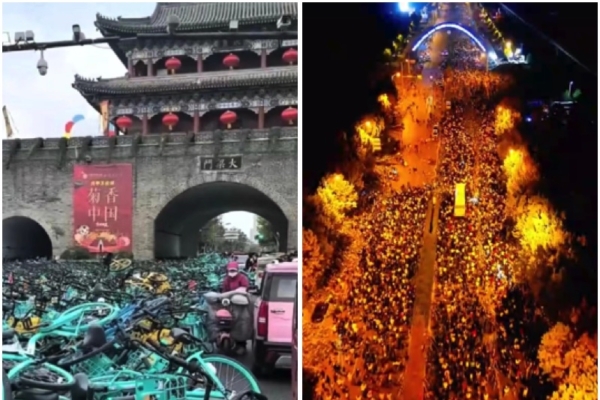
In recent news from Epoch Times on November 12, 2024, a trend of nighttime cycling among students in Zhengzhou has gained attention, initially praised by Chinese state media as a contribution to the tourism industry. However, authorities eventually put a stop to the activity and even went so far as to block universities to prevent students from cycling at night. The abrupt U-turn by the Chinese Communist Party (CCP) officials has attracted international media attention. Bloomberg believes that the CCP’s shifting stance on the nighttime cycling trend reflects its obsession with control.
The origins of this trend are unclear, but in early November, hundreds of cyclists would gather every night. The CCP’s mouthpiece People’s Daily had initially praised this emerging trend of nighttime cycling as a way for college students to inject vitality into China’s tourism industry. However, over the past weekend, after a surge in the number of cyclists, authorities cited transportation and safety concerns to halt the activity.
State media Jihum News reported that a university now requires students to obtain exit permits in order to leave the campus. One student took to social media to express frustration, questioning, “Why are you closing the school? Who goes cycling at night on Mondays and Tuesdays? I’ve had enough, when will things reopen?”
According to CNN, the CCP authorities have long been uneasy about spontaneous youth gatherings, whether political or of other nature. The CCP government is accustomed to cracking down on large gatherings outside its direct control to strengthen party dominance.
In 1989, Beijing university students rode bicycles to Tiananmen Square to participate in democratic protests, only to face a brutal crackdown by the CCP military. To this day, the events of June 4th remain one of China’s most sensitive political taboos.
At the end of 2022, young people took to the streets in major Chinese cities or gathered on university campuses to protest Xi Jinping’s strict pandemic restrictions, posing one of the most unusual challenges to CCP rule in decades.
While the nighttime cycling in Zhengzhou may not be solely linked to conveying political messages, with many participants joining for fun, Diana Fu, Associate Professor of Political Science at the Munk School of Global Affairs & Public Policy at the University of Toronto, told Bloomberg, “Any collective action by Chinese youth has the potential to become politicized, especially against the backdrop of persistently high youth unemployment rates.”
“If their anger turns towards the party-state, it could spark a social movement akin to the anti-lockdown protests,” Fu stated.
Last month, even Halloween costumes – once widely allowed – faced restrictions in some Chinese cities, after people employed various costumes to criticize the CCP government last year.
“The collective cycling events in Henan highlight the sensitivity of the party-state to collective action threats,” said Kevin Slaten, head of the China Dissent Monitor project, to Bloomberg. “The party-state is very sensitive to the risks of collective action, especially by students, and therefore instinctively took such preventive repression.”
However, such repression may lead to consequences. An article titled “The Big Problem of Unreleased Student Energy” was under review over the weekend, with a message on WeChat stating that the article potentially violated regulations. Former reporter Xiang Dongliang wrote, “If they are not allowed to cycle at night in Zhengzhou, there will definitely be an outlet.”