
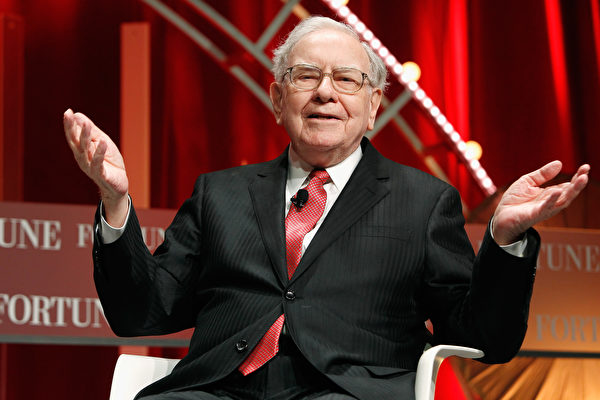
Renowned investor Warren Buffett, one of the most well-known investors globally, is currently hoarding cash at an unprecedented rate, a move that has sparked speculation among observers. This pattern of accumulating cash bears resemblance to his actions prior to the outbreak of the global financial crisis, leaving many to wonder about the underlying reasons this time around.
Buffett’s Berkshire Hathaway company, valued at $1 trillion, revealed in its latest quarterly report that its cash and cash equivalents (primarily U.S. Treasury bonds) stood at $325.2 billion for the third quarter, compared to $276.9 billion at the end of the second quarter. This marks the highest cash reserve for the company since at least 1990, enabling Buffett to potentially acquire the entire equity of companies like Coca-Cola, or all publicly listed companies outside the top 25 in market value in the U.S., including giants like Disney, Goldman Sachs, Pfizer, General Electric, and AT&T.
In recent months, Buffett has actively reduced his holdings in two major investments – Apple and Bank of America. Furthermore, this marks the first time in 6 years that Berkshire Hathaway has halted its purchase of its own company’s stocks.
Some investors and analysts speculate that Buffett remains faithful to the value investing principles he learned from legendary investor Benjamin Graham. They point out that Apple’s relatively high price-to-earnings ratio indicates the stock may be overvalued, suggesting a mismatch between its current price and future profit growth potential.
Moreover, Apple recently cautioned investors that future new products may not yield profits on the scale of the iPhone, as the company is heavily investing in developing artificial intelligence technology to narrow the gap with competitors like Google’s parent company, Alphabet.
Nicholas Colas, co-founder of investment research firm DataTrek Research, indicated in a recent report that Buffett may believe stock values, including his own, are overpriced and could lead to a substantial correction or a bear market.
Some viewpoints suggest there might be other motives behind Buffett’s actions. Over the years, Buffett has consistently praised Apple while lamenting the difficulty in finding attractive investment opportunities in the market, a recurring concern he has voiced.
Hence, speculation arises that Buffett’s actions could be setting the stage for his successor, ensuring ample cash resources for them to utilize flexibly post his departure. Others believe Buffett may foresee impending risks or crises in the market, hence the decision to retain cash to seize better investment opportunities during market downturns or crises.
Buffett has also restricted purchases of other stocks this year, only acquiring $5.8 billion worth of shares as of the end of September. This amount pales in comparison to the $133.2 billion in stock sales executed by Berkshire Hathaway.
Morningstar analyst Gregory Warren stated he does not believe Buffett’s actions aim to prepare for a major acquisition, as Berkshire Hathaway has not offered funding to large U.S. enterprises seeking hundreds of billions of dollars to support their operations, such as Intel.
Despite the surge in investor optimism following Trump’s election victory last week, analysts are holding a more pessimistic outlook for future returns on U.S. stocks.
David Kostin, chief U.S. equity strategist at Goldman Sachs, predicted by the end of October that the average annual return rate for the S&P 500 index over the next decade would be a mere 3%. By contrast, the figure was 13% in the past decade, with a long-term average of 11%.
Vanguard, the asset management giant, recently forecasted an annual return rate range of 3% to 5% for U.S. large-cap stocks and a return rate range of 0.1% to 2.1% for growth stocks.
(This article referenced relevant reports from the Financial Times and Wall Street Journal)