
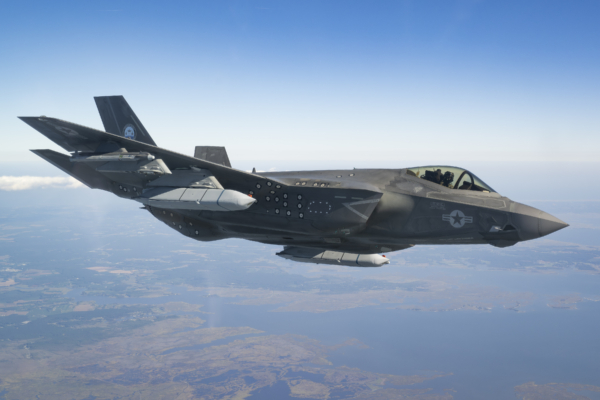
Despite the Chinese Communist Party resorting to all means, such as investing heavily, stealing technology, and poaching talent to develop stealth fighter jets in an attempt to catch up with the US military, they have been thwarted due to a lack of a key material science technology, making it difficult for Chinese military aircraft to compete with the American F-35 stealth fighter.
The fifth-generation fighter must possess stealth capabilities, high maneuverability, advanced aerospace electronic systems, multi-role capabilities, and network or data fusion capabilities. Compared to Chinese and Russian fighter jets, there is no doubt that the two American jets, F-35 and F-22, have a clear advantage.
The F-35 is the latest in a long line of stealth aircraft designs. The main focus of the design is to reduce the detectability of onboard radars. Radars work by emitting electromagnetic waves and receiving signals reflected back to detect and locate targets, so the design of stealth aircraft aims to minimize this reflection.
An article in “The National Interest” on November 6 stated that former US Navy combat expert Eric Wicklund previously explained that while replicating the stealth design of the F-35 is possible, replicating the radar absorbent material (RAM) of the F-35 remains difficult. He likened China’s situation in this regard to reverse engineering Damascus steel without understanding the underlying processes.
This technological flaw has led to Chinese stealth fighter jets being less efficient in evading radars. At the same time, the advanced aerospace electronics, sensor fusion, and electronic warfare systems of the F-35 ensure that this aircraft maintains superiority in situational awareness and networking capabilities, making it difficult for Chinese jets to match up.
Wicklund explained a primary reason why China has yet to produce a jet that can rival the F-35. “Merely manufacturing a stealthy shape is just one aspect of stealth. Even the internal structure and how it’s configured are crucial,” Wicklund said.
He believes that China lacks in material science, inhibiting Beijing’s ability to develop effective RAM, a material that can absorb or scatter up to 80% of incoming radar waves.
Stealth aircraft are coated with a special elastic material on the surface to maintain an even electrical conductivity, reducing radar wave reflections. This material, codenamed “RAM,” with its composition remaining highly classified by the US military, can be applied in multiple layers and includes components that can convert radar wave energy into heat. It can interfere with radar waves after being exposed to them, nullifying the radar waves and achieving stealth.
According to Wicklund, stealing the stealth design of an aircraft from a computer is straightforward, but developing cutting-edge RAM is a more challenging task. “I can hand a piece of RAM to the Chinese, and they can analyze it and realize it’s real, but the issue is reverse-engineering it. They know what it is, but they don’t know how to manufacture it,” he said.
He explained that giving US RAM technology to China is like giving Damascus steel to an Egyptian swordsmith. The Egyptians would recognize the superior quality of the blade but would be unable to reverse engineer it. This is the predicament China currently faces in RAM technology.
Wicklund also likened the troubles China faces in RAM to the difficulties encountered in developing the WS-15 jet engine. Over the years, China has struggled to produce fan blades that can withstand the heat generated by a jet engine.
He stated that RAM would be another tricky foundational technology, and without it, Chinese stealth fighter jets will not be able to compare with the F-35.
Achieving stealth through design and surface technology: Stealth aircraft often feature flat surfaces and sharp edges, aiding in redirecting radar waves away from receivers, significantly reducing the aircraft’s visibility on radar screens.
The F-35 aircraft has a smooth blended surface, serrated edges, and sharp internal corners. All these designs aim to minimize radar reflections. The F-35’s weapons are also stored internally rather than hanging externally to further reduce detectability.
Another major anti-detection feature comes from engine technology. The exhaust of a hot engine is the main detection source for aircraft, and stealth aircraft take measures to minimize it. Their engines utilize cooling systems and thrust vectoring to achieve this.
Even with the most advanced stealth design and features, no aircraft can be completely undetectable. However, these technologies reduce detection effectiveness, range, as well as the ability to track and target aircraft.
The United States is currently the only country capable of developing and producing advanced aircraft like the F-35 or F-22.
The F-35 is designed specifically for air superiority and strike missions, also equipped to perform electronic warfare and ISR (intelligence, surveillance, and reconnaissance) functions. The most notable feature of the F-35 is its advanced aerospace electronics and sensor fusion, providing unmatched situational awareness for pilots.
The F-22 boasts exceptional agility. However, the F-35 prioritizes stealth and sensor fusion in its airframe design over agility.
Key sensors on the F-35 include: Northrop Grumman’s AN/APG-81 active electronically scanned array radar; BAE Systems’ AN/ASQ-239 Barracuda electronic warfare system; Northrop Grumman/Raytheon’s AN/AAQ-37 distributed aperture system; Lockheed Martin’s AN/AAQ-40 EOTS; and Northrop Grumman’s AN/ASQ-242 communication, navigation, and identification suite.
The sum of all advanced systems makes the F-35 an aircraft with superior situational awareness, better command and control, and enhanced networking capabilities than any other aircraft in production.
Stealth aircraft’s combat power has been fully demonstrated in the Gulf War and the Kosovo War. In the Gulf War, US stealth fighters accounted for only 2% of the total number of bombing sorties by multinational forces, yet they executed over 40% of the operational missions with zero losses. Stealth aircraft will undoubtedly change the combat mode of future wars, and stealth strikes have become the development direction of the US Air Force for future operations.