
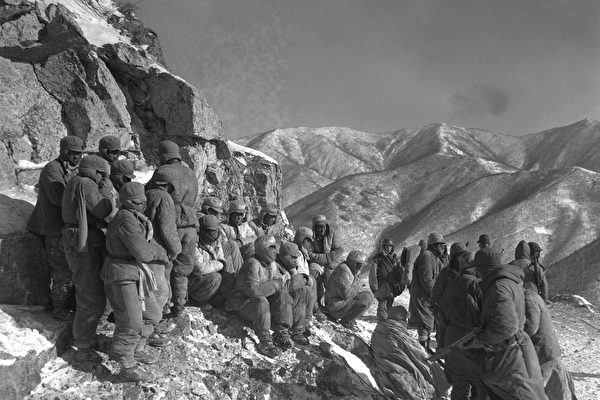
Recent revelations by American soldiers who fought in the Korean War have exposed fabricated scenes in the widely promoted Chinese Communist Party film “Battle at Changjin Lake.” The film, which portrays a tribute by an American general to the Chinese soldiers, has been debunked as “impossible.” Contrary to the film’s depiction, during the intense battle at Changjin Lake, the outnumbered American forces managed to break through the enemy’s siege, evacuate all their equipment, and rescue nearly 100,000 Korean refugees, marking a miraculous victory.
Several American Marines who were present during the Battle at Changjin Lake, along with their families, gathered in Washington D.C. to commemorate the 74th anniversary of the battle. The event coincided with the 249th anniversary of the establishment of the United States Marine Corps on November 10.
The Battle at Changjin Lake, which took place in the early stages of the Korean War in 1950, was adapted into the film “Battle at Changjin Lake.” According to an official report from Xinhua News Agency in early 2022, the propaganda film had been viewed by over 100 million people by February of that year.
General Smith, depicted prominently in the 2021 film “Battle at Changjin Lake,” was the commanding officer of the First Marine Division of the U.S. military. However, there is no evidence to support the scene in the film where he is shown saluting Chinese soldiers who had frozen to death.
Stanley L. Spangle, aged 92, emphasized that for the American soldiers, the Chinese troops were considered enemies, and saluting them was inconceivable. Similarly, William Marvin Parks, who operated a bulldozer during the battle, stated that their commanders would never have authorized such a gesture, as it contradicted General Smith’s character.
Milton Walker, who served as artillery during the battle, described General Smith as a gentleman who cared deeply for his subordinates. The portrayal in the film of him saluting the enemy was deemed entirely inconsistent with Smith’s personality and values.
“They lost [the Battle at Changjin Lake],” remarked Gail Shisler, General Smith’s granddaughter and a biographer, upon watching the film. She expressed doubts about the accuracy of the Chinese side’s depiction and narrative, stating that creating a heroic epic under such circumstances seemed unlikely.
David “Ben” Wells, a volunteer who honors the battle heroes, declared, “We have always stood against communism, from the 1950s to now, and we will continue to do so. We cherish our free country and society and will never pay homage to communist forces.”
American historians and Marines who participated in the Battle at Changjin Lake highlighted the extreme disparity in strength between the opposing forces. The overwhelming Chinese forces attempted to encircle and annihilate the U.S. troops by exploiting favorable terrain and ambushing them strategically.
The Battle at Changjin Lake marked the first engagement following the establishment of the People’s Republic of China. According to military historian Charles Neimeyer, the Chinese Communist forces expended significant efforts in attempting to defeat the American troops completely.
Orders from Mao Zedong to annihilate and defeat the First Marine Division at Changjin Lake were specifically carried out by Song Shilun, the commander and political commissar of the Ninth Corps participating in the battle, as well as the deputy commander of the “Volunteer Army.”
Considering the circumstances, Neimeyer regarded the successful breakout of the First Marine Division to the eastern coast and the preservation of most of their forces, along with the evacuation of nearly all equipment and the elimination of a large number of enemy soldiers during the breakout, as nothing short of miraculous.
In addition, American forces helped evacuate nearly 100,000 Korean refugees who were seeking to escape North Korea. Among them were the parents of Moon Jae-in, who later became the President of South Korea.
President Moon Jae-in of South Korea praised the Battle at Changjin Lake in 1950 as the “most successful battle in U.S. military history.” During a speech in a joint session of the U.S. Congress in April of the previous year, he lauded the First Marine Division for breaking through the overwhelming Chinese forces, achieving a “miraculous result.”
The Marines not only broke through the encirclement by the 16th Corps of the Chinese “Volunteer Army” but also successfully reached the port of Hungnam on the East coast. However, the First Marine Division suffered heavy losses while the Chinese forces endured even greater casualties. Song Shilun described the Battle at Changjin Lake as “more difficult than the Long March” in his memoir.
Reflecting on the portrayal of the Chinese side as victors, one of the machine gunners from the First Marine Division at that time, Bobol, expressed that they knew the reality of the situation. Despite amassing vast numbers of troops, the Chinese forces fell short of their goal to dislodge the American forces completely.
Rudy B. Meekins, who was 19 at the time, emphasized the significant numerical advantage of the enemy forces during the battle. He emphasized that their ability to break through the encirclement and inflict substantial losses on the enemy forces was a decisive victory under extremely unfavorable conditions.