
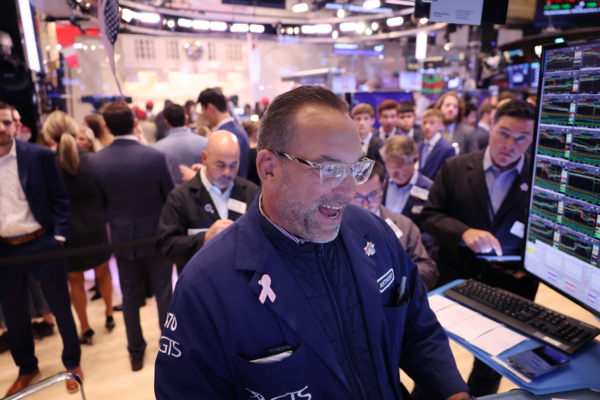
The S&P 500 index briefly broke through the 6,000-point mark and closed with the largest weekly percentage gain in a year, fueled by Donald Trump’s election as U.S. president and the possibility of a Republican sweep in Congress, leading to increased positive expectations for business policies.
Investors are hopeful that Trump’s return to the White House will result in tax cuts and regulatory relaxation. The Federal Reserve cut interest rates by 25 basis points on Thursday, further boosting the stock market for the week.
The S&P 500 and Dow Jones Industrial Average recorded their best single-week percentage gains since November 2023, while the Nasdaq achieved its best weekly performance in two months and its second-highest weekly performance in 2024.
Investors are also keeping an eye on the possibility of a Republican “sweep” in the current election. Currently, the Republicans have secured control of the Senate and are expected to maintain a slim lead in the House, making it easier for Trump to push forward with his legislative agenda.
The Nasdaq set new closing highs for three consecutive trading days, while the S&P 500 index notched its 50th closing record of the year.
According to Reuters, Mike Dickson, Head of Research and Quantitative Strategies at Horizon Investments in Charlotte, North Carolina, stated, “This is a psychologically important number, but given all the developments this week, I don’t think it’s particularly important whether we close at 6,005 or 5,995.”
“This week the market rose significantly, with so much good news, it shows in the prices,” he said. “All of this far exceeds whether we are on the right or left side of 6,000 at the close.”
The Dow Jones Industrial Average rose 259.65 points, or 0.59%, to 43,988.99 points, the S&P 500 index rose 22.44 points, or 0.38%, to 5,995.54 points, and the Nasdaq Composite index rose 17.32 points, or 0.09%, to 19,286.78 points.
Nvidia and Sherwin-Williams joined the Dow, replacing Intel and Dow Inc. Tesla continued its post-election rally, with the electric car manufacturer’s stock rising 8%, accumulating a 29% increase for the week and pushing its market value back over $1 trillion.
The Dow crossed the 44,000-point mark for the first time, partly driven by Salesforce’s move after Bloomberg reported a 3.59% increase following its announcement to recruit 1,000 employees to promote its artificial intelligence Agentforce tool.
The S&P 500 and Nasdaq also saw gains for the fourth consecutive trading day.
Interest rate-sensitive industries, such as real estate and utilities, led the performance among the 11 major sectors of the S&P 500, while bond yields continued to decline for the second day after the elections.
However, the benchmark 10-year U.S. Treasury yield remains near a four-month high, as expectations for Federal Reserve rate cuts in 2025 have decreased due to concerns that proposed tariffs by the new government could reignite inflation fears.
Small-cap stocks performed better after Trump’s election win. The Russell 2000 small-cap index rose over 8%, marking its largest single-week gain since April 2020.
The University of Michigan Consumer Confidence Index shows that U.S. consumer confidence reached a seven-month high in early November driven by optimistic Republican outlook, with the index of future expectations climbing to its highest level in over three years.
On the other hand, U.S.-listed Chinese stocks declined as the latest fiscal support measures from the Chinese government failed to impress investors. JD.com fell by 6.99% and Alibaba dropped by 5.94%.
At the New York Stock Exchange, advancing stocks outnumbered declining stocks by a ratio of 1.7 to 1, while on the Nasdaq, the ratio was 1.21 to 1.
In the S&P 500 index, 88 stocks hit 52-week highs and 10 touched new lows, while the Nasdaq Composite index recorded 211 new highs and 108 new lows.
The trading volume on U.S. exchanges was 15.46 billion shares, an increase from the 20-day average daily volume of 12.74 billion shares.
(This article referenced reports from Reuters and The Wall Street Journal)