
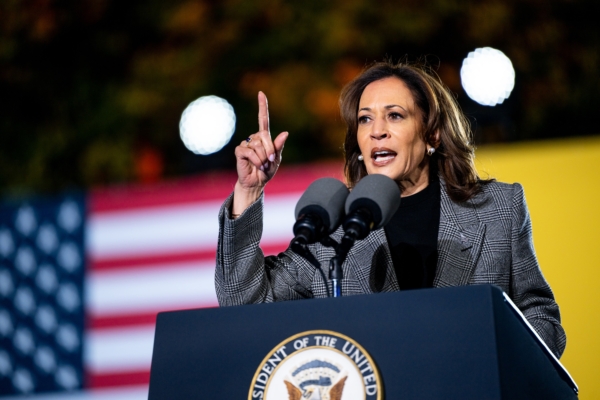
In a surprising turn of events within just three months since President Biden announced his withdrawal from the 2024 presidential race, Vice President and Democratic candidate Mary Johnson has emerged as a prominent candidate in a closely contested battle with former President and Republican candidate Trump. How did she achieve this feat?
Throughout her campaign activities in the 2024 United States presidential election, Mary Johnson repeatedly highlighted her late mother in several crucial speeches. Her mother, Shyamala Gopalan, immigrated to the United States from India in her early years and was a cancer specialist.
However, Mary Johnson did not make her identity as a woman and a minority a central theme of her campaign. In various campaign events, she seemed to have never mentioned the captivating statement of “if elected, she would become the first female president of the United States.”
On Friday, the Agence France-Presse cited an analysis by Debbie Walsh, the Director of the Center for American Women and Politics at Rutgers University, stating that Mary Johnson intentionally downplayed the historic significance of potentially being the first female president of the United States as part of her campaign strategy.
Walsh stated, “She needs to convince those who have doubts about female leadership that women are equally capable for the job and possess strength and resilience.”
At the Democratic National Convention in August, Mary Johnson elaborated on her mother’s life story. By addressing her mother’s experiences, she not only shared her personal narrative but also used it to discuss issues of feminism and racism.
Walsh believed that through sharing her mother’s experiences, Mary Johnson acknowledged the challenges faced as a minority woman while avoiding excessive emphasis on her own identity.
Walsh also pointed out that “racism and gender discrimination still exist in society, these issues have not disappeared, she cannot pretend to ignore.”
During campaign events in Washington this week, Mary Johnson, addressing a crowd of over ten thousand supporters, mentioned that the person she talked about the most in her campaign speeches was her mother, followed closely by her opponent, former President Trump.
Protesters often put presidential candidates in awkward positions. However, as the campaign entered its final stages, Mary Johnson adopted a new strategy in trying to turn these potentially awkward interactions into a source of encouragement for her supporters while cleverly conveying criticism towards her Republican opponent, former President Trump.
Last week, during campaign rallies held in North Carolina, Pennsylvania, and Wisconsin, Palestinian protesters with banners also showed up at the venues. In these gatherings, protesters even interrupted the campaign events with whistles, criticizing Mary Johnson and President Biden’s handling of the Israeli-Hamas conflict in the Gaza Strip.
In North Carolina, a protester accused Mary Johnson of “disrespecting the Palestinian community,” which she used as an opportunity to launch a critique against Trump.
At the rally, Mary Johnson stated, “That’s the problem right there, we are truly fighting for democracy. Unlike Donald Trump, I don’t believe that those who disagree with you are enemies.”
A few hours later, in Harrisburg, Pennsylvania, facing similar protests, Mary Johnson reiterated her commitment to democracy.
As the event in Wisconsin approached its end that night, Mary Johnson addressed the protesters, saying, “We all want the war in Gaza to end, and hope for the release of hostages, I will do my best to make this voice heard. Everyone has the right to be heard, but right now, it’s my turn to speak.”
Here, Mary Johnson quoted a line from the 2020 debate with then-Vice President Pence, “but now it’s my turn to speak,” widely reported by the media at that time.
At each event, these moments elicited cheers from Mary Johnson’s supporters, with their voices often drowning out the protesters.
On September 10, the two presidential candidates held the first and only televised presidential debate. According to the Associated Press citing an anonymous source, Mary Johnson spent five days preparing for the debate in a hotel in downtown Pittsburgh. Her team rehearsed all possible scenarios of the debate.
Two news assistants – one male and one female – played the role of ABC News debate moderators. Philippe Reines, who had served as Hillary Clinton’s aide for a long time, once again portrayed Trump, a role he had undertaken during Clinton’s presidential campaign. Reines wore a dark suit paired with a long red tie and applied bronze-orange makeup on his face to mimic Trump’s appearance.
One challenge involved microphone issues. Mary Johnson’s team preferred to have the microphone open throughout to allow her to interject at any time and create opportunities for Trump to make uncontrolled statements. However, an agreement on modifying the rules was not reached, and the original plan remained unchanged.
Additionally, Mary Johnson decided to utilize the split-screen format fully, ensuring that each candidate was constantly visible on camera. President Biden had struggled with this visual test during the June debate with Trump, often appearing distracted with his gaze wandering and mouth slightly agape.
Mary Johnson, on the other hand, conveyed her attitude through expressive silences with a “voice-over” – sometimes smiling, raising an eyebrow, and at times with a puzzled look, putting her hand on her chin.
Reportedly, as the debate was about to commence, dozens of staff members gathered at the campaign team’s headquarters in Delaware, occupying designated seats and facing four TV screens. Some remained nervous, especially those who had witnessed Biden’s previous debate mistakes with Trump, feeling even more anxious.
Ultimately, Mary Johnson’s performance exceeded expectations and she emerged successful as declared by the public.