
Recently, there have been rumors that the leader of the Chinese Communist Party has lost his military power. It is a major flaw in military strategy to have discord among commanders and instability in the rear. The United States may have more accurate intelligence and seems unfazed by the continuous theatrics of the Chinese military. The US Seventh Fleet has had almost no aircraft carriers in the past few months, with the USS Washington just arriving late. As Israel launched a second counterattack against Iran, the weaknesses of the Chinese military have been exposed, allowing the US military to better prepare for potential conflicts.
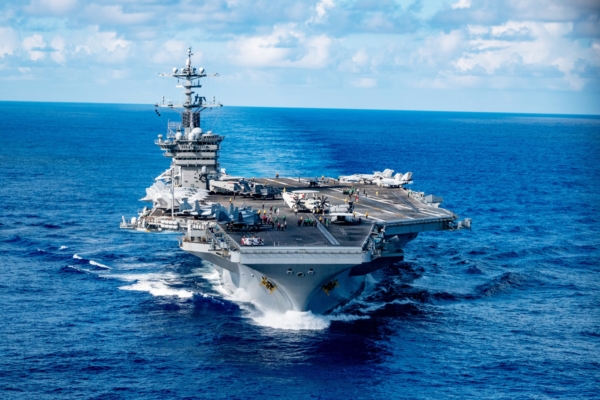
On October 29, the USS Washington (CVN 73) carrier strike group arrived in the Western Pacific to participate in Exercise Keen Sword 25, ending the months-long gap without a carrier in the Seventh Fleet.
In June, the USS Roosevelt (CVN 71) carrier strike group in the Western Pacific was redeployed to the Middle East to replace the Eisenhower, which had overstayed its deployment. The USS Reagan, stationed in Japan, returned to the US mainland, and there was a partial personnel exchange with the USS Washington, which had just finished its mid-term maintenance; however, the Washington did not promptly head to its base in Japan.
In August, the USS Lincoln carrier strike group deployed to the Western Pacific but was promptly called to reinforce the Middle East region to prevent potential conflicts. After tensions eased, the USS Roosevelt carrier strike group returned to the US mainland.
The US has the USS Carl Vinson and USS Nimitz carriers available in the Indo-Pacific region but has not deployed them to the Western Pacific. The Seventh Fleet has had no carrier strike groups for months, only two amphibious assault ships patrolling alternately.
The Chinese Navy’s aircraft carriers and destroyers continue to deploy, with a particularly high-profile show of force around Taiwan on October 14, and more recently a joint exercise of two aircraft carriers in the South China Sea. However, the US military appears unmoved.
In September, the USS Truman aircraft carrier (CVN 75) deployed to the Atlantic, expected to head to the Middle East, allowing the Lincoln carrier to return to the Western Pacific. However, the USS Truman carrier went north into the North Atlantic, participating in joint exercises with NATO and making a port call in Norway. This exercise was intended to deter Russia, but compared to the Indo-Pacific region, it may have required more attention.
The US has carriers available on the Atlantic side but kept carriers in the Middle East rather than deploying them to the Indo-Pacific region for months. This is likely not due to poor planning or lack of available carriers but because the United States has insights into the internal problems of the Chinese military, including the fact that the Chinese Communist Party leader may no longer control the military completely.
If there is discord among the Chinese leadership, the likelihood of initiating a conflict significantly decreases. Therefore, the US decided to withdraw all carriers from the Western Pacific, not rushing to send other carriers to fill the gap. It was not until nearing the US election that the USS Washington carrier arrived.
In 2024, the Chinese Navy conducted frequent exercises beyond the First Island Chain, with Chinese military aircraft harassing the Taiwan Strait more than ever before. These actions are mostly political maneuvers. While the Chinese Communist Party expelled Li Shangfu, Wei Feng, and others from the party and military back in June, the new Chinese Defense Minister Dong Jun did not replace them on the Military Commission at the July third plenary session. The purge of the rocket force and the Equipment Development Department of the Military Commission likely extended to the aerospace industry, becoming a new area of concern.
Massive corruption often accompanies a high volume of counterfeit products to conceal the poor quality and performance of weapons resulting from shoddy workmanship. In September, China test-fired an intercontinental ballistic missile, likely to verify the performance of the DF-31 or DF-41 missiles, but doubts linger over the precise capabilities of the Rocket Force.
Rumors emerged that Xi Jinping had lost his military authority, with General Zhang Yuxia effectively controlling the military; the absence of the Chinese Communist Party leader from critical military meetings and activities was noted. Although details are unknown, it is certain that there is mutual mistrust among the Chinese Central Military Commission chairman and senior military leaders. High-ranking military officials within the Chinese military likely lack trust among themselves, including between the two vice chairmen of the Military Commission and members of the Military Commission itself.
Discord among the leadership is a major taboo in military strategy, and the problem lies in the top-level command system. Whether the Chinese military is combat-ready under such circumstances is known to the US military and likely understood by Chinese leaders as well. Most Chinese military leaders have no desire for war; they prefer corruption and promotions, and even more so in the current situation where war is less desired.
Amidst the discord among the leadership, a power crisis has emerged in the leadership circles of Zhongnanhai, adding another layer of instability. If a conflict were to erupt at this time, with an unstable rear, it would violate the second major taboo in military strategy.
It is probable that Zhongnanhai is currently unable to command the military, with senior military leaders in Beijing possibly intending to bolster their own positions with the military. However, it is uncertain who within the military would unequivocally listen to whom, further complicating the situation.
This kind of intelligence will undoubtedly be promptly relayed to the Pentagon; the US had the confidence to move its aircraft carriers out of the Western Pacific based on this information. Perhaps there has been silent communication between the Chinese and US military, resulting in some kind of tacit understanding to avoid conflict. The Chinese military may have informed the US that they still need to conduct exercises continuously but these are just theatrics, not to be taken seriously.
It is unclear whether the US military has also kept a low profile in the Western Pacific for several months to reduce tensions. Of course, the US not only has insights into the internal chaos in Beijing but has also essentially identified the weaknesses of the Chinese military, making the response more apparent.
This year, Iran has launched long-range attacks on Israel twice, and Israel retaliated twice. The first strike was limited, destroying the S-300 air defense radar near an Iranian nuclear facility; the second strike was much larger, reportedly thoroughly destroying Iran’s air defense radar system and critical targets like missile production facilities, claiming that Israeli jets can now freely enter Iranian airspace.
Military experts believe that Israel’s second attack exposed Iran’s true capabilities, revealing that their claimed long-range attack capabilities are limited, and their defense capabilities are even poorer. The Israeli airstrikes once again demonstrated the failure of Iran’s S-300 air defense missile system, exposing vulnerabilities of both Iran and China.
China has purchased more S-300 air defense systems from Russia and produced clones of Red Flag-9 air defense missiles. The airstrikes against Iran indicate that Chinese air defense systems will likely have weaknesses as well. China has also imported a few S-400 air defense missiles from Russia, presumably to be deployed around Beijing, but the extent of their superiority compared to the S-300 remains uncertain.
On October 26, Israel deployed approximately 100 fighter jets, showcasing their long-range strike capabilities, albeit not at the same level as the US military. Israel lacks strategic bombers, with limited ammunition capacity and power.
On October 16, the US deployed B-2 stealth bombers to strike five underground weapons storage sites of the Houthi rebels in Yemen, believed to have used Massive Ordnance Penetrators. This action also served as a deterrent to Iran and possibly China. It was reported that B-2 bombers based in Australia were involved in this long-range strike mission, underscoring their proximity to China.
If B-2 bombers were to launch airstrikes as the Chinese Rocket Force prepared to mobilize, a missile battalion’s launch vehicles and missiles could potentially be destroyed in one fell swoop, a major weakness in the Rocket Force. On October 17, Xi Jinping visited a missile brigade of the Rocket Force, entering a missile launch vehicle storage area with multiple missiles densely packed around; it is speculated outside that these could be new Dongfeng-26 missiles.
The US also has more fifth-generation fighter jets, such as the F-22 and F-35C, deployed one after another to the Middle East, likely aiming to gain substantial combat experience for the F-35C.
China deployed clones of the S-300 on its Type 055 and Type 052D destroyers, making it easier for US fighter jets to identify weaknesses in their air defenses.
On October 31, China boasted about the Liaoning and Shandong aircraft carriers conducting their first joint exercise in the South China Sea recently. The Liaoning initially sailed into the Philippine Sea before entering the South China Sea, circumnavigating the Philippines and proceeding to the eastern side of Taiwan to participate in the October 14 military exercise around Taiwan before crossing the Taiwan Strait and returning to Qingdao.
Chinese experts quickly lauded the offensive operational capabilities of the two aircraft carriers. However, the Chinese aircraft carriers, designed based on Russian models, are not meant for offensive actions but to expand the close-range air defense perimeter. Russia has retired its Su-33 aircraft from service on their carrier, favoring the MiG-29 for air interception.
Chinese aircraft carriers employ the J-15 fighter jet, an imitation of the Su-33, known to struggle in performing air raid missions, typically taking off with only four air-to-air missiles and lacking anti-ship capabilities; they also lack ground attack capabilities near land, primarily used for air defense to intercept enemy aircraft nearby. While the Liaoning and Shandong may have some additional anti-aircraft carrier aircraft when together, they are incomparable to the offensive carrier strike groups of the US.
Photos released by the Chinese Ministry of National Defense show a squadron of 12 J-15 fighter jets flying over the two aircraft carriers. It is notable that the majority of these jets took off from the Liaoning’s (16) flight deck, leaving only two planes on it; the Shandong’s (17) deck had approximately 18 aircraft, with two parked at the back of the ski-jump deck, not taking off.
This suggests that the touted joint exercise with the two aircraft carriers was likely more for promotional filming purposes rather than actual joint training, possibly due to safety concerns, as they did not dare to have both carriers launch and recover aircraft simultaneously. The pilots on the Liaoning had longer training periods, primarily participating in promotional activities, while the pilots on the Shandong waited in readiness. After the Liaoning’s operation, the J-15s on the Shandong may have taken off, but likely did not meet filming requirements, resulting in very few displayed videos and images.
The domestically built Fujian aircraft carrier, mimicking the US military, has yet to be delivered and lacks attack capabilities, posing a potential target. Chinese escort ships are unable to even protect themselves, let alone the aircraft carriers, a significant weakness in the Chinese Navy, explaining why the US has primarily used amphibious assault ships for several months.
The October 14 military exercise around Taiwan exposed weaknesses in the Chinese Air Force. Chinese fighter jets were claimed to be carrying live ammunition but lacked air raid capabilities; they could not even carry a full load of air-to-air missiles, and their night combat capabilities were limited, they were still vulnerable to air defense missiles near the First Island Chain, significantly reducing their combat capabilities.
The S-300 air defense system and its clones prove ineffective; Chinese coastal military facilities will struggle to fend off US aerial strikes. The US has established decentralized air bases in Guam, Japan, South Korea, the Philippines, and Palau and is preparing to restore World War II airfields in the Mariana Islands to fully leverage their air superiority and counter any potential risky actions by China.
The USS Washington aircraft carrier will be permanently deployed in the Western Pacific, meaning the F-35C fighters will also be permanently stationed in Japan. The US has previously announced plans to deploy F-35A, F-35B, and F-15EX fighters to Japan, clearly aiming to exploit vulnerabilities in the Chinese military.
Currently, China is committing the major military taboo of discord among leadership and rear instability, which is considered favorable news for the US and neighboring countries. If China were to collapse internally, it would be even more reassuring for many.
(Due to character limit, the article is continued in the next message.)