
【Epoch Times October 29, 2024】Viewers and friends, hello, welcome to “Qin Peng Observation”.
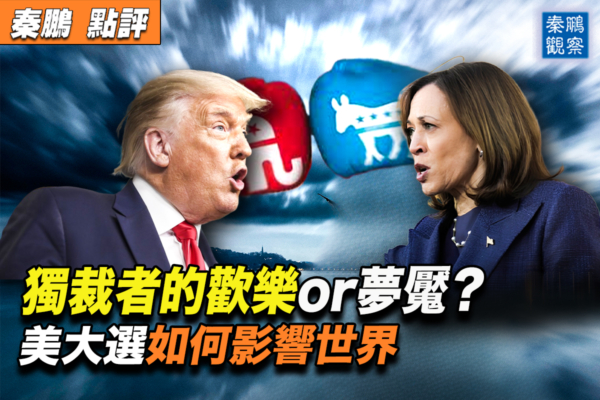
Today’s focus: The world is eagerly anticipating the final countdown of the US election, whether Trump or Harris will take office, what will they bring:
Will the powder keg in the Middle East reignite?
Will Harris’ presidency lead to a third world war?
If Trump takes office, will dictators like CCP, North Korea, and Russia be ecstatic?
Will Trump betray Ukraine? Will the US withdraw from NATO?
On today’s show, we continue to provide exclusive content for a clean world. Please follow my Clean World and YouTube account in the comments section, thank you!
The US election is still in a deadlock. Although online betting and financial markets are increasingly releasing signals about Trump’s victory, the question of who will claim the presidency remains uncertain, drawing close attention from around the world.
From the perspective within the US, both candidates have painted a picture of a terrifying scenario if the other is elected. Trump claims the world is facing a third world war, suggesting that if Harris becomes president, our sons and daughters may be forced to enlist and fight in a country nobody has heard of. He claims that only he can bring peace to the world.
On the other hand, the Democratic Party criticizes that Trump in office will please dictators, likening him to Hitler, expressing extreme concern over his unrestrained pursuit of power.
Similarly, many countries and international organizations are feeling uneasy. Trump’s economic plans have raised concerns. For example, a former deputy managing director of the International Monetary Fund who previously served in the Biden administration publicly stated that the US election will have a significant global impact. Although the US economy is very strong and inflation is expected to continue to slow down, a more expansionary fiscal stance may lead to different outcomes. However, “The Wall Street Journal” disagrees, dismissing the IMF’s prediction that promoting growth through tax reform in the US might cause financial problems, suggesting an anti-Trump sentiment within the IMF.
On the other side, it appears that the CCP is genuinely anxious. The 12th meeting of the Standing Committee of the National People’s Congress, which was initially scheduled to be held at the end of October, is now postponed until after the US election results are clear, on November 8 Beijing time, corresponding to November 9 on East Coast time. Clearly, the Chinese leadership anticipates that the outcome of the US election, regarding Trump’s potential victory and the imposition of high tariffs against China, will have a significant impact on the Chinese economy, prompting different countermeasures.
Moreover, Chinese hackers have infiltrated the US telecommunications system in an attempt to obtain the campaign data of Trump and Harris’s teams. The latest reports from US media indicate that hackers collected voice information from a Trump campaign advisor whose identity remains undisclosed.
In an earlier incident this year, the US Department of Justice not only accused Russia and the CCP of interfering in the US election but also implicated three members of the Iranian Revolutionary Guard in conducting cyberattacks to disrupt the US election. This indicates that the anxiety extends beyond just the CCP.
So, what will be the results if different individuals are elected? Let’s analyze today.
First, let’s look at the Middle East. The ongoing wars in the region may be causing the Democratic Party to lose crucial swing states like Michigan. Michigan has the largest population of Arab and Muslim Americans in the US, approximately 240,000. In 2020, Biden won Michigan with a 150,000-vote margin, largely due to the Arab and Muslim Americans who predominantly voted for the Democratic Party. However, now, Arab and Muslim American voters are angry about Gaza and Lebanon, leading to actions against supporting the Democratic Party.
To the Democratic Party’s dismay, last Saturday, Muslim religious leaders and mayors in Wisconsin supported Trump at a gathering. They believe he promises peace, not war!
According to Brown University statistics, the US has spent a record of at least $18 billion in military aid to Israel. The Gaza Health Ministry claims that these weapons have fueled Israel’s destruction of Gaza, resulting in 43,000 Palestinian deaths, including nearly 17,000 children. A June survey by CBS showed that 61% of Americans believe the US should stop arming Israel, including 77% of Democrats.
Regarding this matter, Vice President Harris seems to be in a dilemma. CNN host Dana Bash once asked her, “Will you do something different? For example, will you withhold arms shipments to Israel? That’s what many progressive left-wingers hope you will do.” Harris responded, “Israel has the right to defend itself, how to defend itself is important. Too many innocent Palestinians have been killed. Let us achieve a ceasefire.”
Bash continued, “But has there been no change in the weapons policy so far?” Harris replied, “No. We need to reach an agreement.”
As we can see, the Biden administration is in a quandary, inevitably leading to a divided base.
Unlike Harris, who walks a tightrope between supporting the Israeli military and acknowledging the suffering of the Palestinian people, Trump has taken a completely different approach. He stated, “Nobody supports Israel more than me.” He believes Israel should strike Iran’s nuclear facilities in response to Iran’s missile attacks. Previously, he even supported Israel to quickly end the Gaza war and engage in other battlefields.
Although Trump did not initiate new wars during his term, he assassinated Iranian General Soleimani, actions that contradicted his claimed anti-war and peaceful image. But why do Muslim and Arab American voters seem to be receptive to him?
Because during his first term, Trump took a different approach, forging alliances with Arab countries like Saudi Arabia and the UAE while strengthening support for Israel to reconcile, all the while aiding Israel in combating Iran and its supported axis of resistance organizations, including Hamas and Lebanon’s Hezbollah. Despite both Saudi Arabia and Iran being Muslim countries, one being Sunni and the other Shiite, with a millennium-old enmity, Iran’s attempts to export the Islamic revolution to other Muslim nations, most Arabs and Muslims in the Middle East actually oppose Iran.
During Trump’s presidency, he also took actions that deterred Iran and its backers, encouraging peace in the Middle East: Firstly, he authorized the military to eliminate the longstanding issue of ISIS unresolved during Obama’s era; Secondly, not only did he kill Soleimani but also withdrew from the Iran nuclear deal, imposing stronger sanctions on Iran, depriving them of the financial capital needed for malevolence; Thirdly, he harshly dealt with other dictators in the Middle East, such as Assad of Syria, striking a missile attack during dinner with Xi Jinping or engaging with Putin with a mix of diplomatic gestures and military action, eliminating 250 Russian soldiers.
Therefore, my conclusion is that Trump’s re-election would bring about peace in the Middle East.
Now, if Harris were to be elected, how would the Middle East respond? Some may argue that with Israel currently decimating Hamas’s major forces and eliminating leaders of Hezbollah, would there not be continued peace?
The answer is no. For the past 30 years, Hamas leaders have been eliminated multiple times, only for new leaders to emerge and the pattern of violence to resume. Simply relying on appeasement will not solve the problem in the Middle East unless a robust order is established to suppress the evil alliance; otherwise, tragedies will continue to reoccur.
Similarly, a recent poll in a swing state conducted in October revealed to “The Wall Street Journal” that voters believe the former president would handle Middle Eastern and Ukrainian issues better than the Democratic Party.
So, how would these two candidates, if elected, impact Europe? This remains a contentious issue. Anti-Trump individuals believe that Pence’s emergence would leave Ukraine and NATO in a precarious position. On the other hand, some of Harris’s supporters argue that her election would ultimately benefit Ukraine. During a meeting with Zelensky in September, Harris reiterated her unwavering support for the Ukrainian people, vowing to stand by Ukraine and ensure its victory in the conflict.
Harris also indirectly criticized Trump: “However, some in our country want Ukraine to abandon a large part of its sovereign territory, demand Ukraine to accept neutral status, and force Ukraine to give up security cooperation with other countries.”
In contrast, a New York Times interview on October 24 posed a different perspective. The title of the article was “Under Trump leadership, they will never do this”: Two Republican foreign policy experts discuss what a second term means for the world.
These experts are potential advisors for Trump’s second term, with one having served as the national security advisor in 2019 and 2020, and the other being the former deputy assistant secretary of defense who authored the “National Security Strategy” in 2018. They advocate differing global strategic outlooks, with one emphasizing “Peace Through Strength” and the other asserting that “China is America’s biggest challenge,” arguing for mobilizing resources from other regions worldwide to counter the Chinese threat.
In the interview, the former official defended the US’s slowdown in military aid to Ukraine, asserting that all wars ultimately end in negotiation. The official advocated for increased US economic pressure on Russia to put Russia at a disadvantage in negotiations. However, he cautioned against excessive military escalation on the battlefield, which would result in uncontrollable situations.
He believes Trump would not halt US assistance to Ukraine immediately upon taking office, suggesting that Trump might continue providing military aid to Ukraine while also fostering diplomatic pathways. He stressed that Trump would maintain an unpredictable process surrounding negotiations, keeping Russia in a passive and unbalanced state, compelling Putin to reach a ceasefire agreement.
The other expert questioned the effectiveness of current sanctions on Russia, arguing that their practical outcomes are minimal. He also criticized the general condemnation of Trump’s willingness to engage with Putin and Kim Jong-un. He found it odd that during the US-Soviet Cold War era, there was no criticism when US presidents engaged in dialogues with Soviet leaders.
Both experts believe that Trump is not pursuing peace for the sake of peace, but rather leveraging military and diplomatic means to apply pressure on Putin, forcing Russia to make concessions.
Following his meeting with Trump on September 28, Ukrainian President Zelensky informed Fox News that he received “a very direct message from Trump: he will stand by us, he will support Ukraine.”
The current situation on the battlefield between Russia and Ukraine reflects a dilemma: On one hand, limited aid from the US and Europe enables Ukraine to defend itself, causing them to infiltrate Russian territory. However, in eastern Ukraine, Ukraine is losing towns promised to be recaptured. On the other hand, both sides suffer significant casualties, but Russia’s population is approximately 3.5 times that of Ukraine, recently bolstering their stance by involving North Korea. By October 24th, 12,000 North Korean soldiers had already arrived in Russia, including 500 officers and 3 generals. Anonymous sources from the Ukrainian military disclosed that Kim Jong-un’s top military official, General Kim Yong-chol, recently arrived inside Russia, assuming command of the dispatched North Korean forces.
Furthermore, China, which has historically supported Russia’s logistical campaigns and global political endeavors, complicates matters.
Therefore, the US and its allies face a dilemma: whether to continue a seemingly unwinnable war with Russia on the Ukrainian front and give advantages to China and North Korea by depleting US military resources, or instead apply pressure on both sides, with a focus on confronting China.
To address Vladimir Putin’s vulnerabilities, Trump must navigate a delicate balance. Putin’s wishes to escape protracted conflicts, end sanctions, and lead Russia into a democratic camp embody three major weaknesses. Therefore, if the new US leader can ensure Putin does not face war crimes charges and handle territorial matters properly, European peace is imminent.
When discussing Europe, many mention the conundrum involving Trump and NATO. However, the solution might be simpler than anticipated, as Trump genuinely desires NATO allies to assume a fair share of defense obligations, rather than solely relying on US contributions. Trump has committed that if re-elected in November, he will push NATO countries to increase defense spending goals from 2% to 3% of their GDP.
For these European nations, this should not present a significant challenge despite the uncomfortably thick skin of some allies. Consequently, Trump has had to employ certain pressures, resulting in demonization by left-wing media.
Last Sunday, on October 26th, Vice Presidential candidate Pence reiterated Trump’s stance. He expressed, “Donald Trump wants NATO to be strong. He wants us to remain in NATO.” In an interview with NBC, Pence stated, “But he also wants NATO countries to carry their defense burdens effectively.”
In agreement, he particularly emphasized, “Germany must spend more on security, spending more on defense.”
The third major security concern globally is the Indo-Pacific region, which leads to the other big controversy of the US election this year: whether Trump’s election will be greeted by dictators. Trump has repeatedly praised Xi Jinping, Kim Jong-un, and Putin, referring to them as good friends. This has led some Chinese to idolize and criticize individuals like human rights activist Chen Guangcheng, who defended Trump, facing backlash.
In response to this issue, Chinese dissident writer Yu Zhi-guan, residing in Ireland, offered some insightful comments, writing:
Let’s begin with how Trump treated “friends” Xi Jinping.
“On April 7, 2017, over dinner at Mar-a-Lago, as Trump was enjoying his grilled dover sole, he suddenly informed Xi about his decision to launch missiles at a Syrian military base, punishing Syria’s dictator Assad for using chemical weapons against civilians. Assad is Xi’s close friend, and there were Chinese personnel at the airfield. Wasn’t this an act of intimidation towards Xi? Facing Trump’s ruthless demeanor, Xi could only awkwardly respond by commenting that military actions can be taken to stop child killings. Who reveals such martial candor during a dinner party?”
Yu Zhi-guan remarked: If one were to say that Trump set up a “Feast at Hong Gate” for his “friend” Xi Jinping, serving him a drink that was not only sobering but also intimidating, he might have drawn inspiration from a similar ancient Chinese strategy of psychological warfare with this approach. On the other hand, for another “friend,” Kim Jong-un, Trump set up a “Phantom Array,” serving him a chalice of self-inflicted humiliation.
“On February 28, 2019, Trump and Kim Jong-un held a “Trump-Kim Summit” in Hanoi. Trump’s bottom line was for Kim Jong-un to agree to destroy all nuclear weapons and then discuss how the US could lift sanctions against North Korea. Kim Jong-un attempted to deceive Trump by dismantling only one of several nuclear testing sites to obtain maximum benefits. However, Trump saw through Kim Jong-un’s deception, immediately terminated negotiations, even canceling the prepared luncheon, giving Kim Jong-un no face to exit in frustration.”
“This move by Trump, even the Democratic Party had to praise it. Even the New York Times, known for its critical coverage of Trump, published an article praising it.”
During Trump’s era, a shift occurred, marking the end of 40 years of appeasement towards the CCP, initiating a trade war, technology war, military containment, and uncovering the evil nature of the Chinese Communist Party’s ideology. Is this how one would treat good friends?
Despite the seeming contradictions, how should we assess Trump’s contradictory behavior? Understanding Trump’s background in real estate development, hotels, and casinos, he has primarily interacted with a diverse range of individuals, with a significant portion being rogues. This led him to develop his own methods for dealing with both major and minor rogues.
Of course, this is not to suggest that Harris’ presidency would spare the CCP. In fact, US foreign policy, especially towards the CCP, has solidified over the past eight years and cannot be abandoned by whomever takes office. Nevertheless, there may be differences in the approach and intensity under different leadership.
Last week, a survey released by the Chicago Council on Global Affairs showed that Americans have reached a new low in favorability towards China since the establishment of diplomatic relations, with a significant decrease over the past two years, with the majority of respondents believing the US should actively limit China’s growing power.
That concludes our discussion on how the US election results will impact the world today. Feel free to share your thoughts in the comments section.
Thank you for tuning in to today’s episode. For those who enjoy the show, please subscribe to my new YouTube channel and Clean World. Thank you!
Subscribe to the YouTube channel here:
https://www.youtube.com/channel/UCjix7du7PHahnSJm8dctzDA
Subscribe to the Clean World channel here:
https://www.ganjing.com/zh-CN/channel/1eiqjdnq7go7cVXgAJjJp39H61270c
Production Team of “Qin Peng Observation”