
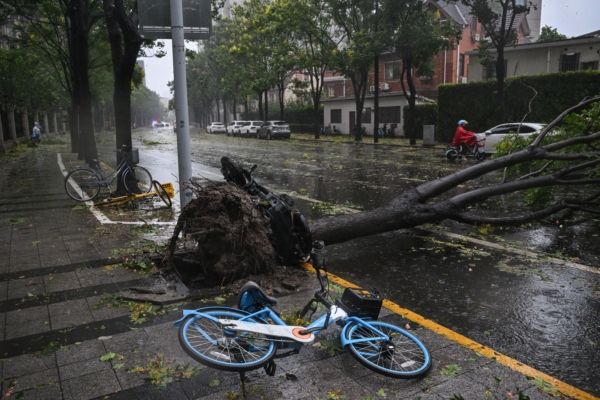
On the morning of September 16, the powerful typhoon “Beibija” made landfall in Shanghai. Residents reported that trees were blown down and people were blown away. By noon on the same day, the typhoon moved on to Jiangsu. Residents of Changzhou City in Jiangsu said that there was heavy rain and strong winds, and flying objects could hit people on the streets.
Around 7:30 a.m. on September 16, this year’s 13th typhoon, “Beibija” (super typhoon category), landed in Lingang New City, Pudong, Shanghai, with maximum wind speeds near the center reaching 14 levels.
A Shanghai resident named Li Feng told a reporter that when the typhoon hit, he saw people still walking on the streets, but the wind was so strong that “it blew people away,” and “the wind was howling, blowing down a lot of trees.”
He also mentioned that during the typhoon’s landfall, even the 632-meter-high Shanghai Center building’s thousand-ton “damping devices” were swaying.
The Shanghai Center building, located in Lujiazui, Shanghai, has a total height of 632 meters, with a structural height of 580 meters and a total weight of up to 850,000 tons.
Li Feng further mentioned, “The water level at the Bund rose very high.” Delivery services also stopped during the typhoon. He said, “With such strong wind and heavy rain outside, it can really blow people away.”
Another resident of Shanghai, Chen Longfei, said, “I was almost blown away when the typhoon arrived in the morning.”
Likewise, Wang Mingming from Shanghai mentioned that many flights at Pudong Airport were canceled today, with over 600 planes reportedly canceled. The Shanghai Metro also suspended services but resumed in the evening.
According to official reports, as of 12:30 p.m. on the 16th, Shanghai suffered damage to 4 houses, with 1 injured person, over ten thousand trees fallen or broken, and power interruptions in 153 locations, with more than 800 mu of farmland flooded. 577 train services were canceled, along with 1461 flights and 39 ship routes. 139 scenic parks in Shanghai were closed, and two bridges, Donghai Bridge and Changjiang Bridge, were shut down.
The Shanghai Metro issued an announcement today that Line 6 from Jufeng Road Station to Gangcheng Road Station planned to gradually resume operations starting from 6:20 p.m., making all metro lines in Shanghai operate normally again.
The intensity of Typhoon “Beibija” exceeded that of Typhoon “Gloria” in 4906, making it the strongest typhoon to hit Shanghai in 75 years. By midnight on the 16th, at least 414,000 people had been evacuated in Shanghai.
Affected by Typhoon “Beibija,” Suzhou, Jiangsu experienced strengthened winds, with the Liuhe River monitoring a wind speed of 13 levels and 37.5 meters per second around 10 a.m. on the 16th. Kunshan and Zhangjiagang also had level 10 strong winds.
The China Meteorological Administration announced at noon that Typhoon “Beibija” had moved into Kunshan, Jiangsu, with maximum wind speeds near the center reaching 13 levels and 38 meters per second. It is expected to move further inland, bringing strong winds and rain to Zhejiang, Jiangsu, Anhui, and other areas.
In the evening on the 16th, Lin Xiong in Changzhou, Jiangsu, informed a reporter that the typhoon had reached Jiangsu from Shanghai.
“The wind is very strong now, you can see it outside, a mix of strong winds and heavy rain,” said Lin Xiong. Around 3 or 4 p.m. on the 16th, there was very heavy wind and rain outside, with garbage, tree branches, and tiles flying on the roads. The solar panels on a nearby farmer’s roof were also damaged by the wind.
Lin Xiong described the situation as frightening, with everyone staying indoors. “Flying debris on the road could hit people, from tree branches to tiles, a variety of things could hit people.”