
【Epoch Times, September 13, 2024】Hello everyone, welcome to today’s edition of “Extraordinary Economics”.
Today’s focus: US stock market slightly drops after presidential debate! Google faces second wave of antitrust cases, facing breakup crisis! High-end mooncakes not selling well, hospital mooncakes selling out! Concept stocks related to Jay Chou plummet! AI music scams millions of dollars in traffic effortlessly! Mass layoffs in two factories affecting 20,000 workers!
First, let’s be concerned about some financial market news.
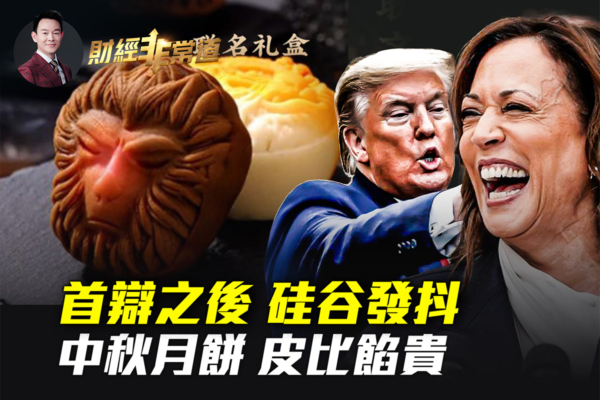
After the first televised debate between the two US presidential candidates on Tuesday, on Wednesday, both US stock indices and futures indices dropped slightly, with investors’ attitudes towards Trump and Biden’s debate not very clear, waiting for the upcoming inflation data, which will influence the Federal Reserve’s upcoming monetary policy meeting.
Whether influenced by the US financial market or not, international oil prices saw a sharp rebound during the European stock market trading session on Wednesday, rising by over 2%. This was partly due to the impact of Hurricane Francine on oil exploration activities in the Gulf of Mexico. In addition, industry data showed an unexpected decrease in US crude oil inventories, leading to an increase in oil prices.
After Apple’s new product launch on Tuesday, Apple’s stock price did not rise despite the new iPhone 16 incorporating the latest artificial intelligence applications. On the contrary, it fell slightly, dropping nearly 2% on the same day. This indicates that investors were slightly disappointed with Apple’s new product launch, partly because Apple did not raise the retail price of the iPhone 16 compared to the higher costs, and also because AI did not bring more stunning new features. Wall Street’s evaluation of the product launch was just “meeting expectations.”
Everyone knows Jay Chou, but what many people don’t know is that there is also a “Jay Chou concept stock” in the Hong Kong stock market.
The company behind this concept stock is named “Star Legend,” established in 2017. Although Jay Chou himself is not involved in the operation of Star Legend nor does he hold shares, Jay Chou’s mother, Ye Hui Mei, and his agent Yang Jun Rong hold 23.92% of the shares, so it is considered a “Jay Chou concept stock.” In July 2023, Star Legend went public on the Hong Kong Stock Exchange, and thanks to the “Jay Chou concept stock” blessing, Star Legend quickly gained favor from the capital market with a market value soaring up to 11 billion Hong Kong dollars. However, the recent sharp decline in the Hong Kong stock market saw Star Legend plummet dramatically. On September 11, Star Legend suddenly plunged, triggering market circuit breakers multiple times. By the closing time, Star Legend plummeted over 72.24%, evaporating 5 billion Hong Kong dollars of market value. I wonder how Jay Chou will comfort his mother upon hearing this news, maybe he will sing her a song?
Over the past month, the US Department of Justice has been frequently clashing with Google over antitrust issues. Following Google’s defeat in August, they will once again face a second wave of antitrust lawsuits filed by the Department of Justice, this time focusing on Google’s ad tech business.
On September 9, the Justice Department filed a lawsuit against Google for illegal monopoly in the digital advertising industry. The Justice Department stated that Google used classic monopoly tactics to expand market share by acquiring competitors, controlling the transaction method of the online advertising market.
Google stated that businesses choose to cooperate with them because it is indeed effective. They emphasized that the Justice Department’s accusations are too narrowly focused on web advertising, as the times have changed since digital media has risen, advertisers are shifting to social media platforms where Google has no control!
The trial of the “second anti-monopoly case” against Google is expected to last for several weeks. If the Justice Department wins, Google might be forced to split its advertising tech business. The advertising business is Google’s most important cash cow, and ad tech is a crucial part of it. Last year, this business generated $31 billion in revenue for Google, accounting for one-tenth of its total revenue.
Previously, we reported that in August of this year, the US Department of Justice won an antitrust case against Google for monopolizing the online search market. This is the largest antitrust case in the US in over twenty years, marking significant significance in US commercial history.
Antitrust litigation is a major theme in US business history. Over the past century, companies such as Standard Oil, American Telephone and Telegraph Company (AT&T) have faced antitrust breakup. The most famous case in the tech field was the 1998 Department of Justice antitrust case against Microsoft, where Microsoft was also ordered to be split but ultimately avoided this fate through a settlement.
Google’s search monopoly case is the first victory for the US government in the anti-monopoly confrontation with internet giants. In March of this year, the US Department of Justice filed an antitrust lawsuit against Apple for monopolizing the smartphone market; at the same time, the Federal Trade Commission filed separate lawsuits against Amazon and Facebook’s parent company Meta, accusing them of maintaining illegal monopolies; in addition, Nvidia, the biggest beneficiary of the AI wave, is also under the scrutiny of antitrust regulators.
Everyone knows that the US is a country of immigrants, but today’s America is experiencing its largest wave of immigration. A large number of people from around the world are pouring into America seeking personal safety and economic opportunities, especially those escaping from the authoritarian rule of the Chinese Communist Party, becoming a prominent part of the mass exodus towards freedom. These immigrants not only rapidly increase America’s population but also change its labor force composition, with the economic impact likely to last for decades.
According to estimates from the Congressional Budget Office, approximately 9.3 million people have immigrated to the US through legal and illegal channels since 2021, almost equating to the total number of immigrants in the past decade. Immigration has led to a nearly 1.2% annual population growth rate in the US, the highest level since the early 1990s.
The surge in the immigrant population has sparked controversy, as many immigrants entered the US through unauthorized channels. According to government data, less than 30% are “legal immigrants,” around 2.6 million people. Most of the remaining 6.5 million people have crossed the southern border into the US without authorization and are seeking asylum from border officials.
Since 2020, the top ten largest immigrant source countries are located in Latin America or the Caribbean region, with Venezuela accounting for 14%, and Mexico 13%. These new immigrants entering the US are settling in various parts of America, with the top five immigrant destinations being Florida, Texas, California, New York, and New Jersey.
According to the data from the immigration court, approximately 80% of new immigrants speak Spanish. Moreover, the unemployment rate for new immigrants is 8.2%, generally higher than the local workforce’s rate of 4.2%. This year, the overall unemployment rate in the US has been continuously rising, reaching 4.3% in July, partly due to the increasing number of new immigrant job seekers.
New immigrants’ incomes are often lower than local workers because of their lower educational levels and inadequate English proficiency. The Congressional Budget Office also stated that as immigrants gain experience and more immigrants with university degrees increase, this situation will gradually improve. Furthermore, immigrants start paying federal taxes from the day they begin working, which will also help reduce the federal deficit.
According to census data, the most common occupations for new immigrants are construction workers, housekeepers, and janitors, as well as chefs.
For well-educated immigrants with university degrees, software developers are the most common occupations.
Now, let’s talk about an odd piece of news. Last Wednesday, a so-called “musician” named Michael Smith from North Carolina was sued for fraud. This guy’s fraud isn’t ordinary; he meticulously planned scams for seven years, using high-tech artificial intelligence methods to effortlessly siphon off millions of dollars. What’s more bizarre is, his fraud makes scams in countries like Myanmar and Cambodia seem amateur; he used music on streaming platforms! Isn’t that impressive?
According to the indictment from the US Department of Justice, Michael Smith, 52 years of age, from 2017 to 2024, uploaded hundreds of thousands of AI-composed songs on platforms like Spotify, Amazon Music, and Apple Music. He forged thousands of AI accounts on these platforms and used them to automatically transfer AI music, generating more than 660,000 transmissions per day. Additionally, he “hired” thousands of bots to help increase traffic, and simultaneously used internet proxies to conceal his fraudulent activities and evade tracking by authorities. Currently, investigators have charged him with three counts: wire fraud, conspiracy to commit wire fraud, and conspiracy to launder money. Each charge carries a maximum sentence of 20 years in prison.
As we all know, musicians put their songs on platforms like Spotify to earn revenue through “streams.” According to Spotify’s statistics, the revenue for a track with 1,000 plays per month is just $0.03, making it very meager for unknown composers. However, Smith effortlessly created hundreds of thousands of songs using AI, then falsified astounding play numbers, easily earning large sums of money from the platforms.
What’s even more unfortunate is that Smith is not an isolated case; similar incidents are frequent. In the AI era, generating music with AI is as easy as snapping fingers, and Spotify seems to have been ruined by these pseudo-musicians. Earlier reports on related media have mentioned how scammers utilized AI to cover legitimate songs, then mix them into playlists, ultimately stealing massive traffic with ease.
According to experts, this situation has been ongoing for several years, with the most copied genres being country, electronic, and jazz music. It seems that there is still a long way to go in the battle against AI music scammers.
Reports from European media state that on September 2, Volkswagen issued a statement in Germany, announcing plans to consider closing one car manufacturing plant and one component factory in the country. If implemented, this would be the first time in Volkswagen’s history that they close factories in Germany.
On September 9, there were reports that the Volkswagen Group was preparing for layoffs, with the first round potentially affecting 20,000 people. However, this news has not been officially confirmed yet.
Volkswagen CEO Obomu expressed that faced with internal transformation within the group, a weakening German and European market, and intense competition from new energy vehicles from China, Volkswagen will break its record of never closing factories in Germany.
Regarding the rumored large-scale layoffs, Obomu frankly explained that the current economic situation is quite severe. European car sales are declining, and competition from Asian competitors is aggressively entering the market. Though the pie is shrinking, the table is getting more crowded.
Since its establishment in 1938, Volkswagen has always been at the forefront of the global automotive industry. Headquartered in Wolfsburg, Germany, Volkswagen is not only one of the giants in the European automotive industry but also a highly influential multinational corporation worldwide. With well-known brands like Volkswagen, Audi, Skoda, Porsche, etc., under its umbrella.
In recent years, Volkswagen’s profit margin has remained at relatively low levels. Looking at the global layout, Volkswagen has around 650,000 employees worldwide, with nearly one-third in Germany. Volkswagen faces a situation similar to the initial situation of the three major US car manufacturers, which had to deal with union issues. Currently, in Volkswagen’s supervisory board, union representatives occupy half of the positions. At the same time, Lower Saxony, a crucial shareholder in the group, often aligns their stance with the union. This situation has led to rising labor costs year after year and a continuous decline in the group’s profits.
In the first half of this year, Volkswagen’s sales in the Chinese market reached 1.345 million vehicles, a 7.4% year-on-year decline. This data not only reflects the fierce competition in the Chinese market but also highlights the severe challenges Volkswagen faces in the Chinese market. In terms of market share percentage, the Chinese market currently accounts for only 30.9% of Volkswagen’s total global sales volume, while at its peak, the Chinese market used to contribute to 40% of Volkswagen’s global market share.
Especially noteworthy is that Volkswagen’s long-standing dominance in the Chinese market has silently changed. BYD successfully surpassed Volkswagen, becoming the sales leader in the Chinese market. Looking at the full-year expectations, this trend seems difficult to reverse, further intensifying the competitive pressure Volkswagen faces in the Chinese market.
According to financial reports, Volkswagen’s revenue total profit in the Chinese market in the first half of 2024 was 801 million euros, equivalent to earning 4,650 euros for each car sold in China, a 43% decrease compared to 2022. To cope with cost pressures and ensure production stability, Volkswagen is considering further concentrating core supply chain elements in China, and the closure of German factories might signal this strategic adjustment.
Facing the Chinese Communist Party investing heavily in subsidizing electric vehicle companies, allowing Chinese-made electric cars to flood the market at low prices, this has brought significant challenges to Western car companies. For self-protection, Volkswagen has to cut off limbs to survive.
Faced with Volkswagen’s decline, German media “AutoWeek” exclaimed: the era when German car companies led the way is past, and it may be challenging to return to the peak.
As the weekend is approaching, let’s talk about a few news related to eating and playing. First, let’s talk about food. The mooncake business in mainland China this year is quite worrying.
When it comes to mooncakes, all mooncake-producing companies are at a loss, some have even stopped making them. Besides food factories, mainland China also has a big mooncake seller, which is hotels. The “Custard Mooncake” from the Peninsula Beijing Hotel used to be a highly sought-after item, but this year, they have started big promotions, offering free room vouchers and meal vouchers with a certain amount purchased. Even high-end hotel mooncakes have begun to see significant price drops this year, dropping down to 200-300 yuan per box. If you have friends who work in hotels, you can see them early on in the year already selling mooncakes on their social media platforms, showing off their mooncakes every day with fancy captions, but seldom getting any attention.
Why are hotels so persistent in selling mooncakes? According to industry insiders, selling mooncakes is a major source of income for hotels, with profits higher than those from food and accommodation, generally above 40%. Therefore, selling mooncakes during Mid-Autumn Festival is a significant event. However, this year’s mooncake situation is much more severe than last year.
To sell mooncakes, businesses are coming up with all sorts of tricks. The rising star in the tea and beverage industry, “Nai Xue’s Tea,” launched a snack gift box in collaboration with “Harry Potter,” providing various gift cards, fridge magnets, and other peripheral products.
Daohuang Village is good at catching the trend. With the recent online game “Black Myth: Wukong” gaining explosive popularity, Daohuang Village quickly launched a co-branded gift box “Gathering the Moon, Facing Destiny.” The mooncakes were directly designed after characters in the game like Tianming Ren, Huxianfeng, and Huangmei. If you can’t defeat a major boss, you can energize yourself with a mooncake first.
In light of all this, both the quantity and intensity of co-branding this year are weaker than last year.
Here’s a funny thing: last year, many people in mainland China went to mental hospitals to buy mooncakes. Specifically, they went to “Shanghai Mental Health Center” to buy mooncakes that were originally made for the staff canteen but turned out to be delicious and cost-effective, becoming a trendy spot for Shanghai locals to buy mooncakes!
This year, another hospital’s mooncakes have become popular – the “Guizhou Provincial Hospital.” People brought chairs and backpacks, lining up early in the morning, creating queues that stretched for miles and nearly paralyzed traffic.
This is what they fought to buy – mooncakes that are so simple they aren’t even packaged, just a plastic container and bag. Just this? Why are they selling out and remaining popular? The answer is simple: high-quality ingredients, delicious, and not expensive.
This simple and humble “Guizhou Provincial Hospital mooncake,” reveals a trend in the Chinese mooncake industry: abandoning packaging and returning to basics.
“Slenderizing” mooncakes has become a major trend. According to the China Food Industry Association, this year mainstream mooncake gift box prices range from 70 to 220 yuan, marking a decrease from last year. Mooncakes exceeding 500 yuan have mostly exited the market.
Many consumers are beginning to visit bakeries or supermarkets to buy loose mooncakes, without fancy packaging, just in a plastic bag, making them incredibly budget-friendly, much more affordable than the high-priced boutique gift box mooncakes.
Besides the glitzy packaging and strange flavors, mooncakes that are truly traditional, simple, made with genuine ingredients, and crafted with care, are people’s favorites.
Wishing you not only a warm Mid-Autumn Festival but also hoping you find good and affordable mooncakes!
That’s it for today’s program, welcome to subscribe to NTD Chinese YouTube channel for diverse programs. Thank you once again for watching “Extraordinary Economics,” see you next time!
Subscribe to NTD Chinese YouTube channel:
https://www.youtube.com/@NTDCHINESE
Production Team of NTD’s “Extraordinary Economics”