
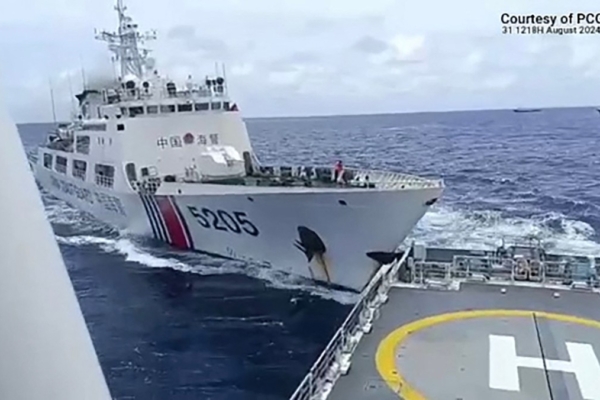
In the past decade, the Chinese Communist Party’s maritime police force has continuously expanded and militarized, bullying neighboring countries at sea and challenging international maritime laws using its domestic legal framework. This has raised concerns of potential armed conflicts and has become a dangerous force undermining peace in the Asia-Pacific region.
The activities of the Chinese Communist Party’s maritime police have been increasingly widespread, patrolling areas including Vietnam’s exclusive economic zone, near the coasts of the Philippines and Malaysia, as well as around the Diaoyu Islands and Kinmen Island controlled by Taiwan. This demonstrates that the Chinese Communist Party’s maritime police has become a key element in intimidating maritime neighbors.
According to data from the U.S. Naval War College in 2019, the Chinese Communist Party’s maritime police has over 140 ocean-going patrol vessels with a displacement of over 900 tons.
The total number of Chinese Communist Party’s maritime police vessels is believed to exceed the combined total of the U.S. Coast Guard, the Japan Coast Guard, and the Philippine Coast Guard.
In international law, maritime law enforcement and military activities are distinct. Most countries’ coast guards are led by administrative agencies rather than being part of the military, especially during peacetime. For example, the Japan Coast Guard is under the Ministry of Land, Infrastructure, Transport and Tourism, its operations are strictly restricted by domestic laws, and there are strict firewalls between the Japan Maritime Self-Defense Force.
In contrast, the Chinese Communist Party’s maritime police has become increasingly militarized in recent years. In 2018, the Chinese Communist Party’s maritime police transitioned from a sub-agency under the State Oceanic Administration to a paramilitary force under the command of the Chinese Communist Party Central Military Commission.
The Chinese Communist Party’s 2021 Maritime Police Law stipulates that the maritime police can carry out military actions, meaning they can conduct military operations during peacetime under the guidance of the Chinese Communist Party’s Central Military Commission.
Chinese Communist Party’s maritime police vessels are equipped with steel hulls and weapons, and the newer vessels appear indistinguishable from naval ships. According to the U.S. Department of Defense’s 2022 “Chinese Military Power Report,” in 2021, the Chinese Communist Party’s Navy transferred 22 Type 056 light frigates to the maritime police. Although these vessels have removed missiles and torpedoes, they retained 76mm main guns and powerful radars.
More and more countries are viewing the Chinese Communist Party’s maritime police as a differently painted navy rather than a coast guard.
Yeh Yunhu, Secretary-General of the Chinese Coast Guard Association and professor of Maritime Police at the Central Police University, stated that “We have been monitoring the Chinese Communist Party’s maritime police. Since Hu Jintao proposed becoming a maritime power and during Xi Jinping’s tenure, the Chinese Communist Party’s maritime police have been like unbridled horses charging forward, growing larger and more assertive.”
Previously, China’s maritime jurisdiction was divided among five departments, including marine surveillance, fisheries administration, customs, maritime affairs, and border defense militia, and in 2013, they were merged to form the Chinese Communist Party’s maritime police.
Yeh Yunhu explained that before the merger, marine surveillance has always been quite large, the largest unit within the maritime police, while the naval border patrol units organized by the Armed Police were relatively smaller. When the merger occurred in 2013, it was expected that marine surveillance would lead everything, but unexpectedly, the Chinese Communist Party used the public security system to lead everything, with a deputy minister from the Chinese Communist Party’s Ministry of Public Security acting as the head of the maritime police bureau.
Regarding the Chinese Communist Party’s maritime police coming under the direct command of the Chinese Communist Party Central Military Commission in 2018, Yeh Yunhu believes that Western coast guards have never operated in such a way. How could you make the coast guard subordinate to the military commission and then allow them to carry out national defense actions within the coast guard law?
“We see from the outside that such things are not comparable to the naval forces of other countries but are essentially a second navy,” he said.
After 2018, the Chinese Communist Party’s maritime police deployed destroyers equipped with guns and cannons such as the 052 or 056 modified with 76mm rapid-fire guns to patrol the waters around the Diaoyu Islands and even enter Japanese territorial waters, causing significant tension. In response, Japan warned directly that if these vessels come, they may dispatch the Maritime Self-Defense Force to respond.
Yeh Yunhu stated that the expansion of the Chinese Communist Party’s maritime police is intended to use the navy to overwhelm other countries’ coast guards and exploit grey areas. They have equipped their ships with capabilities and tonnages, including shipborne gun systems, which far exceed those of ordinary coast guard equipment. “It’s not that we can’t afford to equip them, but we don’t need to. Equipping these things restricts law enforcement,” he said.
In 2021, the Chinese Communist Party passed the Maritime Police Law, in which safeguarding sovereignty and territorial integrity is the most crucial aspect among the many tasks of the Chinese Communist Party’s maritime police.
Yeh Yunhu explained that by making so-called maritime rights the central task, the Chinese Communist Party has a mistaken perception of maritime law enforcement. Law enforcement at sea has never been the most vital task of maritime police; only military personnel will safeguard national sovereignty.
“When Taiwan’s Coast Guard enforces maritime order, the maintenance of sovereignty has never been a top priority. It simply implies that there is jurisdiction over the area, not necessarily for the protection of sovereignty,” he said.
The Chinese Communist Party’s Maritime Police Law also allows the maritime police to conduct law enforcement operations in China’s “jurisdictional waters” (not defined which waters), using all means, including weapons, against foreign organizations or individuals violating sovereignty. They can also establish temporary maritime control zones to restrict or prohibit the passage of vessels and personnel.
Since June 15 this year, China has implemented the “Administrative Enforcement Regulations for Maritime Law Enforcement Agencies,” allowing new measures such as inspections, detention, and seizure for foreign vessels and personnel.
A spokesperson from the U.S. State Department responded by saying that under the 1982 United Nations Convention on the Law of the Sea, China’s domestic laws do not apply to another country’s exclusive economic zone or ships flying the flag of another country in the high seas. Enforcing these laws jeopardizes regional peace and security.
While the Law of the Sea Convention allows coast guards to use force, it is merely a preventive measure to stop vessels, not for eliminating enemies. The actions of the Chinese Communist Party’s maritime police have no relationship to the framework established by the Law of the Sea Convention for peaceful times; it is more akin to a low-level armed conflict rather than law enforcement.
In mid-June, during the latest tense standoff between the Chinese Communist Party’s maritime police and the Philippine Navy, the Chinese Communist Party’s maritime police conducted the first “boarding inspection” since expanding their law enforcement powers.
Analysts suggest that naval vessels should be exempt from such law enforcement activities to avoid significant legal disputes that could amount to acts of war.
Yeh Yunhu noted that the regulations in the Chinese Communist Party’s Maritime Police Law are peculiar. The initial draft had preliminary determinations of jurisdictional areas, but the approved version entirely removed it. As a result, it is unclear which areas the Chinese Communist Party’s maritime police can conduct inspections, detentions, or forcible containment. The entire Maritime Police Law gives the impression that activities can occur in any region, even in international waters where the principle of freedom of the high seas applies. It is improbable to board, inspect, or detain foreign vessels in international waters.
Yeh Yunhu pointed out that when Taiwan established its Coast Guard Law, it prioritized international law before domestic law. You cannot prioritize domestic law over international law. The Chinese Communist Party’s Maritime Police Law is essentially based on domestic law rather than international law. It’s primarily a set of operational rules that must conform to the Party’s leadership, which could surpass everything else.
“We find it bizarre that maritime police vessels are under the Central Military Commission, but on the other hand, they are authorized to enforce the law.”
“The Chinese Communist Party’s thinking is to calculate its power, claiming its fist is bigger, and its rules are correct. It uses practice to gradually change international regulations,” analyzed Yeh Yunhu. The primary goal of international law is to minimize conflicts with other countries and seek a relatively peaceful state, not create rules that favor major powers waging war against smaller nations. If that were the case, the world would be in constant conflict, engulfed in flames everywhere.
Yeh Yunhu stated that from a legal perspective, the primary purpose of the Chinese Communist Party’s Maritime Police Law is to change regional rules through its enforcement and to oppress countries around the East China Sea, South China Sea, and Taiwan Strait to satisfy its political needs.
The pressure exerted by the Chinese Communist Party’s maritime police on neighboring countries has not brought any tangible benefits to Beijing in ensuring its maritime claims but has instead triggered opposition from various countries.
An evident example is the consensus reached at the unprecedented U.S.-Japan summit and the U.S.-Japan-Philippines summit held in Washington in April this year, with the South China Sea and Taiwan Strait issues at the center.
Yeh Yunhu expressed that China’s suppression of the Philippines instead of reaching out to Indonesia with their probing activities to test the U.S.’s response, assess whether the Philippines could withstand the pressure. In their interactions with Taiwan, China crosses the Taiwan Strait, even conducts comprehensive law enforcement exercises in the eastern waters to test Taiwan’s reactions. In the East China Sea, China is actively patrolling around the Diaoyu Islands, sometimes even sailing in formation, testing Japan’s responses.
“China has been trying to figure out which strategy is effective, trying to test where your red line lies.”
To stop China’s behavior, Yeh Yunhu emphasized that all countries must have a consensus and establish a clear red line on what is unacceptable.