
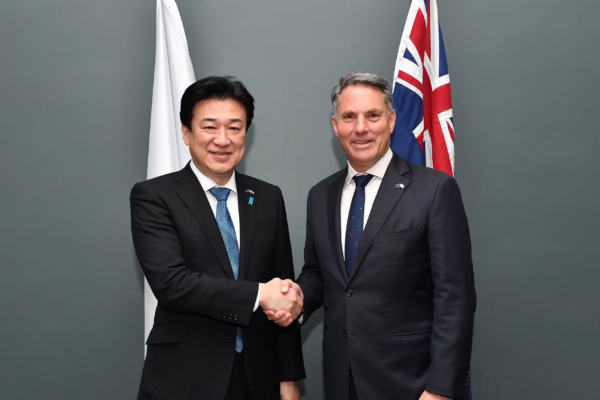
On Wednesday, September 4th, Japanese Defense Minister Minoru Kihara and Australian Defense Minister Richard Marles held a meeting in Melbourne, Australia, agreeing to cooperate in enhancing long-range missile capabilities. This is the latest effort by both countries to address the increasing expansion of China in the Indo-Pacific region.
According to the meeting minutes released by the Japanese Ministry of Defense, Kihara expressed strong concerns about the increase in military activities by China in the vicinity of Japan, particularly the recent intrusion of Chinese military aircraft into Japanese airspace. Both countries agreed to further strengthen cooperation against attempts to unilaterally change the status quo through force or coercion.
Kihara and Marles agreed that both nations will continue to work together to help Japan obtain the capability to counterattack enemy missile launch sites and assist Australia in achieving precise strike capabilities with long-range missiles.
According to reports from NHK, both sides confirmed that due to Australia’s deployment of Tomahawk cruise missiles, the two countries will enhance interoperability between the Self-Defense Forces and the Australian military, as well as strengthen defense cooperation with the United States.
In August of this year, Australia announced the purchase of over 200 Tomahawk cruise missiles from the United States to enhance the navy’s long-range strike capabilities. In January, Japan procured about 400 Tomahawk cruise missiles from the United States to strengthen its counterattack capabilities.
In March, Japanese Chief of Staff for the Maritime Self-Defense Force, Ryo Sakai, revealed in a press conference that after deploying the Tomahawk cruise missiles in the Maritime Self-Defense Force in 2025, the U.S. and Japan will share target information in the system, allowing them to coordinate attacks on the same target when exercising their counterattack capabilities.
According to reports by Kyodo News, during the meeting, the two sides also discussed the possibility of Japan using Australian missile launch facilities. Earlier this year, Japanese government sources revealed that Japan and Australia are negotiating for Japan to utilize Australia’s vast land as a testing ground for its developing missiles.
Additionally, Kihara conveyed Japan’s intention to participate in Australia’s bidding process for new naval vessels. Kihara mentioned that Australia has shown interest in Japan’s destroyers and stated that Tokyo is providing information on the matter, although he did not disclose any specific details.
Reported by the Nikkei, the Japanese Ministry of Defense plans to jointly develop a new type of destroyer with Australia based on Japan’s Maritime Self-Defense Force’s “30FFM-class frigate”. The feature of the “30FFM-class frigate” is its manpower efficiency, requiring only about half the personnel of traditional destroyers.
The two ministers also reaffirmed that progress is being made in intelligence gathering, surveillance, reconnaissance activities, and joint training exercises between the two countries’ military forces under the Reciprocal Access Agreement (RAA) that came into effect in August last year. The agreement streamlines procedures for the Self-Defense Forces and Australian military to operate in each other’s territories.
Both sides also stressed the importance of promoting defense cooperation among Australia, Japan, and the United States to strengthen deterrence and response capabilities in the Indo-Pacific region. They agreed to continue working with like-minded countries to realize a “free and open Indo-Pacific”.
During a post-meeting press conference, the defense ministers expressed concern over China’s military activities, fearing that it could “further exacerbate tensions in the region”.
Recently, China has been escalating provocative actions against Japan, intensifying regional tensions. Last Monday, August 26th, Chinese military aircraft intruded into Japanese airspace for the first time. Last Saturday, August 31st, a Chinese warship was confirmed to have violated Japanese territorial waters.
This Thursday, September 5th, Kihara and Marles, along with Japanese Foreign Minister Yoko Kawashima and Australian Foreign Minister Penny Wong, will attend the Japan-Australia Defense and Foreign Ministers’ “2+2 Meeting” in Melbourne.
During the meeting, both sides will confirm the expansion of defense equipment development and joint training, as well as strengthen their bilateral relationship positioning as a “quasi-alliance”. They will also exchange views on China’s escalating military provocations.