
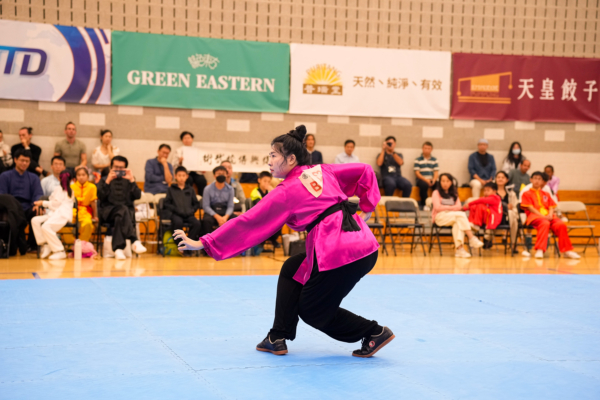
Deng Xiaobin used to be a designer and a model, having won the Best Popularity Award in the International Model Star Overseas Competition and the Outstanding Award in the Hanfu Design Competition held by New Tang Dynasty Television. Just over a year ago, she began to get involved with traditional Chinese martial arts through what seemed like a chance encounter.
On August 31, 2024, during the preliminary round of the New Tang Dynasty Martial Arts Competition, she competed in the women’s youth group in the categories of bare-handed routines and weapons routines using Xingyi and Whip techniques.
Deng Xiaobin shared that her initial inspiration to practice martial arts came after watching the story of Yue Fei in a Shen Yun performance. “I greatly admire the heroic spirit of Yue Fei, and his historical story is a somber one.” This led her to dream of learning traditional martial arts, with a specific goal in mind: “If one day I can learn traditional martial arts, I want to master the long spear to pay tribute to the loyal spirits of the Yue family army.”
When her martial arts teacher first saw her, he advised her to lose weight before starting weapon training.
After a period of martial arts practice, she unintentionally lost 40 pounds and gradually built up the strength in her arms as per her teacher’s guidance. In theoretical martial arts classes, the teacher provided explanations on various aspects of martial arts, cultivation, qigong, techniques, which inspired her and reinforced her determination to continue practicing martial arts.
Through martial arts, Deng Xiaobin gained many insights, “I discovered that martial arts movements have meaning and purpose. Each seemingly isolated movement in martial arts actually corresponds to opening acupoints. The human body is mystical, and there are methods and sequences to open up the meridians.”
She felt that there were similarities between martial arts and dance, “Both require fluency of the body, the opening of meridians. Once meridians are open, practicing becomes effortless and almost without feeling tired. This showcases the strong health benefits of traditional martial arts.”
After practicing martial arts, she noticeably felt an increase in her body’s energy, and gradually began to experience many profound aspects such as functionality and Tianmu (天目). “This process is slow but intriguing. It’s like knowing there are beautiful sceneries on the mountaintop, working hard to climb up, and seeing different landscapes at every step along the way.”
Deng Xiaobin mentioned that martial arts can be divided into internal and external styles. External styles focus on external performance, while internal styles emphasize the circulation of meridians and energy systems. Traditional martial arts can be both outwardly expressive and internally cultivative, the true essence of traditional martial arts and spiritual cultivation are closely interconnected.
She said, “I found that the process of martial arts practice is a process of endurance. Enduring hardships can enhance enlightenment. It has been very helpful for me to understand Buddhist principles. Enduring hardships also helped eliminate many worries. After continuously letting go of various attachments, my mood has improved significantly.”
Deng Xiaobin expressed her heartfelt gratitude to all participants in the competition, “Because what we inherit is what many martial arts predecessors dedicated hundreds or even thousands of years, pouring their hearts and even lives into, passing down. If all of this were lost, it would be a regret for humankind.”
Deng Xiaobin believes that the traditional martial arts competition organized by New Tang Dynasty Television holds significant meaning, “Imagine 5 or 10 years from now, if no one knows what traditional martial arts are, wouldn’t that be a dreadful situation?” She remarked, “Nowadays, many sources and origins of martial arts styles cannot be found online. Most of what people see in movies and television is the modern martial arts.”
“In today’s society, even foreigners highly respect Chinese martial arts and want to help protect this cultural treasure. As Chinese people, as those who pursue traditional culture, as those with a sense of justice and conscience, we should understand what true traditional martial arts really are.”