
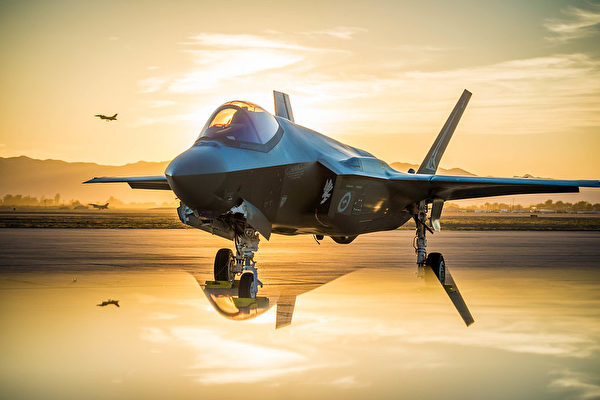
Amid escalating tensions between Iran and Israel, the Pentagon confirmed on August 22 that the aircraft carrier “Abraham Lincoln” had arrived in the Middle East. This carrier, carrying F-35C fighter jets, demonstrates the United States’ strengthened air power presence in the region to deter potential threats.
As tensions continue to rise in the Pacific region, the U.S. Navy announced on July 15 that it would deploy an F-35 fighter squadron to the Iwakuni Air Base in Japan to join the 5th Carrier Air Wing. Defense analysts believe the deployment of F-35C stealth fighters to the stationed carrier in Japan signifies a significant upgrade in the U.S. military’s capabilities in the Asia-Pacific region, particularly countering stealth aircraft from countries like China.
The F-35 stealth multirole fighter, a fifth-generation aircraft manufactured in the United States, is currently in service in 20 countries with a total flight time exceeding 773,000 hours. Known for its stealth capability, versatility, range, speed, and advanced electronic warfare and avionics equipment, the F-35 is crucial for maintaining air superiority and is hailed as an unstoppable fighter jet.
Designed to cater to the needs of the Air Force, Marine Corps, and Navy, each variant of the F-35 is tailored for specific roles, ensuring its adaptability remains relevant in evolving technologies and solidifying its position as a potent airborne platform.
The F-35C, a carrier-compatible version of the F-35, boasts various capabilities including air superiority, close air support, and electronic warfare. It features unique adaptations for carrier operations such as larger wings and control surfaces, reinforced landing gear, extended range, and folding wingtips.
Overall, the F-35 fighter aircraft possesses five key factors that establish it as the dominant fifth-generation fighter in the skies, alongside the F-22 “Raptor,” aiding the U.S. Air Force in maintaining air superiority. Manufactured by Lockheed Martin, this multirole stealth fighter is designed for versatile operations against both air-to-air and air-to-ground targets.
In a world where both China and Russia are advancing in advanced air defense and radar technologies, stealth capabilities are indispensable for any modern U.S. fighter aircraft. With tensions escalating in regions like the Taiwan Strait, South China Sea, and Eastern Europe, the survival ability of the F-35 in contested airspace is crucial.
The F-35’s stealth features, known as Low Observability Technology, are implemented by skilled air force personnel. Starting with a stealth design, the F-35 possesses unparalleled capabilities to evade enemy detection and penetrate contested airspace. Its aligned edges, reduced engine noise, internal weapon and fuel carriage, and embedded sensors contribute to its unique stealth performance.
The F-35’s advanced stealth coating application technology utilizes laser deposition techniques to bond polymer film onto the skin.
One of the most outstanding qualities of the F-35 fighter aircraft is its versatility. Unlike the F-22 “Raptor” solely for Air Force pilots, the F-35 is designed as a series of multirole fighter aircraft. Improved Lightning II variants tailored for the Marine Corps, Navy, and Air Force aim to meet specific defense requirements.
The F-35A, known as the “Runway Queen” of the series, operates similarly to traditional fighter aircraft and requires approximately 8,000 feet of standard runway for takeoff and landing. The F-35B variant is tailored for the Marine Corps, boasting Short Takeoff and Vertical Landing (STOVL) capabilities and being the most mechanically complex of the three models.
The Navy’s F-35C variant is designed with carrier capabilities, equipped with heavy-duty landing gear and a tail hook.
Additionally, the Israeli version of the F-35I fighter aircraft can be customized to integrate Israel’s advanced technologies to meet operational needs.
In stealth configuration, the “Lightning II” can carry four AIM120 AMRAAM missiles for air-to-air missions or four AIM-120/GBU-31 JDAM smart bomb combinations for air-to-ground missions.
The F-35 can also enter “Beast Mode,” carrying up to 14 AIM-120 missiles for ground operations, 2 AIM-9x missiles for air-to-air missions, or 4 Aim-120/9X missiles and 6 GBU-31 missiles.
The F-35 utilizes the Pratt & Whitney F135 afterburning turbofan engine, with a dry thrust of 28,000 pounds and an afterburner thrust of 43,000 pounds. The engine’s power enables a range of 1,200 nautical miles per aircraft and speeds exceeding 1.6 Mach.
The F135-PW-100 engine features two variants: the F-35A and F-35B use the CTOL version (Conventional Takeoff and Landing), while the F-35B employs the dual-cycle STOVL model.
According to Airforce-Technology.com, the F135 engine has a jump-jet variant that provides 18,000 pounds of thrust through the rear and 20,000 pounds of thrust through the lift fan, along with 3,900 pounds of thrust through the two roll posts to assist in controlling the F-35B during vertical takeoff and landing.
Unlike previous models, the F-35 is equipped with large touchscreen displays and helmet display systems, allowing pilots to directly view real-time information around the aircraft.
The Distributed Aperture System (DAS) and a suite of infrared cameras provide pilots with this capability, serving as a significant advantage. The F-35 also features the AN/APG-81 Active Electronically Scanned Array (AESA) radar system, offering robust electronic warfare capabilities.
In January of this year, the Pentagon awarded Lockheed Martin a nearly $100 million contract to integrate AGM-88G High-Speed Anti-Radiation Missiles (HARM) onto all three variants of the F-35. This potent anti-radar missile can destroy enemy radar and air defense systems.
Given the critical role of electronic warfare in modern combat, this integration is seen as a crucial asset.
The capability for the F-35 to provide data exchange services for all Joint Strike Fighter aircraft, even those flown by foreign militaries, at a cost-effective manner, is unparalleled. The F-35 stands as the most technologically advanced fifth-generation fighter aircraft currently available.
Thanks to secure data link transmission, any technological improvements or data sharing can be incorporated into the F-35 platform in the coming years. This key capability ensures the F-35 maintains its edge over a more extended period.
In conclusion, the F-35 is renowned globally, with the 1000th F-35 fighter completed in construction this February, ready for delivery to customers. The aircraft’s stealth, speed, payload capacity, avionics, and electronic systems truly establish it as an unmatched combat platform.
With the changing global landscape, the production of the F-35 is expected to continue rising, with more countries equipping themselves with the aircraft. Japan stands as the largest customer for F-35, while many European nations are also preparing to integrate the fighter aircraft. The U.S. military plans to have a total of 2,456 F-35s in service by 2044. Initially, during the F-35 production plan’s early stages, Lockheed Martin estimated selling over 5,000 units of this fighter aircraft.
(Note: This article draws reference from “National Interest.”)