
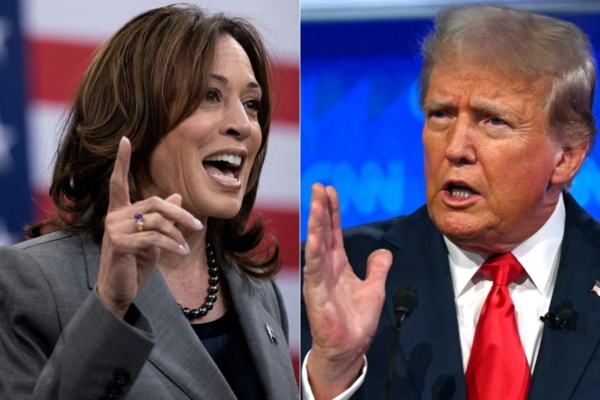
At the Democratic National Convention, Hillary Clinton vowed to lead America to victory over the Chinese Communist Party in the 21st century, echoing the similar aspiration expressed by Republican presidential nominee Donald Trump. As the 47th President of the United States, who has the superior strategy in defeating the CCP?
On the evening of August 22nd, after officially being nominated as the Democratic presidential candidate, Hillary Clinton stated, “I want America, not China (CCP), to win the competition of the 21st century. We must strengthen, not give up our global leadership position.”
She said that as the future President, she will defend America’s security and values. “In the enduring struggle between democracy and tyranny, I know where I stand – and I know to whom the United States belongs.”
This echoed Joe Biden’s speech in April 2021 to Congress: “We are competing with China and other countries to win the victories of the 21st century.”
In that speech, Biden presented an ambitious plan to enhance America’s national strength, including initiatives ranging from free college education to increased research and development investment. The goal is simple – to resist the challenges posed by the CCP.
Since the end of the 20th century, the U.S. has supported China economically and technologically, providing technical training, granting China most favored nation status, and supporting China’s accession to the World Trade Organization. However, in recent years, the U.S. has come to view the CCP as its biggest adversary.
In October 2022, the Biden administration’s National Security Strategy stated that the CCP is America’s sole competitor due to its intentions to reshape the international order, and increasing economic, diplomatic, military, and technological capabilities to achieve this goal.
In May 2020, the Trump administration’s policy document on China explained the reasons for the shift in American stance. The document stated that China’s rapid economic development and increased interaction with the world did not lead to the kind of citizen-centered, free, and open society that the U.S. had hoped for. Instead, the CCP leveraged international rules of openness to seek to change the international order to suit its interests and ideology. The CCP has continually expanded the use of economic, political, and military force to coerce countries to acquiesce to its actions, jeopardizing significant U.S. interests and undermining the sovereignty and dignity of nations worldwide. In response to Beijing’s challenges, the Trump administration adopted a competitive strategy against the CCP.
On July 15, Trump was officially nominated as the Republican candidate for the 2024 presidential election; on August 22, Hillary Clinton was formally nominated as the Democratic candidate. So far, how do the two parties differ in their strategies to defeat the CCP?
Trade can be said to be the most critical issue in the U.S.’ policy agenda toward China, with both parties supporting an anti-CCP stance. Both parties agree on reducing the trade deficit with China and decreasing reliance on imports from China. However, their agendas differ in the strategies to achieve the goals.
Compared to the more targeted strategies employed by the Biden administration, Trump adopted broader, more comprehensive trade barriers. The core objective of his trade strategy was to bring back manufacturing jobs taken by China to the U.S.
In his 2024 campaign materials, Trump proposed imposing a universal baseline tariff on most imported foreign goods and suggested a mechanism to progressively increase tariffs on countries deemed to manipulate their currency or engage in other unfair trade practices. The Trump administration had previously labeled China as a currency manipulator.
Trump also pledged to “end U.S. reliance on China” through a series of trade barriers, including the most extreme measure of revoking China’s most favored nation status. This proposal was supported by bipartisan organizations such as the China Communist Party Committee (CCP) in the U.S. House of Representatives.
In addition to considering revoking China’s most favored nation status, Trump also promised to gradually stop importing all essential goods from China over a four-year period, including “all products from electronics to steel to pharmaceuticals.”
The Biden administration, like the Trump administration, was determined to curb trade with China, but Biden’s approach was more targeted. Biden sought to focus on certain strategic areas such as renewable energy, critical materials, semiconductors, and healthcare products.
In May 2024, the Biden administration increased tariffs on 14 categories of imports from China. This included quadrupling tariffs on electric cars manufactured in China to 100% and doubling tariffs on items such as semiconductors and solar panels to 50%.
Hillary Clinton’s public comments indicate that she essentially holds the same position as the Biden administration on trade issues with China. In an interview with CBS News program “Face the Nation,” she stated that the U.S. policy towards China is “not a decoupling, it is risk reduction,” indicating her support for reducing dependence on China.
Technological development has become another key battleground in U.S.-China relations during the Trump and Biden administrations. The U.S. alleges that the CCP has gained unfair competitive advantages through practices such as forced technology transfer and corporate espionage, threatening U.S. national security. Both the Trump and Biden administrations have implemented measures to curb China’s technological and military advancements.
In 2018, Trump launched the “China Initiative” as part of his national security strategy. This was an anti-espionage measure targeting Chinese scholars and researchers working in the U.S. The “China Initiative” authorized the Department of Justice to investigate and prosecute academic spies, such as Chinese researchers in laboratories, universities, and defense bases, engaging in technology transfer contrary to U.S. interests.
However, civil rights organizations criticized the initiative for racially profiling and discriminating against Asian Americans, and “contributing to intolerance and biased rhetoric.” In 2022, under the leadership of Biden, the Justice Department abandoned the “China Initiative.”
Trump strongly condemned the decision to shut down the program by the Justice Department. He stated that if elected, he would expand efforts to curb CCP espionage activities.
In addition to anti-espionage policy recommendations, Trump also promised to enact “radical” new regulations to restrict Chinese ownership of critical infrastructure in energy, technology, medical supplies, and telecommunications, and compel Chinese companies to divest their holdings.
During his tenure, Trump placed over 300 Chinese companies on an “entity list,” including major tech companies such as ZTE Corporation, SMIC, and Huawei. This blacklist made it nearly impossible for U.S. companies to sell products to them.
Trump also stated that he would implement visa sanctions and travel restrictions to “prevent China from accessing U.S. secrets.” In May 2020, Trump suspended issuing visas to Chinese graduate students affiliated with universities linked to the People’s Liberation Army. Biden maintained the decision to suspend visas, with Chinese students being denied visas until 2023.
The Biden administration, in curbing China’s technological capabilities, arguably went further than Trump. In October 2022, comprehensive export restrictions were imposed on Chinese advanced computing semiconductors, semiconductor manufacturing equipment, and supercomputing products.
These export restrictions aimed to curtail China’s access to the advanced integrated circuits necessary for producing next-generation military systems, as well as the capability to develop and produce high-end advanced computing semiconductors.
In addition to restricting technology exports to China, the Biden administration also pressured allies to do the same. In January 2023, Japan and the Netherlands announced export controls on Chinese semiconductor equipment following agreements with the U.S.
Biden continued to expand the blacklist. As of May 2024, an additional 319 Chinese companies were added to the entity list.
Hillary Clinton has close ties to Silicon Valley. However, her policy agenda is not widely known yet. Most anticipate that she will continue Biden’s policies towards China and technology.
In terms of foreign relations, both Trump and Biden have taken a tough stance against the CCP. However, while Trump leaned towards one-on-one diplomacy, Biden emphasized collaboration with allies to counter the CCP.
Trump took a tough stance on the South China Sea issue, advocating for increased naval presence in that region. In July 2020, his administration announced the rejection of almost all of China’s territorial claims in the South China Sea, citing Beijing’s “bullying behavior” in the disputed waters.
On the Taiwan issue, Trump was willing to challenge the “red lines” set by the CCP. In 2016, he became the first U.S. President or President-elect since 1979 to have direct dialogue with the President of Taiwan. He increased U.S. naval patrols in the Taiwan Strait and advocated for selling more weapons to Taiwan, but insisted that Taiwan should pay for U.S. protection.
In an interview with Bloomberg Businessweek in July, Trump stated, “Taiwan should pay for our defense.” “You know, we’re no different than an insurance company.”
He also expressed dissatisfaction with Taiwan’s dominance in the semiconductor manufacturing sector, claiming that Taiwan “has taken our business.”
This reflects Trump’s “America First” ideology in foreign policy. Another example of “America First” is Trump’s threat to withdraw from NATO unless member countries pay sufficient dues. Currently, about one-third of NATO’s 32 member countries have not reached the alliance’s target level of spending 2% or more of their GDP on defense.
Biden and Hillary Clinton are not afraid to challenge the CCP on the South China Sea and Taiwan issues.
In May 2022, the U.S. State Department updated its Taiwan guidelines, removing acknowledgments of the “One China” policy and no longer supporting Taiwan independence. During a press conference in Tokyo in May 2022, Biden expressed willingness to defend Taiwan militarily. In April of this year, Biden signed a bill including $8 billion in military aid to Taiwan and some other Asia-Pacific countries. In June, Biden reiterated in an interview with Time magazine that the U.S. does not rule out using force to defend Taiwan. Hillary Clinton also supports continued U.S. military aid to Taiwan.
On Monday, the Democratic Party passed a platform stating that President Biden will steadfastly commit to maintaining peace and stability in the Taiwan Strait, in line with America’s “One China” policy – guided by the Taiwan Relations Act, the Three Joint Communiques, and the “Six Assurances” to ensure that both sides do not unilaterally alter the status quo.
In addition, in September 2023, Hillary Clinton attended the U.S.-ASEAN Summit and met with Philippine President Ferdinand Marcos Jr. She affirmed U.S. support for defending the Philippines’ sovereignty rights and jurisdiction in the South China Sea.
Biden advocates for uniting allies to collectively confront the CCP. Shortly after taking office, he held a Quadrilateral meeting with Australia, Japan, and India to rebuild alliances with Asian democratic countries, as well as through NATO with European democratic countries. Secretary of State Blinken reiterated America’s commitment to NATO during his first visit to Europe, stating, “We have an unshakeable pledge: the United States is fully committed to NATO.”
Biden believes that the competition between the U.S. and the CCP is not merely a power struggle but an ideological struggle between democratic governance and authoritarian rule.