
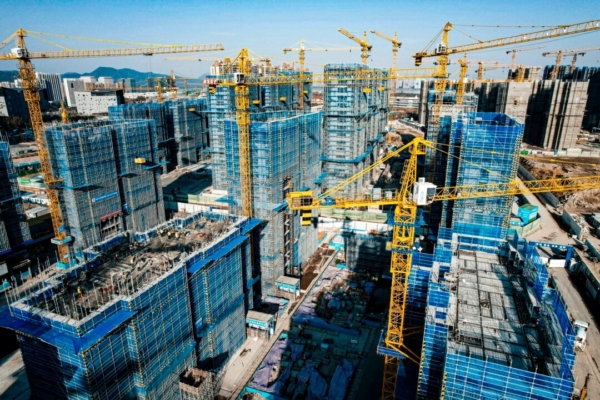
Facing the ongoing slump in China’s real estate industry, the Chinese authorities introduced a financing “whitelist” earlier this year. Official data from the Chinese Communist Party (CCP) shows that nearly 1.4 trillion yuan of financing has been approved for projects on the whitelist. However, recent semi-annual reports released by real estate companies indicate that the majority of them are still operating at a loss.
On August 21, the China Banking and Insurance Regulatory Commission released the latest statistics, revealing that 5392 real estate projects have been approved on the “whitelist” by commercial banks, with approved financing totaling nearly 1.4 trillion yuan.
Liao Yuanyuan, Director of Statistics and Risk Monitoring at the regulatory commission, stated that the urban real estate financing coordination mechanism, focusing on cities and specific projects, has supported the timely funding of approved “whitelist projects.” This mechanism has played a role in promoting project completion and delivery, safeguarding the legitimate rights of homebuyers, and stabilizing the real estate market.
Earlier this year, the CCP introduced the so-called “whitelist,” designating certain residential real estate development projects to receive special financing support.
However, the financial reports released by listed real estate companies in the first half of 2024 do not align with the CCP’s official claims. Regardless of whether they are listed on the A-share market or in Hong Kong, the majority of mainland real estate companies are still reporting losses.
According to a report from “First Financial” on August 20, among A-share real estate firms that have released their semi-annual reports, 47 companies have reported losses. Some of the leading firms with significant losses include Vanke Group, Huaxia Happiness, China Jinmao, *ST Gold Science and Technology, SOHO China, Financial Street Holdings, Overseas Chinese Town A, China Communications Construction Real Estate, ST Dimah, Gree Real Estate, Beichen Real Estate, China Enterprises, and Joy City.
Vanke Group, the leading real estate firm, is expected to report a first-half loss of 7 to 9 billion yuan, representing a year-on-year profit decline of 171% to 191%, marking the first mid-year loss in over thirty years since Vanke went public.
Huaxia Happiness expects a net loss of 4.5 to 5 billion yuan for the first half of the year, significantly widening from last year’s 1.267 billion yuan loss. After deducting non-recurring gains and losses, the net profit loss is estimated to be between 5.9 to 6.4 billion yuan.
Similarly, the fundamental outlook for real estate firms listed on the Hong Kong stock market is also bleak, with many reporting losses.
On August 19, Sun Hung Kai Properties announced an expected first-half parent company loss of 2.2 to 2.4 billion yuan, reflecting an increase in losses compared to the 1.464 billion yuan loss in the first half of 2023, suggesting a trend of expanding losses in the first half of the year. On August 18, China Overseas Land & Investment stated that the company’s first-half loss is expected to range from 1.5 to 2 billion yuan, compared to a profit of 18.6 million yuan in the same period last year, reversing from profit to loss.
On August 16, Yuexi Ocean Group, which is currently undergoing overseas debt restructuring, reported a parent company loss of about 4.5 to 6 billion yuan in the first half of the year, a reduction from the 18.369 billion yuan loss in the same period last year. Several other real estate companies, including China Evergrande Group, Yuexi Group, and Country Garden Holdings, also announced half-year performance forecasts on the same day, all depicting losses in the billions.
According to a report from the real estate market research firm Uwind, since 2022, losses have become a common theme in the performance of Chinese real estate companies, and this trend has been deepening from 2023 to the present. “In recent years, the tightening policies on leveraging in the real estate industry have continued to have an effect, coupled with insufficient market confidence, decreasing purchasing power, and anticipated downturns, hindering the sales and offloading of real estate inventory, naturally affecting profitability.”