
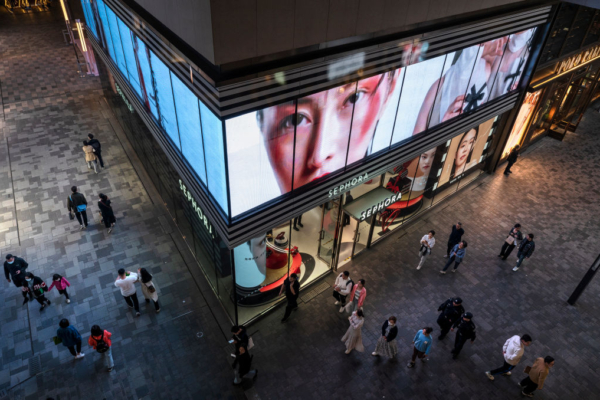
On Wednesday, August 21, global high-end beauty retailer Sephora announced layoffs of approximately 120 employees in China, mainly to streamline positions at its Chinese headquarters.
Sephora, a major source of revenue for French luxury conglomerate LVMH, is currently facing challenges in response to the slowdown in the Chinese beauty market.
With 4,000 employees in China, the announced layoffs on Wednesday accounted for less than 3% of the workforce. However, the layoffs themselves indicate that foreign retailers in the highly competitive Chinese beauty market are under pressure due to reduced purchasing by Chinese consumers and their price sensitivity.
In a statement, the company said, “To address the challenging market environment and ensure future growth in China, Sephora China is currently streamlining the organizational structure at its headquarters to ensure long-term sustainable growth.”
The affected employees will receive severance pay, compensation, and career support services, according to the statement.
Bloomberg was the first to report on this layoff news.
This marks another unfavorable development in the Chinese market for a brand under LVMH after LVMH and Dior announced revenue difficulties. It is worth noting that Sephora had maintained strong growth while most of the luxury industry experienced a slowdown.
According to the company’s disclosed data, driven by Sephora’s performance, LVMH’s selective retail division saw an 8% year-on-year increase in revenue in the first half of the year, despite stagnant sales of leather goods and clothing within the group and a decline in champagne sales.
However, Sephora’s growth mainly came from North America, the Middle East, and Europe, while facing challenges in the Chinese market.
Other foreign cosmetic retailers such as L’Oréal and Estée Lauder have also reported weak demand in the Chinese market, especially for higher-end products, impacting their business.
Estée Lauder issued its annual outlook on Monday, August 19, citing that revenue expectations will be lower than anticipated, primarily due to the impact of mainland China and Asian travel retail business.
Sephora entered the Chinese market in 2005 and currently operates 340 stores. However, for a brand focused on reputation and product uniqueness rather than low prices, competing with local brands and the prevalence of cheap products on platforms like Alibaba and Tmall has been a significant challenge.
Sephora stated that they remain committed to “serving customers across China and providing carefully curated, unique, and innovative high-end beauty experiences.”