
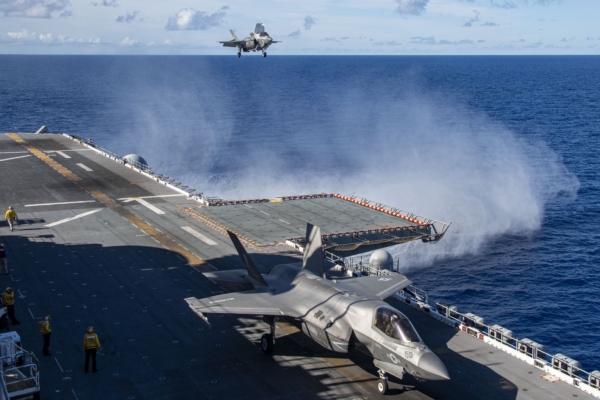
On June 20th, the Chinese Communist Party (CCP) military political work conference called for “continuously deepening political rectification.” The next day, the U.S. military announced that the Roosevelt aircraft carrier would be moved from the Western Pacific to the Middle East. On July 10th, the CCP Central Military Commission issued a decision to “deepen the promotion of military political rectification.” Meanwhile, the Reagan aircraft carrier of the U.S. Navy entered the Eastern Pacific. While the CCP was busy with political rectification, the U.S. aircraft carriers strategically shifted.
In normal circumstances, the U.S. military usually has at least one aircraft carrier cruising in the Western Pacific. Along with the Reagan aircraft carrier stationed in Japan, there are often two aircraft carriers jointly carrying out missions in the Western Pacific, primarily targeting potential CCP movements in the Taiwan Strait and also considering deterrence against North Korea.
On January 31st, the Roosevelt aircraft carrier was deployed to the Western Pacific, and the Carl Vinson aircraft carrier, which had been deployed for 4 months, returned early. Four days before Tsai Ing-wen assumed the presidency on May 16th, the U.S. Reagan aircraft carrier left Japan to begin its 2024 patrol, with one in the south and the other in the north, controlling both ends of Taiwan’s waters.
After Tsai’s smooth inauguration on May 20th, the CCP conducted military exercises around the Taiwan Strait on May 22nd to 23rd. The U.S. military realized the CCP’s show of force, and the two aircraft carriers began to move away from Taiwan, each carrying out its respective tasks.
From June 17th to 19th, the CCP held a military political work conference in Yan’an, Shaanxi, where Xi Jinping stressed the need to “continuously deepen political rectification” and ensure that the control of weapons remained in the hands of “loyal and reliable” individuals.
With the CCP military preoccupied with internal purges, it is unlikely to have the capacity to engage in warfare in the Taiwan Strait at this time. The CCP military’s ongoing political actions confirmed the internal turmoil, suggesting that many more officers might be removed, causing anxiety within the military ranks, making a war scenario less likely.
This situation is good news for the U.S. military as the risk of conflict diminishes, allowing the U.S. military in the Western Pacific to lower its readiness level. After all, the daily operational cost of one aircraft carrier can average between $6 to $8 million; and after roughly six months of deployment, each carrier requires maintenance, incurring high costs.
The Pentagon’s decision to shift one aircraft carrier from the Western Pacific to the Middle East is reasonable; however, the bold move of having both carriers leave the Western Pacific seems significant.
The Taiwan Strait is a complex sea area, with strong northeasterly winds in the winter, and southwestern winds in the summer, accompanied by high waves and occasional typhoons. The CCP’s window for attacking Taiwan is limited. Around May 20th, the CCP only conducted political drills. The next possible risky period is believed to be around the U.S. presidential elections.
The U.S. military is well aware of the potential risks and has already made preparations. Currently, of the 11 U.S. aircraft carriers, one is undergoing mid-term maintenance, with five on each side of the Pacific and Atlantic Oceans. The Washington aircraft carrier has moved past South America into the Pacific; as a result, the Atlantic side now has four carriers, while the Pacific side has six.
The four aircraft carriers on the Atlantic side are the Ford (CVN 69), Truman (CVN 75), Bush (CVN 77), and Ford (CVN 78).
The six aircraft carriers on the Pacific side are the Nimitz (CVN 68), Carl Vinson (CVN 70), Roosevelt (CVN 71), Lincoln (CVN 72), Washington (CVN 73), and Reagan (CVN 76).
On the Atlantic side, the Ford and Truman carriers have recently been deployed to the Mediterranean and Middle East, and are unlikely to be redeployed this year. The Truman and Bush carriers are not yet ready for immediate action, thus prompting the Pentagon to move the Roosevelt carrier from the Western Pacific to the Middle East.
When the Truman carrier is ready, it can come to replace from the Atlantic side; the Roosevelt carrier might return to the U.S. via the South China Sea and the Pacific, or extend its deployment in the South China Sea if signs of CCP activity are detected.
The Carl Vinson carrier of the U.S. is currently participating in the Rim of the Pacific multi-country military exercise in Hawaii, and may be deployed to the Western Pacific subsequently. Moreover, the Nimitz, Lincoln, and Washington carriers are stationed on the U.S. West Coast, the Reagan carrier has entered the Eastern Pacific and can return to the Western Pacific at any time. Currently, the U.S. should be able to deploy five aircraft carriers simultaneously in the Western Pacific; in case the Roosevelt returns from the Middle East to the South China Sea, the U.S. may have up to six aircraft carriers under extreme circumstances.
With the U.S. presidential election nearing, the U.S. military is prepared to address potential risks in the Taiwan Strait during this period. Anticipating further provocations, the U.S. military is expected to remain vigilant against the CCP.
As two U.S. aircraft carriers depart the Western Pacific, the CCP’s Shandong aircraft carrier immediately took the opportunity to sail out. In the early hours of July 9th, the Shandong traversed the Bashi Channel near the Philippines, entered the Pacific from the South China Sea, and returned on July 19th.
Taking advantage of the U.S. aircraft carriers’ absence, the Shandong quickly set sail, initially accompanied by one Type 055, one Type 052D destroyer, and one Type 054A frigate, with a relatively thin escort; a replenishment ship and two more destroyers later joined, likely as hasty deployments, with the replenishment ship’s maximum speed of 25 knots causing a delay in the voyage.
Such exercises still lack practical value for combat. If the CCP were truly prepared for war in the Taiwan Strait, the Shandong and a few escort warships would reach the Pacific first; however, once the conflict begins, subsequent supply ships and destroyers may struggle to pass through the Bashi or Bering Strait. Perhaps without even requiring an attack, the Shandong, lacking fuel, would incapacitate itself; with surrender being the only option to avoid sinking.
Although the U.S. aircraft carrier fleet has temporarily vacated the Western Pacific, the Carl Vinson aircraft carrier is in Hawaii and could swiftly arrive in the Philippines Sea in case of an emergency. Accompanying the Carl Vinson in the Rim of the Pacific exercise are one Ticonderoga-class cruiser and six Burke-class destroyers, presenting a backup for the U.S. military.
U.S. F-22 fighters are participating in the “Pitch Black 2024” multinational air combat exercise in Australia; the F-22 and F-35 fighters can quickly move from bases in Alaska to Japan, Guam, and other locations; the B-52, B-1B, and B-2 bombers can also reach the Western Pacific within 24 hours, leaving no window of opportunity for the CCP.
As the Shandong set sail, the CCP’s air force conducted large-scale exercises near the Taiwan Strait, simulating coordinated drills. Taiwan’s military announced that from early July 9th to early July 10th, they detected 35 instances of CCP aircraft (with 26 crossing the median line and entering the southwest and southeast airspace) and 8 CCP warships engaged in activities around the Taiwan area; on the morning of July 10th, the CCP dispatched a total of 37 aircraft including J-16, H-6, KJ-500, and drones, with 36 of them crossing the median line, reaching Taiwan’s southern and southeastern airspace heading towards the Western Pacific, in coordination with the Shandong conducting “air-sea joint training.”
From early July 10th to July 11th, the CCP deployed a total of 66 aircraft for drills around the Taiwan area (with 56 crossing the median line and entering the airspace over the north, southwest, and southeast), and 7 warships. According to Taiwan’s military’s flight path map, the CCP aircraft disturbing the northern airspace were about 72 sea miles from Keelung; those disturbing the southwest and southeast airspace were approximately 91, 58, and 33 sea miles from Eluanbi. The Taiwan Air Force has released footage targeting J-16 fighters and monitoring H-6 bombers. The CCP military has been persistently conducting such drills in the following days.
Taking advantage of the absence of the U.S. aircraft carriers, the CCP attempted to provoke tensions in the Taiwan Strait, while also executing other maneuvers.
The CCP fleet again passed through narrow straits between Japanese islands; CCP destroyers even ventured into the Bering Sea, and into the exclusive economic zone near the Aleutian Islands of the United States.
From July 15th to 17th, China and Russia conducted joint naval exercises in the South China Sea.
From July 8th to 19th, the CCP and Belarusian armies conducted joint training very close to the borders of Belarus and Poland, just a few kilometers from the NATO border. Amid the ongoing conflict between Russia and Ukraine, this move by the CCP appeared to be a provocation against NATO, especially during the NATO summit, raising concerns externally about whether the CCP military is preparing to join the Russia-Ukraine battlefield.
The NATO summit declaration strongly targeted the CCP, intensifying cooperation between NATO and U.S. allies in the Indo-Pacific region, with British, German, and French aircraft frequently participating in exercises in the Indo-Pacific area. As the CCP fumbles in its strategy, it finds itself in a new strategic dilemma.
In June, the Italian aircraft carrier Cavour began a 5-month deployment in the Indo-Pacific region, appearing in the South China Sea on July 8th to conduct joint exercises with U.S. warships. Meanwhile, the Shandong aircraft carrier was leaving the South China Sea for the Pacific. The Italian carrier carries F-35B fighters, making it a formidable force against the CCP’s J-15 carrier-based fighters.
The Japanese Defense White Paper for 2024 revealed a sharp decline in CCP Rocket Forces’ DF-21 missiles, with increases in DF-26 and DF-17 missiles unlikely to compensate for the gap. This indicates that the CCP’s conventional medium-range missile arsenal is insufficient, suggesting that they may lack the ability to initiate war in the Taiwan Strait in the near future.
With the CCP engaging in extensive political rectification, internal power struggles among CCP top leaders following the Third Plenum in Beidaihe may be ongoing, leaving little room for Taiwan-directed military actions. Continuous flooding in various regions of China has kept CCP soldiers occupied with staged rescue operations, making significant mobilizations practically difficult. This presents the U.S. military with a valid reason to adjust their readiness levels, prompting the strategic shift of aircraft carriers, while the CCP continues its facade of strength to conceal its actual weaknesses.