
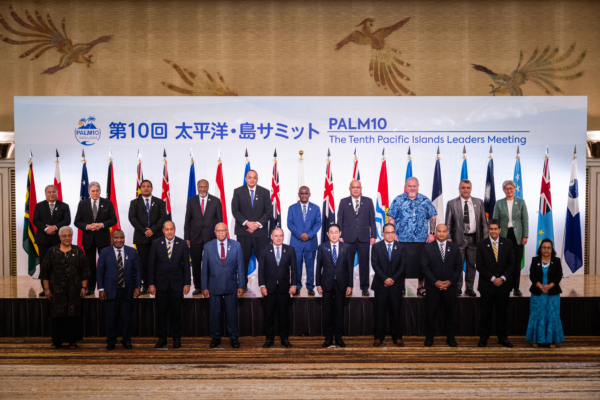
On July 16th to 18th, Japan and Pacific Island nations held a three-day “10th Pacific Islands Leaders Meeting” (PALM10) in Tokyo. Japanese Prime Minister Fumio Kishida and leaders from the 18 member countries of the Pacific Islands Forum (PIF) attended the summit.
During the summit, leaders agreed to enhance cooperation on security, trade, and climate issues. Kishida stated in a press conference after the summit, “Our collective efforts to uphold and strengthen a free, open, and rule-based international order are becoming increasingly important.”
In line with Kishida’s perspective, the leaders jointly issued a 36-point statement emphasizing values of freedom, democracy, and the importance of maintaining a “rule-based order that is free and open” in the face of the “increasingly complex geopolitical environment” today.
The leaders expressed strong opposition to attempts to unilaterally change the status quo through threats or force. While the statement did not directly name any country, both Japan, the United States, and Australia used such language to express concerns about China’s growing influence in the region.
According to the released PALM Action Plan, countries will “strengthen defense exchanges” through visits to Japanese Self-Defense Force vessels and aircraft, as well as enhance cooperation between the Japan Coast Guard and local maritime authorities. The statement highlighted that such visits should be by request only, respecting the sovereignty of each country.
The PALM Action Plan outlines cooperation in areas such as climate change, economic development and trade, technology, maritime conservation, and security.
Some leaders expressed concerns about China. Palau President Surangel Whipps Jr. told Nikkei News on Tuesday that after a Palau tourism delegation was recently denied entry into Macau and a series of suspicious cyberattacks, pressure from the Chinese government has reached a “new high.” He stated that Palau, which maintains diplomatic relations with Taiwan, is working to reduce reliance on mainland Chinese tourists.
Leaders also agreed to expand cooperation in trade, investment, tourism, and other areas, with Japan pledging to support cybersecurity construction in the region. Kishida reiterated that Japan’s participation would align with the “Blue Pacific Continent 2050” strategy approved by Pacific region leaders, which provides guidance on priority cooperation areas.
Whipps pointed out that Huawei’s dominant position in Palau’s communication networks is a “significant issue” in terms of cybersecurity. He mentioned, “Our cellular network is Huawei, and we will work to address all these issues within the next year.”
He added, “Our telecom sites are undergoing significant upgrades to help us prepare.”
The Pacific is a crucial area of shared concern for all parties. Japan imports energy through the Pacific maritime route, with nearly 45% of tuna and bonito coming from the exclusive economic zones of Pacific Island countries.
Although the territorial area of Pacific Island nations is small, their exclusive economic zones extend up to 200 nautical miles (about 370 kilometers) into the sea, presenting challenges for monitoring illegal fishing and transnational crime activities.
Since 1997, the Pacific Island Leaders Meeting has been held every three years, with its strategic significance increasing since 2018. Japan’s attention has expanded from traditional trade and aid concerns to deeper security cooperation and focus on maritime security.