
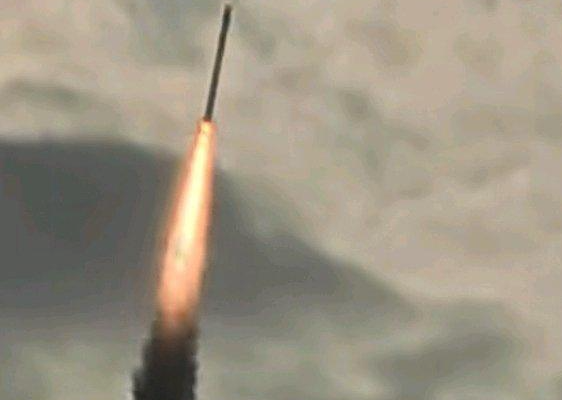
China has once again reported a failed rocket launch. On Thursday morning, the private commercial aerospace company, Interstellar Glory, experienced a failed launch of its “Hyperbola-8” carrier rocket, carrying three Yunyao-1 meteorological satellites, with the specific reason for the failure yet to be disclosed.
At 7:40 on July 11th, the “Hyperbola-8” carrier rocket carrying the three meteorological satellites took off from the Jiuquan Satellite Launch Center’s 95A launch pad, but encountered abnormal flight and ultimately declared the launch a failure.
This was the first launch of the “Hyperbola-8” rocket in 2024, which was originally intended to place the satellites into a sun-synchronous orbit. Prior to this, the “Hyperbola-8” rocket had undergone seven launches, with this being the fourth failure.
The “Hyperbola-8” rocket, developed by Beijing Interstellar Glory Technology Co., Ltd., is a commercial carrier rocket featuring a four-stage serial configuration with three solid and one liquid propulsion system. It is launched using a vertical hot launch method, measuring approximately 24 meters in length, with an average diameter of 1.4 meters and a mass of about 42 tons. It generates a liftoff thrust of 770KN and is capable of launching payloads such as satellites to sun-synchronous orbits at distances of 500 kilometers or 700 kilometers from the ground.
This is the latest case of a failed launch of a privately-owned Chinese rocket.
Earlier on June 30th, the private aerospace company, Space Pioneer, conducted a static test of the propulsion system of their new “Sky Dragon-3” carrier rocket. During the analysis of the thruster, the rocket was supposed to remain on the launch pad but unexpectedly lifted off and exploded.
The rocket’s debris eventually fell in the mountains in Gongyi City, Henan Province. Residents living 500 meters away reported that after the incident, all the glass in nearby villages was shattered.
—
This incident marks another setback in China’s efforts to advance its space capabilities through privately-owned space companies. The failure of the Hyperbola-8 rocket launch adds to the challenges faced by the country in its endeavors to compete in the global space industry.
The occurrence of such failures highlights the inherent risks and complexities involved in the development and operation of space exploration technologies. These setbacks call for thorough investigations to determine the root causes of the failures, ensuring lessons are learned to prevent similar incidents in future missions.
While setbacks are inevitable in the pursuit of space exploration, it is crucial for China’s space industry to address any issues promptly and implement necessary improvements to enhance the reliability and success rate of their rocket launches. Only through continuous learning and adaptation can advancements be made in the field of space exploration.
As the world watches China’s progress in space exploration, the resilience and determination of the country’s space industry will be key in overcoming challenges and achieving success in the ambitious goals set for the future of space exploration.