
In today’s society, the role of weapons and military forces has been imbued with a deeper meaning than just slaughter. Powerful military might is often utilized for deterrence, maintaining world peace, and ensuring human security. Despite wars becoming more covert, they have never ceased. “Military Affairs” takes you to the forefront to uncover the details and truths of the struggle between good and evil.
People have become accustomed to hearing about the remarkable performances of attack drones on the battlefield. However, the news of a drone equipped with a six-barrel Gatling machine gun capable of firing 3,000 rounds of ammunition per minute still manages to catch many by surprise.
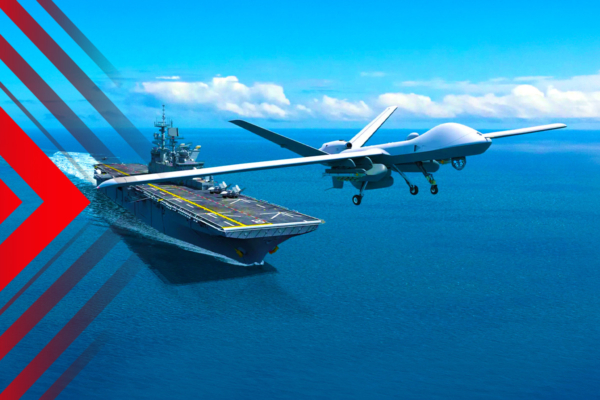
Recently, General Atomics conducted a live ammunition test at the Yuma Army Proving Ground in Arizona, featuring a Mojave short takeoff and landing attack drone equipped with a pair of Dillon Aero DAP-6 machine gun pods.
According to the company, each DAP-6 pod is equipped with an M134D-H minigun, using 7.62mm ammunition and M13 ammo belts, with a magazine capacity of 3,000 rounds and a firing rate of 3,000 rounds per minute. The Mojave carries two pods, resulting in a combined firing rate of 6,000 rounds per minute. With just one minute of firing time, it can empty its magazines. The ammo load of the machine gun pods can be adjusted according to mission requirements to reduce ammo load and increase flight distance.
During the exercise, the Mojave successfully destroyed all designated targets. In videos released by General Atomics Aeronautical Systems Inc. (GA-ASI), the Mojave conducted seven shooting actions against multiple ground targets, firing a total of 10,000 rounds, averaging about 1,428 rounds per shot. During the test, a Chevrolet pickup truck was instantly reduced to debris. While the bullets fired from the minigun do not explode, the truck experienced an explosion, possibly due to fuel residue igniting.
C. Mark Brinkley, Senior Director at General Atomics Aeronautical Systems, stated that the Mojave’s first minigun demonstration showcased the abilities of the engineering and flight control team, with technical support from Dillon Aero. The successful operation of the machine gun requires hardware and software upgrades and extensive ground testing to ensure the guns fixed on the wings can accurately target. A calibration target placed on the ground was a wall approximately four feet high and eight feet wide. Once the flight control team mastered the shooting accuracy of each gun, they could effectively strike any ground fixed target from the air.
General Atomics Aeronautical Systems plans to further enhance this project with new features, including equipping sensor pods for aerial target acquisition, enabling the minigun to target enemy aircraft, thereby extending combat capabilities and flexibility. Building upon this, the company is also developing a hybrid of the Mojave and MQ-1C Gray Eagle drones as a new armed reconnaissance drone platform, seeking opportunities to market it to the US Army.
The idea of integrating aircraft with weapon pods is not entirely new. During the Cold War, the former Soviet Union designed and deployed many similar gun pod systems, but all were on manned aircraft. However, mounting weapon pods on drones might be a first. Nevertheless, the Mojave’s successful deployment of the machine gun pods, firing ammunition and hitting targets accurately, marks a significant achievement. Vibrations and recoil during the test did not cause flight or aiming issues.
Integrating weapon systems like machine guns onto drones poses challenges similar to adding missiles to drones. It is not yet clear how operators remotely control the Mojave drone to use the gun pods. Targeting and firing on ground targets with weapon pods on drones, especially using 7.62mm machine guns, require operators to hit targets directly through real-time optical sights transmitted wirelessly, particularly in dynamic environments where both the drone and ground targets are in motion. This is entirely different from guided weapons that target and lock onto objects through sensors. However, it is not impossible that in the future, with the assistance of artificial intelligence, the gun targeting and firing process could be completed autonomously, with operators serving as decision-makers on the drone platform. But this remains a possibility for the future.
Compared to gun pods, various guided weapons seem easier to integrate with drones. Before carrying the DAP-6 pods, the Mojave could already mount guided weapons. The drone was unveiled to the public in 2021 and made its maiden flight the same year, with three weapon hardpoints under each wing capable of mounting AGM-114 Hellfire missiles and AGM-179 Joint Air-to-Ground Missiles (JAGM). Since its debut, General Atomics Aeronautical Systems has been promoting the drone’s various capabilities, including its ability to carry up to 16 Hellfire missiles at once.
Among various guided weapons, laser-guided bombs have always been the preferred choice for ground attack weapons. However, this does not mean that the option of gun pods is unnecessary for future drone mission platforms, including armed reconnaissance drones.
The Mojave drone equipped with gun pods has spurred discussions on the future development of drones. Unlike advanced small precision-guided munitions designed to reduce collateral damage risks, machine guns and cannons excel at concentrating firepower on smaller targets or clusters of targets. The Mojave armed with machine guns can shift shooting focus more quickly from one target area to another. This capability may prove particularly valuable for close air support in densely populated urban areas or situations where friendly forces are in close proximity to enemy positions. Cannons also provide a form of wide-area suppressive fire when engaging larger targets.
In addition to the weapon options, the early MQ-1C-derived Mojave is well-suited for operations in remote or austere locations with limited logistical support, such as unpaved runways.
General Atomics Aeronautical Systems is also exploring the potential of using short takeoff and landing drones like the Mojave and Gray Eagle as small aerial transportation platforms. They can carry cargo in the form of wing pods, allowing these drones to not only deploy various sizes and capabilities of precision-guided munitions but also conduct logistical resupply in contested areas, effortlessly transporting and delivering 1,000-pound cargo within a range of 500 kilometers. The US military believes that a diverse distributed transportation chain is becoming increasingly critical to support future operations in contested environments, especially in the Pacific region confronting potential high-end conflicts with the Chinese Communist Party.
The Mojave has also demonstrated impressive short takeoff and landing capabilities on land and at sea. In a series of experimental flight tests conducted last year, the Mojave performed multiple takeoff and landing flights on the deck of the HMS Prince of Wales aircraft carrier in Wales.
Through the live ammunition demonstration of the Mojave drone, General Atomics emphasized the integrated design and versatility of unmanned aerial systems. The Mojave not only has the capability to act as a sensor, shooter, and aerial transport platform but also helps mitigate collateral damage on the battlefield, protecting innocent lives.
Of course, the Mojave and Gray Eagle are subsonic aircraft without stealth capabilities, leading to significant concerns about their survivability and practicality, especially in high-end battlefield environments filled with comprehensive air defense fires and other threats. Additionally, they often need to fly at low elevations and closer to targets to effectively utilize the gun, increasing the aircraft’s risk. Designers are continuously developing new features, including installing expendable countermeasure pods and warning pods to help enhance the drones’ battlefield survivability.
Monitoring the continued development of the Mojave and Gray Eagle will be fascinating. The Mojave has demonstrated its capability to engage ground targets with machine guns, naturally evoking thoughts of the A-10 Warthog. In fact, the most typical example of integrating machine guns with aircraft is the A-10, which is almost the most successful classic example of a ground attack aircraft. The A-10’s 30mm 7-barrel Gatling gun pioneered the modern close air support combat mode. Even today, in the absence of appropriate successors to the aging A-10 aircraft, the Pentagon has not found a replacement that adequately embodies the A-10’s battlefield functions.
General Atomics Aeronautical Systems may have pioneered a new path for using drones to replace the A-10 Warthog for close air support. While the Mojave drone currently carries machine guns that can only fire 7.62mm bullets, which don’t have the killing power of the 30mm Gatling gun, it shows immense development potential. Currently, General Atomics Aeronautical Systems is still focusing on enhancing the accuracy and effectiveness of the attack drone, but with a little imagination, the possibility of drones carrying more lethal weapons in the future isn’t difficult to imagine.