
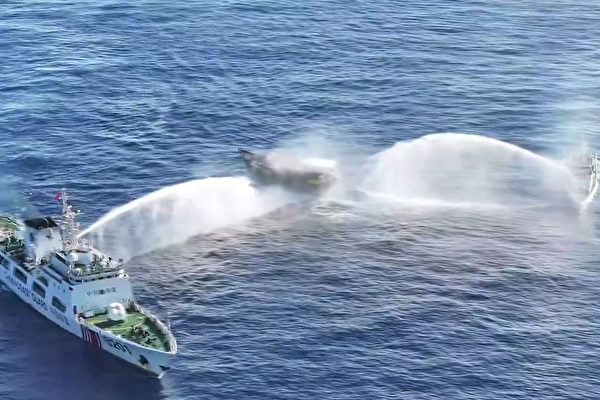
The Chief of the Philippine Armed Forces stated on Wednesday (June 19th) that the behavior of Chinese coast guard personnel on the 17th in the South China Sea constituted “pirate behavior,” and Beijing should compensate the Philippines for its losses.
The Philippine military released several videos of the conflict that occurred on the 17th on social media platforms such as X and Facebook.
The Philippines accused Chinese soldiers of boarding Philippine government vessels, brandishing axes and knives to puncture Philippine navy ships and seizing dismantled rifles.
On the 17th, during a humanitarian relief mission on the BRP Sierra Madre stationed at the Ren’ai Reef, Chinese coast guard personnel were caught on video “threatening to harm Philippine soldiers with an axe.”
Involved in the Philippine military’s relief mission were two rigid-hulled inflatable boats (RHIBs) and a civilian ship contracted by the military.
According to videos released by the Philippine government, the Chinese interfered with the Philippine relief mission, deploying at least eight ships to carry out harassing tasks.
The Philippine government stated that Chinese vessels repeatedly rammed and attempted to block the two Philippine RHIBs, ultimately trapping them near the Ren’ai Reef. The contracted civilian supply ship did not approach the shallows.
In 1999, to assert its sovereignty claim, the Philippines deliberately grounded the BRP Sierra Madre on the Ren’ai Reef, where a monitoring post was established.
In recent months, whenever Philippine ships attempted to provide supplies to stationed navy personnel, they would encounter harassment from Chinese ships.
In the video, amid alarm sounds, Chinese coast guard personnel were seen forcibly dragging away a Philippine military inflatable boat, “threatening to injure a Philippine soldier with an axe at the same time.”
The Philippine Armed Forces claimed that Chinese coast guard personnel “attacked a soldier on the rubber boat,” while “violently ramming the inflatable boats, brandishing weapons with sharpened blades and points… and firing tear gas.” At the same time, “Philippine Armed Forces personnel were providing first aid to an injured navy sailor.”
The Philippine Armed Forces stated that Chinese coast guard surrounded the moored Philippine inflatable boats and then “threw stones and other objects at our personnel”… and “slashed the rubber boats, rendering them inoperable.”
Subsequently, Chinese coast guard crew continued to harass by “using physical attacks, wielding weapons with sharp blades… and dazzling strobe lights.”
According to the Philippine Armed Forces, a Philippine naval inflatable boat was “forcibly surrounded, dragged, and eventually hauled away from the BRP Sierra Madre, intending to isolate it from other Philippine forces.”
The Philippines accused China’s actions of piracy, stating they “robbed supplies, stole equipment, and ultimately destroyed the ships, rendering them immobile.”
One Filipino soldier, Petty Officer Jefferson Facundo, lost his right thumb underwater during collisions between the Chinese steel-hull ship and the Philippine inflatable boats. Facundo was reportedly holding onto the edge of the inflatable boat when it was caught between Chinese vessels.
According to Philippine officials, the Philippine inflatable boats were surrounded and blocked by various Chinese ships, with Chinese coast guard members subsequently boarding the vessel belonging to the Philippine Navy Special Operations Command. Chinese forces confiscated Philippine Navy equipment, including dismantled rifles meant to replenish soldiers on the BRP Sierra Madre.
The Philippines and its allies condemned the Chinese ships’ “ramming and towing” of Philippine supply ships as “dangerous behavior.” The Philippines claimed this was the first time Chinese forces boarded a Philippine government ship in a hostile action and openly waved machetes and knives at sea.
“We do not have weapons or edged weapons… We have video evidence showing Chinese personnel even pointing knives at our personnel as a threat,” said General Romero Brawner, head of the Philippine Armed Forces.
“Nevertheless, our soldiers fought bare-handed. You will see in the video that they tried to push back the enemy… push back the Chinese coast guard forces. They prevented (Chinese personnel) from attacking them with knives and axes,” Brawner said.
According to the Philippines, military personnel are not allowed to carry firearms during supply missions to Ren’ai Reef, and large gray metal ships are not used. Only civilian ships are dispatched to carry out the tasks, with inflatable boats deployed on the 17th.
“I admire the Filipino soldiers because they showed restraint. Our objective is also to prevent war,” Brawner added.
On Wednesday, Brawner awarded a disability medal to injured soldier Facundo at the Western Command headquarters and held a secure teleconference with soldiers stationed at the outpost.
In response to the incident, a Chinese Foreign Ministry spokesperson on Wednesday once again blamed the Philippines, stating that the Philippines “ignoring China’s dissuasion and forcibly intruding into Ren’ai Reef of the Nansha Islands was the direct cause of the incident.”