
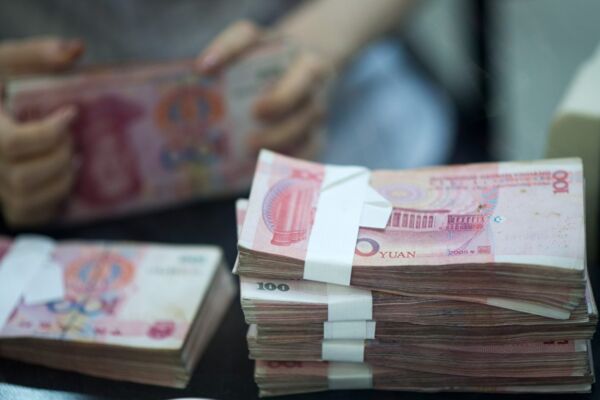
In the first quarter of this year, local governments in China issued bonds totaling about 3.1 trillion yuan (RMB), representing a growth of approximately 9.3% compared to the same period last year. Among them, around 1.7 trillion yuan were issued as refinancing bonds, primarily used for borrowing new money to repay old debts.
According to a report by “First Financial” on April 12, the public bond issuance data revealed that local governments nationwide issued approximately 3.1 trillion yuan in bonds in the first quarter of this year, marking a 9.3% increase compared to the same period last year.
Of this total, new bond issuances amounted to about 1.4 trillion yuan, a year-on-year increase of 14.6%; while refinancing bond issuances totaled around 1.7 trillion yuan, showing a 5.2% increase compared to the previous year. These funds are mainly used for repaying maturing bond principal, debt substitution, settling overdue corporate accounts, and through this process, relieving the current debt repayment pressure faced by local governments.
Wen Laicheng, a professor at the Central University of Finance and Economics, noted that the speed of local government refinancing bond issuances in the first quarter has slightly slowed down, but the absolute scale remains large. The funds are primarily used to substitute existing hidden debts. Currently, local governments are still under pressure to address accumulated hidden debts, including managing legacy PPP projects (public-private partnership projects) and resolving overdue corporate accounts, among other heavy tasks.
A research report by TF Securities pointed out that the average maturity of local government bond issuances in the first quarter of this year has slightly extended, with an average maturity period of 14.79 years, an increase of 0.31 years compared to 2025.
Earlier on March 9, the Chinese Ministry of Finance disclosed the issuance and outstanding debt balance of local government bonds, indicating that as of the end of January 2026, the total outstanding debt of local governments across the country stood at 55.6 trillion yuan.
According to Xinhua, the official news agency of the Chinese Communist Party, in January, local government bonds matured with principal repayments amounting to 109.1 billion yuan, of which 81.8 billion yuan was paid through the issuance of refinancing bonds and 27.3 billion yuan through fiscal funds; interest payments on local government bonds reached 105.4 billion yuan.
Previously, Chinese expert Wang He wrote on Epoch Times that since 2020, the financial strength of local governments in China has weakened, leading to a rapid increase in government debt levels. By 2022, the debt-to-GDP ratio soared to 332% (broad gauge, including explicit debt and local government financing platform debt). Regions with the highest debt ratios, such as Chongqing, Tianjin, Guizhou, Heilongjiang, Hubei, and Xinjiang, all exceed 600%.
Official data from the Chinese Communist Party shows that local government bond issuances exceeded 6 trillion yuan in 2020, surged to 7 trillion yuan in 2021, surpassed 9 trillion yuan in both 2023 and 2024, reaching around 9.8 trillion yuan in 2024, approaching 10 trillion yuan; and crossed the 10 trillion yuan mark in 2025.
In the first quarter of 2026, the issuance of local government bonds reached a staggering 3.1 trillion yuan. Data from corporate warning systems indicate that local governments have already disclosed plans to issue approximately 5.3 trillion yuan worth of local government bonds in the first half of this year.