
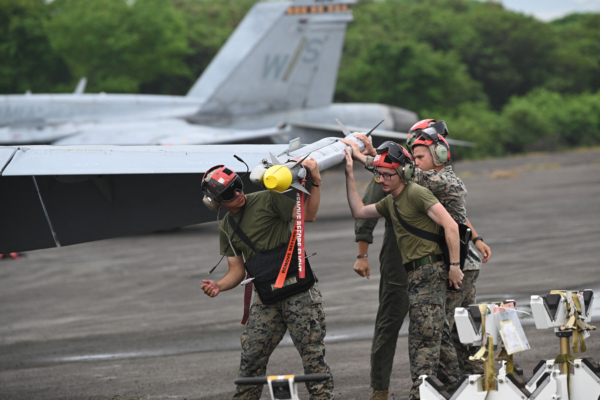
Amid escalating tensions caused by the Chinese Communist Party in the South China Sea, the United States, Australia, and the Philippines conducted a four-day “Multilateral Cooperative Action” (MCA) from April 9th to 12th in the South China Sea. This action marked the second joint maritime exercise in the region this year and the 16th exercise held in the West Philippine Sea since 2023.
The Philippine military stated on Monday (April 13) that this four-day exercise brought together ships, fighter jets, and reconnaissance aircraft from the three countries, enhancing their maritime defense capabilities through coordinated actions.
The Philippine Armed Forces emphasized in their statement that this exercise highlighted the “deepening defense cooperation among the three countries and their shared commitment to regional security.” The Philippines has signed the Visiting Forces Agreement (VFA) with the United States and the Visiting Forces Agreement (VFA) with Australia.
During the exercise, the Philippines deployed the Navy patrol ship BRP Rajah Sulayman, the Coast Guard patrol ship BRP Melchora Aquino, as well as several military aircraft including FA-50 fighter jets, A-29B Super Tucano attack aircraft, C-208B transport planes, and Sokol search and rescue helicopters.
The Australian Defence Force (ADF) sent the HMAS Toowoomba patrol ship with MH-60R helicopters and deployed a P-8A Poseidon maritime patrol aircraft, while the U.S. Indo-Pacific Command dispatched the USS Ashland dock landing ship to participate.
The Philippine military highlighted in their statement that “the highlight of this exercise was the U.S. ship USS Ashland transporting heavy engineering equipment of the Naval Mobile Construction Battalion Four (including a loader, a crane, and two concrete mixers) from Manila Bay to the port of Princess Harbor on Palawan Island.” This demonstrated a substantial logistical joint operational exercise between the Philippine military and the U.S. Indo-Pacific Command.
Lieutenant Colonel Adam Peeples, the captain of the USS Ashland, stated, “We cherish the opportunity to conduct joint maritime operations with allies,” adding that “these exercises not only deepen our friendships, sharpen our skills, and enhance our joint operational capabilities but also showcase the resilience of our crew while deterring aggression and reinforcing our commitment to regional security.”
The U.S. military statement emphasized that the multilateral maritime cooperation actions were conducted in accordance with international law, respecting the navigational safety and freedom rights of all countries.
Furthermore, this exercise served as a prelude to the “Balikatan” annual large-scale joint military exercise scheduled for April 20. It is noteworthy that this year’s “Balikatan” exercise will involve not only Australia but also Japan, which will participate as a formal participating country for the first time rather than as an observer.
Aside from statements from the U.S. and Philippine military, the spokesman for the Southern Theater Command of the People’s Liberation Army of China, Zhai Shichen, issued a statement on April 13, asserting that China will defend its territorial and maritime sovereignty and criticizing the joint patrols by the Philippines and foreign countries as “disrupting stability in the South China Sea region.”
In reality, China repeatedly claims sovereignty over nearly the entire South China Sea (including much of the West Philippine Sea), prompting the Philippines to file an international arbitration case. The international tribunal ruled in 2016 that China’s claims had “no legal basis” and were in violation of the United Nations Convention on the Law of the Sea.
However, China continues to take unilateral actions in the region, provoking Philippine vessels in dangerous ways, such as firing flares at Philippine Coast Guard patrol ships or deliberately ramming ships, in an attempt to force concessions from the Philippines.