
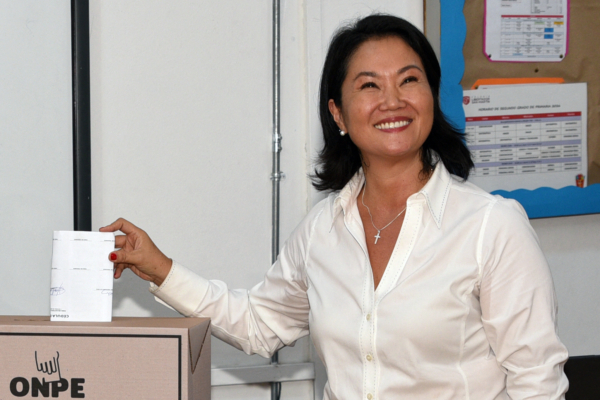
On Sunday, April 12, Peruvian citizens headed to the polls to elect a new president and members of parliament. According to the latest polls, Keiko Fujimori, the daughter of a former Peruvian president and a conservative presidential candidate, is leading in the first round of voting among over 30 candidates and is likely to advance to the runoff.
Early exit polls conducted by the local polling agency Ipsos Peru showed that the conservative candidate Keiko Fujimori, a former member of parliament, leads with 16.6% of the vote, followed closely by left-wing candidate Roberto Sanchez with 12.1%.
Another polling agency, Datum Internacional, also indicated that Keiko Fujimori is in the lead with 16.5% of the vote, while another conservative candidate, Rafael Lopez Aliaga, ranks second with 12.8%.
As there is no clear frontrunner in the Peruvian presidential election and all major candidates have vote shares well below the 50% threshold required for a direct victory, it is likely that a runoff election will be held on June 7.
Furthermore, on the morning of the election day, some areas, including the capital Lima, reported delays in opening polling stations due to late setup of voting tables and absentee election officials assigned to assist voters.
The chaos forced authorities to extend the voting time for approximately 27 million eligible voters by one hour until 6 p.m. (GMT 23:00). Roberto Burneo, the chairman of the National Elections Jury of Peru (JNE), stated that legal action will be taken against the company responsible for distributing voting materials.
Margarita Sandoval, a 35-year-old voter, expressed frustration as she waited in line for two hours in the Chorrillos district in the southern part of the capital and still could not enter the polling station. She said, “I have to work, but now I can’t vote. This election is a disaster.”
Since 2018, Peru has seen frequent changes in its presidency, with 8 presidents being replaced due to impeachment, corruption scandals, and weak ruling coalitions. However, this frequent turnover has led to decision-making paralysis in the country.
Martin Cassinelli from the Atlantic Council pointed out that the public is fed up with the current parliament and believes that it must be held accountable for the political chaos of the past decade.
The lack of trust in politics, along with the impact of drug trafficking, illegal mining, and a large number of illegal immigrants, has led to a rise in violent crimes such as murders and extortion, making “public security” a key issue in this election. As a result, there are 35 diverse candidates running, including seasoned politicians, right-wing businessmen, and a television comedian.
Keiko Fujimori is the most prominent candidate in this election, running for president for the fourth time. She has successfully reached the runoff in the previous three elections. Educated in the United States, she currently leads the largest party in parliament, the Popular Force Party.
Her campaign platform, which includes a pledge to combat violent crime, expel illegal immigrants, and strengthen order and stability, has attracted a significant number of voters.
During an exclusive interview with AFP on April 10, Keiko Fujimori promised to “combat crime and restore order” within the first 100 days if elected. She also stated her intention to attract more American investments to protect Peru’s economy and build closer ties with neighboring countries like the United States, Argentina, Chile, Ecuador, and Bolivia, continuing the current conservative wave in South America.
On the left-wing side, Ricardo Belmont, a former mayor of Lima representing the “Citizen Action Party,” has seen an increase in polling numbers and support. Additionally, well-known comedian Carlos Alvarez, who focuses on combating crime, has gained recognition in the polls.
In the right-wing camp, Rafael Lopez Aliaga, a conservative businessman and former mayor of Lima, has taken a more conservative stance in his campaign. Despite fluctuating support, he remains among the frontrunners.
This election not only affects Peru’s domestic affairs but also has significant geopolitical implications. In recent years, China has become Peru’s largest trading partner through measures such as large-scale copper mining procurement and infrastructure investments.
However, China’s presence has brought negative consequences to the region, including air pollution, deterioration of rivers, severe damage to agricultural and pastoral lands, rising unemployment rates, and disputes over land rights.
Some believe that if the newly elected president chooses to align with U.S. policies, it could potentially change the current economic and trade landscape, significantly weakening China’s influence and control in Latin America.
The U.S. government has increased its diplomatic and security negotiations with Peru ahead of the election and closely monitored the final outcome of this election.
(Reference: Reuters)