
The voice dubbing industry in mainland China is currently facing a crisis of AI “voice theft,” leading to well-known voice actors losing job opportunities and being financially impacted. Legal actions have been taken by some, but till now, they have not been successful due to difficulties in evidence collection and loopholes that make it challenging to prosecute infringement acts.
AI “voice thieves” extract voice materials from movies, animations, and other works, then use AI technology to “clone” voices with a similarity of over 90%, sometimes combining voices of multiple actors to evade accountability.
Recently, renowned voice actor Bian Jiang publicly criticized the unauthorized use and AI synthesis of his voice for public dissemination, stating it severely violates his performance rights, voice rights, damages personal reputation, and causes economic losses.
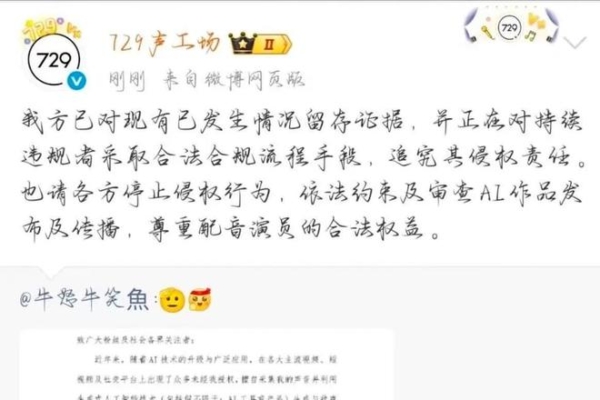
Facing the escalating voice infringement acts, the voice dubbing community has raised its voice. “Bian Jiang Studio,” “729 Voice Workshop,” along with prominent voice actors like Ji Guanlin (dubbing for “Empresses in the Palace”), Lu Yanting (dubbing for “Nezha”), Xia Lei, and Ma Zhengyang, among others, have collectively released a statement demanding official attention to AI voice infringement, advocating for the “Three Prohibitions.”
The “Three Prohibitions” include: prohibiting collection, commercial use, and profit derivation of these voices.
According to reports by Jiupai News and other mainland media, Zhang Jiaming, a well-known voice actor dubbing the role of “Taiyi Zhenren” in the popular Chinese film “Nezha 2,” discovered that his voice, especially that of “Taiyi Zhenren,” has been extensively copied by AI since the end of 2025, with 700 infringement cases found in just one day.
Zhang Jiaming pointed out that this AI voice infringement has directly impacted his income, with some cooperating clients indicating they would no longer work with him since there are numerous similar or even free AI voices available. As a result, three contracts were canceled.
Zhang Jiaming hired a lawyer to gather evidence, which took a month to identify one infringing account. However, before filing a lawsuit, he found out the involved person was a 13-year-old minor, putting him in a dilemma.
Expressing regret, Zhang Jiaming stated that so far, none of his protection measures have been successful. Many infringers have a weak legal consciousness or are individuals seeking to profit from generating traffic. Even if the compensation amount after winning a lawsuit is small and the other party may not be able to pay, the court’s judgment is difficult to enforce, making the cost of protection disproportionate to the infringement.
Another voice actor, Xiao Mu, has also been significantly affected. He found out that some infringers cunningly merge voices of multiple actors onto the same character, making it difficult to distinguish. Moreover, some exploit loopholes in platforms, resurfacing under a new account after being reported and taken down.
Xiao Mu highlighted that certain short video platforms charge users for content featuring these pirated AI voices, indirectly profiting from voice actors’ work without their consent.
At the end of 2025, Anhui voice actor Mi Zi recorded two lines for a New Year’s advertisement at a Beijing KTV chain. However, when the ad was released, her original lines were edited into three, with the additional line generated using AI cloning her voice. This altered ad was then circulated across over a hundred stores nationwide and various online platforms.
In her pursuit of justice, Mi Zi made numerous complaints via hotlines but faced difficulty in initiating legal proceedings due to the court’s refusal to recognize evidence and the missed opportunity for supplementary evidence submission.
Hunan voice actor Chang Xibo discovered his voice had been cloned but found no dedicated complaint option when attempting to report to the platform.
Veteran Chinese voice actor Zhang Xiaomai expressed concerns about the future of the dubbing industry. He mentioned that AI technology has severely squeezed the survival space of voice actors, leading to a sudden decrease in job orders for many practitioners and forcing some to switch to alternative professions like food delivery or real estate.
Zhang Xiaomai believes that AI-generated voices lack soul. He mentioned, “What hasn’t been replaced by AI yet is the vitality and breath in our voices, as well as some real-life flavor.” However, for production companies pursuing low costs, AI’s imitation ability is sufficient. This makes it challenging for newcomers to compete with AI “replicas,” with high learning costs and uncertain prospects, putting the industry at risk of a talent shortage.
Zhao Zhanling, a research fellow at the Intellectual Property Center of China University of Political Science and Law, suggests that platforms should proactively prohibit users from unauthorized use of others’ voices. Voice actors can individually file records of their commercially valuable voices and voiceprints for future accountability in case of infringement.