
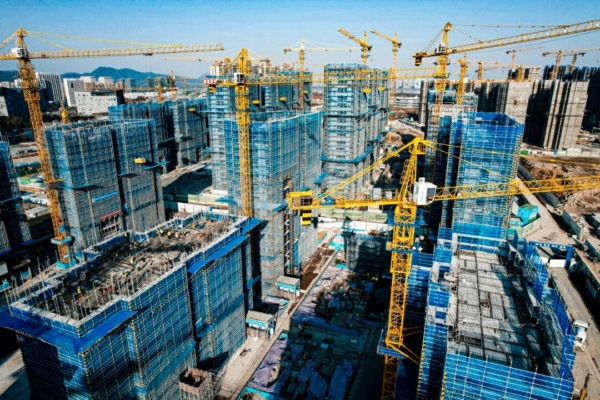
China’s economy continues to decline, impacting various industries, especially those related to the real estate market. Despite official media claiming a “small spring” in the real estate markets of Beijing, Shanghai, and Shenzhen in the first quarter, data shows ongoing sluggishness. Professionals in the real estate industry are facing a collective low point.
In early April, official Chinese media outlets such as China National Radio, Every Economic Net, and Jiemian News reported on signs of stabilization and warming in the Chinese real estate market, with “small spring” phenomena noted in Beijing, Shanghai, Guangzhou, and Shenzhen.
However, official media admitted that both field visits and market data indicate this year’s “small spring” is mostly in emphasis on the “small” aspect. The duration is short, with suppressed housing demand from Lunar New Year released in a concentrated manner in March, leading to a short-term surge in transaction volumes. Additionally, the increase in transaction volume is mainly related to the significant drop in housing prices in 2025, with many second-hand homes and old properties losing their cost-effectiveness over the past few years, thus the transaction volume is mainly driven by the second-hand housing market while the new housing market remains sluggish.
In early April, several Beijing second-hand housing agents told Chinese media that the “small spring” that lasted throughout March seems to be fading away. The previously anticipated peak season for home sales around April and May is essentially nonexistent.
Data released by the China Index Research Institute in early April 2026 showed that the real estate market has not emerged from the gloom: the average price of newly built residential properties in 100 cities nationwide was 17,115 yuan per square meter, up 0.05% month-on-month and 2.24% year-on-year. Among these cities, 23 saw price increases while 72 experienced decreases. The average price of second-hand residential properties in 100 cities was 12,792 yuan per square meter, down 0.34% month-on-month and 8.55% year-on-year.
Key indicators for March in the top 100 cities include a 13% year-on-year decrease in transaction area for newly built residential properties and a cumulative year-on-year decrease of about 22% to around 45.67 million square meters in the first quarter. In the second-hand housing market, about 148,000 units were sold in March, a year-on-year decline of 2.5%, totaling around 333,000 units in the first quarter, a decrease of about 4%-6% year-on-year.
Many people around us are increasingly finding it challenging with work becoming more difficult, and news of company layoffs is rampant. The real estate industry and its upstream and downstream sectors are the hardest hit. The real estate sector has been thriving over the past decade, with countless individuals relying on this industry for survival, including developers, real estate agents, as well as decorators, building material suppliers, construction workers, and designers. However, the real estate industry is now firmly in a deep freeze, with market demand shrinking significantly, leading to major real estate companies falling into financial distress, continuously laying off employees, and even facing bankruptcy.
A senior manager, Lan Zhi (pseudonym), who had been selling new properties in the real estate sector for over a decade in Zhangjiagang, was recently laid off and is now without income. Having worked in the real estate industry for more than a decade, he is unsure of alternative career paths at the age of 40. He plans to start a personal media channel to discuss the real estate industry and help people navigate potential pitfalls.
Lan Zhi described the current situation in the industry, stating, “There used to be five real estate agencies downstairs, now there is only one left. The problem now is the lack of buyers, not the shortage of properties. With prices plummeting, fewer people are interested in buying houses.”
Originally working in new property marketing, Lan Zhi could also handle sales. He mentioned that it is now more challenging to work with second-hand properties in the real estate market. Most agents work on a commission basis without a fixed salary, and many struggle to secure deals for months or even years, making it unsustainable.
He reflected, “Previously, I could sell 20 to 30 units during a new project launch, with a steady monthly sales of 3 to 5 units, earning around 2,000 to 3,000 yuan per unit, plus commissions. Before I was laid off, I had a fixed salary of 7,500 yuan. At one point, I had 12 sales staff under me, but this year, the last two were also laid off. The entire project went unsold for two years.”
According to Lan Zhi, properties in rural areas are not moving, while urban areas are slightly better, although the competition is fierce. About 80% of industry workers are concentrated in urban areas, but the number of potential buyers remains limited.
He noted that large real estate enterprises have collapsed, signaling the end of the real estate cycle, with little possibility of further price increases. He emphasized, “Those who can afford to buy houses have already done so, and even with lower prices, rural populations without financial resources cannot make purchases.”
A real estate agent in Nanchang said, “It is impossible to continue in this industry now; we are essentially working for nothing.”
In recent years, the Chinese Communist regime has been emphasizing the so-called “economic bright outlook” while suppressing voices exposing the real economic situation. As the economic stagnation continues, state media began urging a “counterattack” against claims of China’s economic “collapse” last month.
However, observers note that many of the issues that need to be addressed by the Chinese Communist Party remain unresolved. For instance, in this year’s government work report released during the annual sessions, “stabilizing the property market” dropped from sixth place last year to tenth place this year, shifting from actively promoting market stabilization to focusing on stability instead.
China expert Wang He commented to media that the adjustment in the Chinese Communist Party’s property policy expressions implies an indirect acknowledgment of past policy failures without explicitly stating so. The CCP has lost hope in the real estate sector and given up, akin to “breaking a damaged pot.”
With the real estate sector mired in a prolonged downturn, Chinese economists have recently taken turns encouraging young people to buy houses under the banners of “stopping the decline” and “subsidized interest rates,” sparking public ridicule.
On March 25th, Chinese economist Jia Kang publicly suggested at the Zhongguancun Forum that young people should actively consider using their funds to purchase their “dream homes,” citing observed signs of a “bottoming out” in the real estate market. Tsinghua University professor Li Daokui also proposed “financial subsidies for young people to buy houses,” advocating for the government to significantly reduce bank loan interest rates from the current 4% to 1% to stimulate purchasing power.
This led to online mockery, with suggestions like “experts should lead by buying more properties,” quickly gaining over 1,700 likes on social media.
Professor Xie Tian from the Darla Moore School of Business at the University of South Carolina previously criticized that under such political directives, the conscience of experts has been replaced by policy propaganda, aimed at guiding the public to enter the market to fill fiscal gaps.