
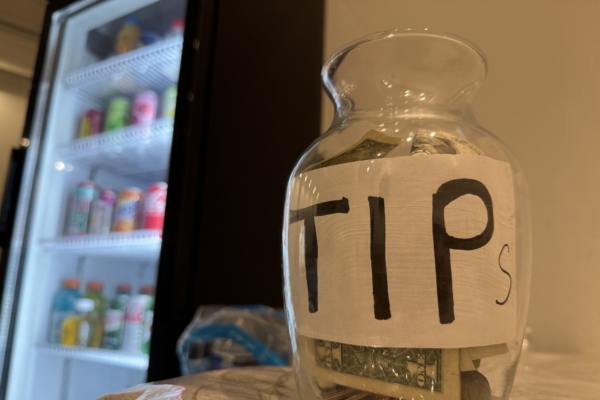
In the United States, while tipping is not strictly required by law, it has become a part of consumer culture. However, an increasing number of people feel that this culture of tipping has gotten out of hand. So, how exactly should tips be given? How much should be given? And what are the differences in tipping practices across different states?
Research from various financial institutions and service industry websites indicates that many people are experiencing fatigue with the current consumer culture and are becoming less willing to tip. This shift is beginning to impact those in the food service industry and other related professions who rely on tips to make a living.
According to a recent survey released by the dining technology company Popmenu on Wednesday, April 8th, nearly 80% of consumers believe that current tipping customs are “excessive,” with 44% of respondents stating that they have reduced the amount of tips they give compared to last year.
Overall, Americans continue to display a generous attitude when it comes to tipping. A new report from the dining technology company Toast shows that in the fourth quarter of last year, the average tipping rate for full-service restaurants (FSR) was 19.2%, while for quick-service restaurants (QSR) it was 15.8%.
Tipping practices vary among consumers in different states: Delaware is the most generous state in the US when it comes to tipping, while California is the least generous.
According to data from Toast, while the overall average tipping rate in Delaware, known as the “Best Tipping State,” stands at 21.8%, California consistently ranks at the bottom with an overall average tipping rate of 17.2%.
Specifically, when dining at full-service restaurants, on average, consumers in Delaware tip 22.2%, while in California, the average tip is 17.6%. For quick-service restaurants, consumers in Delaware tip an average of 18.2%, compared to 14.8% in California.
Toast explains that the report’s figures are based solely on tips made using credit cards or electronic payments at relevant restaurants, with cash tips not included in the statistics. The data is meant for reference purposes only.
So, how much should you tip? Here are some suggested tipping guidelines provided by industry professionals who collaborated with Toast:
– For bars, it is recommended to tip $1-2 per drink;
– For full-service restaurants, a 20% tip is suggested;
– For fast-food restaurants, a 10% tip is optional;
– For coffee shops, a $1-2 tip is appreciated;
– For online food orders for pick-up, a $1-5 tip is optional;
– For food delivery services, a 20% tip is customary.
Tipping culture is not confined to restaurants; it has permeated various service industries, including taxis, room service, appliance delivery, moving services, repairmen, and more. Different scenarios warrant different tip percentages. UCLA’s International Student Center website provides some guidance:
– For hotel room service, the service charge is typically included in the price; if not, a 15%-20% tip is recommended;
– For hairstylists, nail technicians, etc., a tip of 10%-20% is customary;
– Massage therapists usually receive 10%-20% tips;
– Taxi or luxury car drivers are usually tipped 15%-20%;
– Valet attendants can be tipped $1-3;
– Tour guides can receive $1-5 depending on the length of the tour.
While some service professionals do not necessarily expect tips, it is a personal choice. For instance, hotel housekeeping staff may receive $1-2 per night per person, while tipping for car repair services, moving companies, furniture or appliance deliveries can range from $5-20. For plumbers, repairmen, electricians, cleaners, or other home service providers, a tip of $5-20 is common.
Tipping culture in the United States originated before the Civil War when wealthy Americans adopted the European custom of gratuities, which then became widespread in the service industry. While tipping customs in Europe gradually faded, the practice persisted in the US and became an essential part of income for many service workers earning minimum wages.
Opinions on the pros and cons of tipping vary. Some believe that tipping is mutually beneficial as it reduces labor costs and enhances customer service, while others argue that the ubiquitous expectation of tipping adds pressure and frustration for consumers.
A survey conducted by the personal finance website Bankrate revealed that many people are willing to pay extra for services received but dislike the feeling of being obligated to tip.
Charlyn, a Los Angeles professional who dines out frequently, believes that tipping is not a mandatory obligation but rather a show of respect for service staff and a reward for excellent service. She typically tips up to 20% for exceptional service.
There was one instance when she went out for a buffet with friends, pre-paid for the meal, and took care of everything herself during the meal without needing any service. Towards the end of their meal, a server placed a tip tray on their table and walked away.
“I understood they were expecting a tip although they didn’t serve us, so I gave $5. Three servers walked past our table, glanced at the money in the tray, and started whispering and laughing nearby, mocking the fact it was ‘just $5.’ In response, I decided to take back the $5 from the tray,” shared Charlyn, expressing how the pressure to tip can be overwhelming.
This article serves as informational reference only. Epoch Times does not offer investment, tax, legal, financial planning, real estate planning, or other personal finance advice, nor does it assume any investment responsibility.