
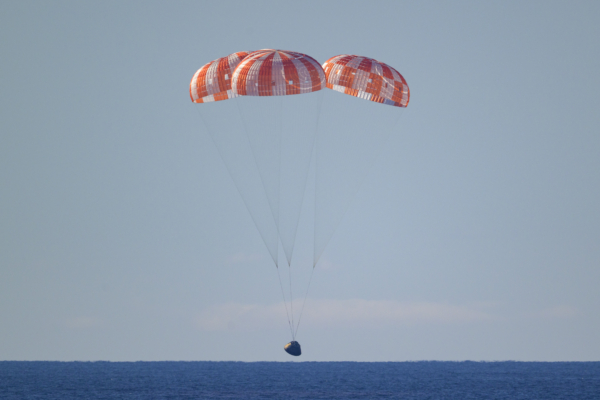
On Friday, April 10, NASA’s Orion spacecraft, carrying four astronauts, successfully splashed down in the Pacific Ocean shortly after 5 p.m. Pacific Time. They had completed a 10-day mission orbiting the moon, marking the first human return to the vicinity of the moon since the end of the Apollo program in 1972, and setting a new record for the farthest distance humans have traveled from Earth.
During the return journey, Orion faced rigorous technical challenges. The spacecraft operated in automatic mode with speeds reaching up to 24,661 miles per hour (approximately 39,000 kilometers per hour) upon entering the Earth’s atmosphere, equivalent to 33 times the speed of sound.
During the intense 13-minute descent, the spacecraft’s exterior reached temperatures as high as 5,000 degrees Fahrenheit (approximately 2,760 degrees Celsius) due to atmospheric friction. The high-temperature compressed air surrounding the spacecraft formed a plasma layer, causing a scheduled 6-minute interruption in communication systems.
Tension rose at the Mission Control Center as everyone anxiously monitored the integrity of the heat shield. Engineers had made adjustments to the landing trajectory to reduce heat accumulation following an abnormal heat shield damage during an unmanned test in 2022.
Subsequently, communication was reestablished, and the live broadcast showed three sets of parachutes unfurling in the blue sky, slowing the free-falling spacecraft to speeds of 15 to 19 miles per hour (approximately 24 to 30 kilometers per hour).
Finally, the spacecraft gently touched down in the Pacific two hours before sunset. Mission Control spokesperson Rob Navias declared it a “perfect bull’s-eye splashdown.”
The USS John P. Murtha, a U.S. Navy amphibious dock landing ship, promptly dispatched a rescue team comprising military aircraft, helicopters, and boats already stationed at the scene.
According to protocol, within about an hour, the crew secured the floating capsule and assisted Commander Reid Wiseman, pilot Victor Glover, astronaut Christina Koch, and Canadian astronaut Jeremy Hansen in disembarking for preliminary medical checks.
This team symbolizes the diverse development of space exploration: Glover, Koch, and Hansen respectively became the first African-American, female, and non-American astronauts to participate in a lunar mission.
The four astronauts lifted off from Cape Canaveral, Florida, on April 1, aboard NASA’s massive Space Launch System (SLS) rocket, embarking on a rare journey around the far side of the moon.
At its peak, the spacecraft reached a distance of 252,756 miles (approximately 406,000 kilometers) from Earth, breaking the record set by Apollo 13 in 1970.
The ultimate goal of the Artemis program is to establish a long-term outpost on the moon as a stepping stone for future human exploration of Mars.
During the mission, the astronauts captured the rare phenomenon of Earthset, reminiscent of the Earthrise images from the Apollo era, and observed a total solar eclipse from space. Pilot Glover expressed that the sight of the solar eclipse “really had all of us stunned.”
Despite achieving significant scientific results, the nearly 10-day flight encountered some technical issues with the spacecraft’s water and propulsion systems, as well as recurring toilet problems, which the astronauts took in stride.
Koch stated, “Unless we are willing to do some inconvenient things, we cannot delve deeper into exploration. Unless we make some sacrifices, take some risks, and it’s all worth it.”
Hansen added, “You do a lot of testing on the ground, but the final test is getting that hardware up into space.”
As planned by NASA, Artemis III will conduct a docking practice between the spacecraft and lunar lander in lunar orbit next year. The highly anticipated Artemis IV is expected to challenge astronauts to land on the moon’s south pole in 2028.
Commander Wiseman emotionally concluded, expressing hope that their mission would briefly pause the world and remind people to cherish the “presents” from this beautiful planet, adding that Earth is a special place in the universe that everyone should value.