
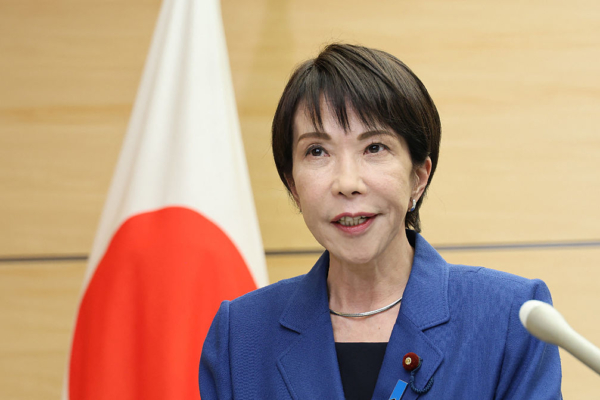
Japanese Prime Minister Sanae Takai announced on Friday (April 10) a plan to release an additional amount of national oil reserves equivalent to 20 days’ worth starting from early May. This move aims to address the global supply disruption caused by the conflicts in the Middle East and to ensure energy market stability while the shipping in the Hormuz Strait has not been fully restored.
Prime Minister Takai emphasized during a ministerial meeting on the Middle East situation, “To ensure stable crude oil supply, we will begin releasing national reserves equivalent to approximately 20 days’ worth starting from early May.”
She added, “We will take all possible measures to ensure the stability of crude oil supply.”
About 90% of Japan’s crude oil imports rely on the Middle East, with a significant portion needing to pass through the Hormuz Strait. This strait is a critical artery for global energy transportation, which has been under Iran’s control and blockade since the outbreak of the US-Iran conflict.
In response, the Japanese government is accelerating efforts to diversify import sources. Prime Minister Takai pointed out that through adjusting shipping routes and supply sources, Japan aims to ensure that over half of its imported oil does not need to pass through the Hormuz Strait before May.
According to a document released by Japan’s Ministry of Economy, Trade, and Industry (METI) on Friday, Japan is significantly increasing its oil imports from its ally, the United States. It is expected that the crude oil purchased from the US in May will reach four times the amount from the same period last year. Additionally, Japan is actively engaging with countries such as Malaysia, Azerbaijan, Brazil, Nigeria, and Angola to seek alternative supply sources.
Despite the two-week ceasefire agreement reached between the US and Iran, the international energy market remains filled with uncertainty. Israel continues to target the Iran-backed Hezbollah in Lebanon, and there is no sign of Iran lifting its near-total blockade of the Hormuz Strait, leading to ongoing severe disruptions in global energy supply.
Domestically, the Japanese government has instructed suppliers to prioritize fuel sales for medical, transportation, agriculture sectors including green tea production, livestock, and fisheries.
Prime Minister Takai specifically instructed relevant departments to address logistical bottlenecks to ensure that paint thinners needed for construction and car repair industry, as well as fuel oil required for green tea production, can be supplied without issues.
This will be the second time Japan releases national oil reserves this year. Previously, Japan started releasing enough reserves for 50 days on March 16 in coordination with other countries. In addition, it has also utilized private sector oil reserves equivalent to 15 days’ worth.
As of April 7, Japan’s total reserve capacity can still supply for 228 days (including 143 days of national reserves). Prime Minister Takai expressed confidence that Japan can ensure sufficient oil supply to sustain until next year.