
The Artemis II mission, carried out by NASA, will return to Earth after completing its mission around the far side of the Moon. It is expected to splash down in the waters off San Diego on Friday. Victor Glover, a local native of Southern California, is serving as the spacecraft pilot, marking a historic milestone in human space exploration with a record-breaking distance traveled during this mission.
According to the city news agency, NASA data shows that during the lunar flyby on Monday, the spacecraft surpassed the 248,655-mile record set by Apollo 13 in 1970. The approximately 6-hour lunar flyby marks a significant milestone in human space exploration since the Apollo era, paving the way for landing preparations near the lunar south pole within the next two years.
Glover, born in Pomona in the San Gabriel Valley of Los Angeles County, attended Ontario High School and graduated from California State Polytechnic University, San Luis Obispo. He served as the pilot of the Orion spacecraft during this mission. Glover had spent over 5 months aboard the International Space Station from 2020 to 2021, riding on a U.S. commercial spacecraft to complete the first full crew rotation mission.
In addition to his background, Glover has strong ties to Southern California. He worked as a test pilot at the Naval Air Weapons Station China Lake in the Mojave Desert and earned a master’s degree from the Air University at Edwards Air Force Base.
Accompanying Glover are Commander Reid Wiseman, Mission Specialist Christina Hammock Koch, and Canadian Space Agency astronaut Jeremy Hansen.
The U.S. Navy has begun arrangements this week to designate the USS John P. Murtha, a landing ship dock, for recovery operations after the spacecraft splashes down off San Diego on Friday. The ship will retrieve the Orion spacecraft and welcome the astronauts back on board.
The Navy stated in a press release on Monday that the ship has unique capabilities to assist NASA in spacecraft recovery and gather crucial data to ensure successful recovery of the spacecraft and crew in future Artemis missions.
A helicopter squadron stationed at Naval Air Station North Island will track the spacecraft’s trajectory as it re-enters the Earth’s atmosphere and assist in recovering the four astronauts after the spacecraft splashes down, bringing them aboard for assessment. Navy divers will be responsible for retrieving the Orion spacecraft from the sea and transporting it to the ship’s deck.
Re-entry into the Earth’s atmosphere is one of the most challenging stages of this mission as the spacecraft will endure extreme temperatures and pressures during its descent.
NASA conducted external inspections using cameras installed on the spacecraft this week to confirm the absence of any damage or anomalies that could threaten the safety of the crew.
Debbie Korth, the deputy manager of the Orion program, stated in a press conference on Wednesday that the inspection results showed the spacecraft to be in good condition. She said, “There are no doubts, and we have found no issues that would give us pause during the re-entry phase.”
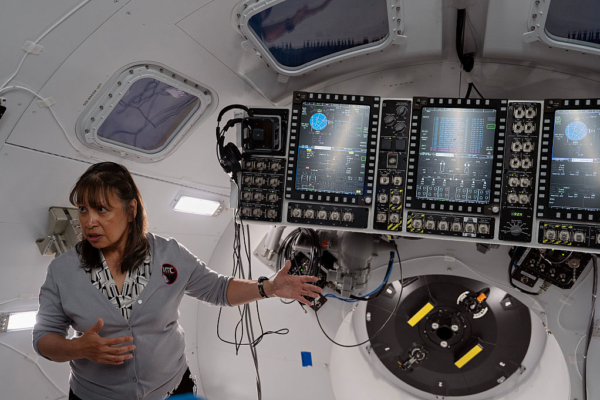
The live broadcast of the Artemis II crew participating in the press conference from inside the spacecraft garnered global attention, showcasing the spacecraft’s living space approximately equivalent to that of two small vans.
On Thursday, the crew began preparations for the spacecraft’s return to Earth and reviewed the return procedures. The astronauts will secure equipment, install seats, and secure loose items before the spacecraft splashes down as scheduled at 5:07 p.m. on Friday.
NASA plans to begin live broadcast coverage of the crew’s return to Earth at 4:30 p.m. on Friday. During the lunar flyby, the Artemis II astronauts captured images of the lunar surface and made observations. There was a brief loss of communication with the mission control center for about 40 minutes when the spacecraft flew over the far side of the Moon.
Upon their return from the Moon’s far side, the crew became among the few humans to witness the “Earthrise” phenomenon.
Communication during the Artemis II mission was partially managed by NASA’s Deep Space Network, overseen by the Jet Propulsion Laboratory in Pasadena.
Current plans indicate that the Artemis III mission is expected to launch sometime next year. The lunar lander is being developed by SpaceX in Hawthorne and Blue Origin founded by Jeff Bezos.
The Artemis IV mission is slated for an early 2028 launch, marking the return of astronauts to the lunar surface.
Artemis V, another lunar surface mission, is scheduled for late 2028, with subsequent missions planned approximately every year thereafter.