
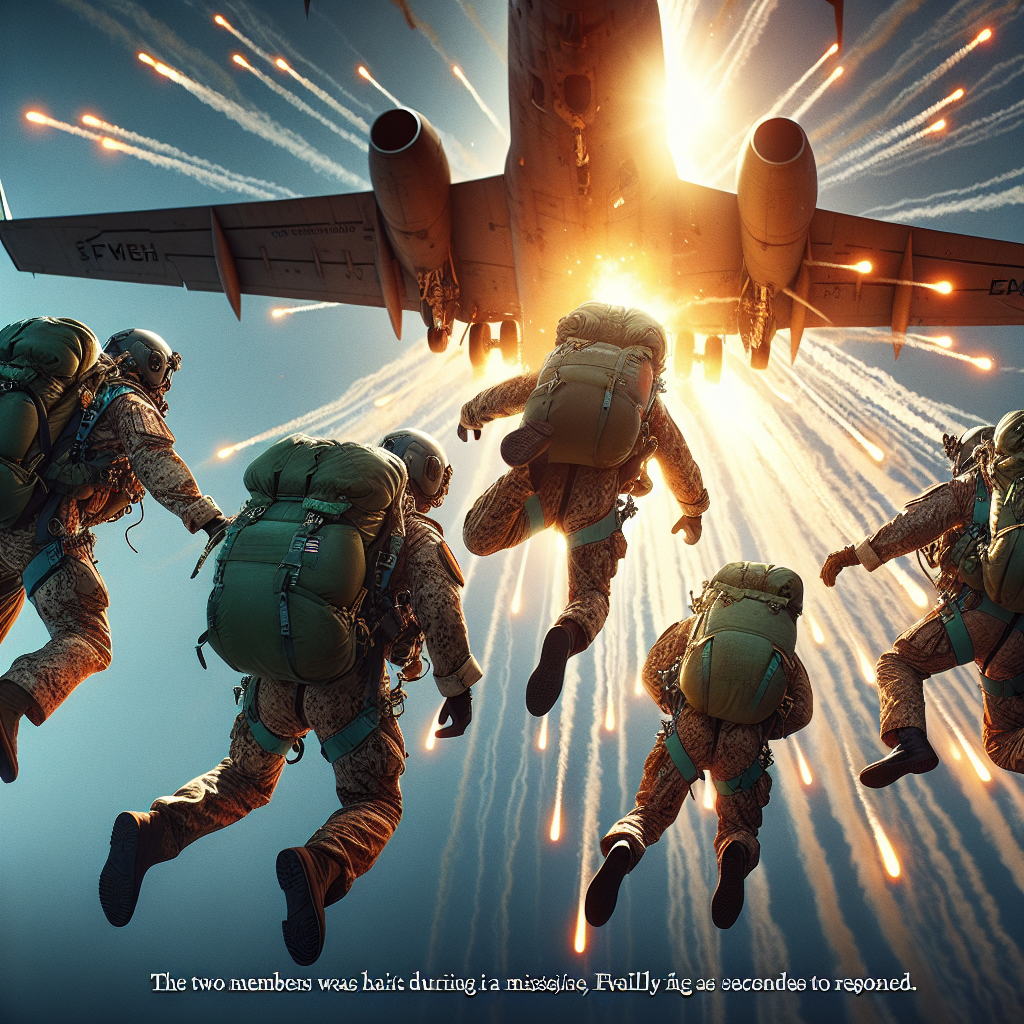
Last weekend, an American F-15E Strike Eagle was hit by enemy fire over Iranian airspace, giving the crew only a few seconds to react. However, the two crew members not only successfully ejected but were miraculously rescued in the end.
The incident took place on Friday, April 3rd. The ejection and escape operation was instantly triggered, leading to a high-risk rescue mission deep in enemy territory. The U.S. military had to race against time to retrieve the two crew members – the F-15E pilot and the weapon systems officer (WSO) – before the Iranian forces.
This event offered a glimpse into the life-or-death speed of pilots during ejection and how they managed to overcome extreme survival threats and be rescued successfully.
Fox News cited expert analysis in reporting that within a few seconds after ejection from the aircraft, the ejection seat transforms from a “last-resort insurance policy” to an “explosive escape engine” – propelling the crew members forcefully out of the cockpit into the sky before the parachute deployment.
This was the intense experience endured by the two crew members of the F-15E. Former F-16 pilot and special operations mission performer, Pete “Gunz” Gersten, described it as “an extremely violent process.”
He explained that at the moment the pilot pulls the ejection handle, the canopy is blasted off in a fraction of a second, and the seat immediately shoots upwards like a rocket, subjecting the body to immense gravitational impact.
According to military data, pilots experience 14G to 20G of gravitational force during ejection. This means that a 200-pound pilot would feel like their body weighs 4,000 pounds at that moment.
“You’re no longer in control of your destiny,” Gersten described, “You become an involuntary passenger, forced to endure this wild life-or-death speed.”
To minimize injuries, pilots undergo rigorous training before pulling the handle: they must press their backs tightly against the seat, keep their spine aligned straight to prevent permanent damage from the tremendous force impact.
In an instant, the damaged aircraft crashed behind them, and the crew members were left hanging in the air, waiting for the parachute to open. In a dual-seat fighter like the F-15E, if one person initiates ejection, the system automatically ejects both crew members in quick succession, with only a split second gap to avoid mid-air collision.
In fact, pilots have never practiced real ejections in reality. Instead, they rely entirely on repetitive simulated training and memorized procedures to cope with this life-or-death test.
“You’re relying on muscle memory to perform something you’ve never done for real,” Gersten said, pointing out that this training starts long before a pilot even steps into a cockpit.
The training extends from classrooms to simulators. In the ejection seat trainers, pilots experience the initial acceleration of the seat shooting upwards. Subsequently, they rehearse a strict parachute operation protocol using virtual reality (VR) technology: clearing their faces (ensuring no obstruction to their vision), checking if the parachute canopy fully deploys, organizing survival equipment, and guiding the canopy ropes towards a safe area.
“When you’re hanging in a parachute, you don’t have a checklist to refer to,” Gersten emphasized, “You must have every step ingrained in your mind.”
The rescue operation of the “Dude 44” crew is hailed as one of the most heart-pounding combat rescues in U.S. history.
After pilots eject and land, their combat survival radios emit encrypted location signals immediately and connect with the U.S. military search and rescue network. While the F-15E pilot was successfully picked up by the U.S. military on that Friday, the situation of the weapon systems officer was perilous. He had to hide and evade in enemy territory until he was successfully rescued on Sunday, April 5th.
Trump revealed details in a subsequent press conference: “The second crew member – the brave weapons systems officer, sustained severe injuries upon ejection. While bleeding heavily, he crawled through cliffs, tended to his wounds, and managed to contact the U.S. forces in a remarkable display of will. Despite being surrounded by Iranian militia at one point, he evaded pursuit by climbing steep mountains… he is a true warrior.”
Although the survival rate of modern ejection systems is as high as 90% to 95%, the act of “escape” itself often comes with a cost. Studies show that up to 30% of pilots suffer spinal fractures due to the massive force impact. Improper limb positioning during ejection can lead to “flail injuries,” fractures, or dislocations caused by the high-speed airflow.
The two crew members of the F-15E were safely rescued, highlighting not only the risks brought by modern high-intensity aerial combat but also reaffirming the critical role of the U.S. military’s rapid search and rescue capabilities in operations behind enemy lines.