
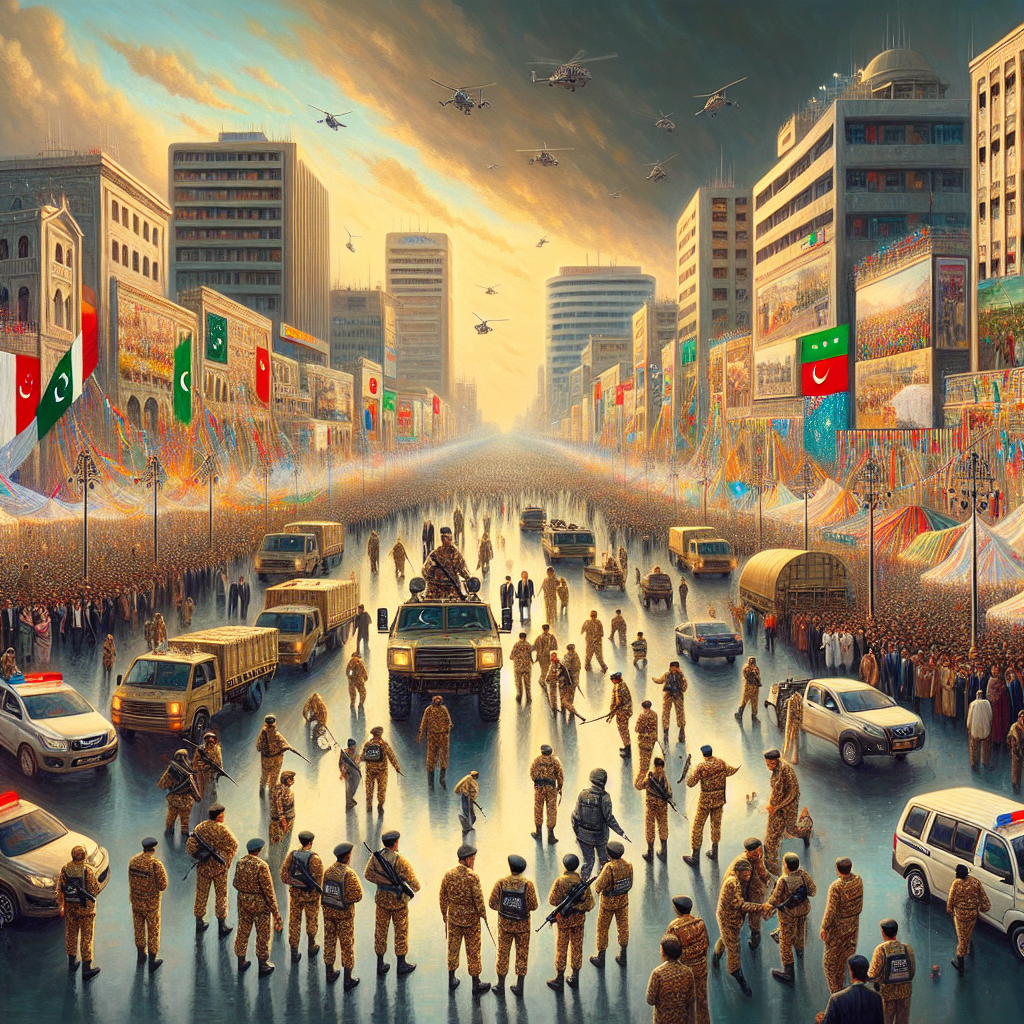
The United States and Iran are set to hold a highly anticipated negotiation in Pakistan on Saturday (April 11). The capital city of Islamabad is bustling with preparations, with streets being painted, security forces being further strengthened, and the entire region awaiting the arrival of the US-Iran talks in an atmosphere of anticipation and anxiety.
On Tuesday evening (April 7) Eastern Time, the US and Iran reached a last-minute ceasefire agreement. The US and Israel agreed to a two-week ceasefire with Iran, while Iran is required to fully, immediately, and securely open the Strait of Hormuz.
Following the ceasefire agreement, Pakistan has actively pushed for the US and Iran to convene negotiations this weekend aimed at permanently ending the war. After almost 40 days of intense fighting, the world is holding its breath, watching the outcome of the US-Iran talks.
Here are the key details to know about the Islamabad negotiations:
The White House announced on Wednesday (April 8) that the first round of post-ceasefire negotiations between the US and Iran will be held in Islamabad on Saturday morning local time.
It is expected that the US-Iran negotiation teams will arrive in Islamabad on Friday.
On April 8, Iran’s Supreme National Security Council stated that the negotiations could last up to 15 days – meaning that at least some delegation members may stay in Islamabad after Saturday’s talks or return to the Pakistani capital for subsequent rounds of negotiations.
According to Al Jazeera, the Serena Hotel in Islamabad will host the negotiation delegations. The hotel is adjacent to the Pakistani Foreign Ministry and is located in an area with key government institutions and embassies. The hotel has been requisitioned from Wednesday evening until Sunday, with all guests asked to check out. The hotel is expected to serve as the venue for the negotiations.
However, according to Turkey’s Anadolu Agency, Pakistani officials said the negotiations will be held at a highly secure military venue, with security being handled by the Pakistani military.
Authorities have declared April 9 (Thursday) and 10 (Friday) as public holidays in the capital, excluding essential services such as police, hospitals, and public utilities. Security measures in the city have been intensified. The Red Zone where Serena Hotel is located has been sealed off, and major entrances to Islamabad have been closed.
White House spokesperson Karoline Leavitt confirmed on Wednesday during a press conference that the US delegation participating in the negotiations will be led by Vice President Pence. Trump’s Middle East envoy Steve Witkoff and son-in-law Jared Kushner will also attend the talks.
According to Turkish state media Anadolu Agency, Pakistani sources mentioned that the Iranian negotiation team is expected to include Iran’s Parliament Speaker Mohammad Bagher Ghalibaf and Foreign Minister Abbas Araghchi. It was also mentioned that four senior commanders from Iran’s Islamic Revolutionary Guard Corps (IRGC) will participate in the talks. The IRGC is responsible for leading Iran’s military operations during the war. Ghalibaf has served as a commander in the IRGC.
However, Iran has not officially confirmed the composition of its delegation.
Per Al Jazeera, it is expected that Pakistani Prime Minister Shehbaz Sharif will officially preside over the US-Iran talks. Depending on the arrival time of the negotiation delegations, he will hold preparatory meetings with both sides on either Friday or Saturday.
Ishaq Dar, Pakistan’s Deputy Prime Minister and Foreign Minister, has been actively involved in shuttle diplomacy throughout the US-Iran conflict, and he is expected to help drive the actual negotiation process on Saturday.
Al Jazeera reports that the US and Iran delegations are expected to sit in separate rooms on Saturday, with Pakistani officials transmitting messages between the two delegations.
However, per Turkey’s Anadolu Agency citing Pakistani government sources, the negotiations do not have a fixed timeframe, and the delegations of both sides will engage in direct and indirect contacts.
A source mentioned, “Both sides will also sit face-to-face and hold talks separately with the Pakistani authorities.” He added that due to the “complexity of the issues,” the negotiations may last “several days.”
Al Jazeera reported that officials confirmed a 30-member US security team has arrived in Islamabad.
In recent weeks, Pakistan has become a crucial mediator in the US-Iran conflict. Under intensive diplomatic efforts, Pakistan’s Chief of Army Staff General Asim Munir had multiple calls with US and Iranian leaders.
Mushahid Hussain, former Information Minister and defense expert in Pakistan, told Al Jazeera that President Trump maintains a good personal relationship with General Munir and other members of Pakistan’s mediation team, which is why Islamabad has positioned itself as the central hub for the US-Iran negotiations.
It is currently unclear whether General Munir will take part in the US-Iran talks.
Pakistan shares a 900-kilometer (560-mile) border with Iran and has the second-largest Shia Muslim population globally after its neighbor. These factors enhance its importance to Iran. Unlike much of the Middle East, Pakistan does not have US military bases, making it more credible in the eyes of Iran. Additionally, Pakistan has been a major non-NATO ally of the US since 2004.
Both sides enter the negotiations with significant differences.
Iran’s state media released a so-called ten-point plan, which notably includes Iran continuing to control the strategically vital Strait of Hormuz, ending international sanctions against Iran, and “accepting” uranium enrichment activities.
On Wednesday, US President Trump made it clear that the rumored ten-point ceasefire plan proposed by Iran is not factual. He pointed out that some content was not part of the US version and had never been included in discussions with the US.
Al Jazeera cited analysts stating that due to deep-rooted mistrust on both sides, the likelihood of reaching a final agreement in the near term remains slim.
Raz Zimmt, Iran Program Director at the Institute for National Security Studies in Tel Aviv, told Axios that the primary focus is how much the US-Iran negotiations will involve the nuclear issue.
He stated, “Three minimum requirements must be met: removing uranium enrichment at 60% from Iran, diluting uranium enrichment at 20% to a low level, and halting uranium enrichment activities for as long as possible.”
“If these demands – some of which Iran had previously rejected before the war – are accepted, then at least a significant outcome can be achieved. If Iran still possesses this nuclear capability at the end of the war, it will be a major failure,” Zimmt said.
On Wednesday, Trump posted on Truth Social, saying, “The US will closely cooperate with Iran, as we believe Iran has undergone an effective regime change!”
“Iran will no longer have uranium enrichment activities, the US will work with Iran to unearth and clear all the buried underground (nuclear facility destroyed by a B-2 bomber last June) nuclear ‘dust’,” he said.