
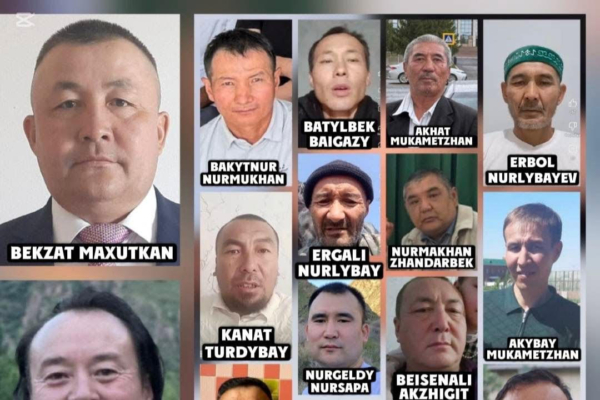
On April 9, 2026, the court in Kazakhstan held a trial for 19 ethnic Kazakhs from Xinjiang, China. The case was primarily charged with “inciting ethnic hatred,” and the trial was conducted behind closed doors. Witnesses on site said the trial lasted less than 30 minutes, and the judge is set to announce the verdict on April 14.
The final hearing for the case took place on the morning of April 8 in Taldykorgan City, Almaty Region, Kazakhstan. Prosecutors presented sentencing recommendations, requesting over half of the defendants to be sentenced to 5 years in prison, with the rest receiving the same term but with probation.
Selkgen, the founder of the Kazakh human rights organization “Atazhurt Volunteers,” who has been closely following the progress of the case, stated to reporters that the prosecution insisted that these 19 protesters incited ethnic hatred against the Chinese through their public actions, thereby invoking Article 174 of the criminal law.
He explained that Article 174 has long been controversial domestically and internationally in Kazakhstan, with multiple human rights organizations and United Nations human rights mechanisms criticizing its application scope. It is commonly referred to by outsiders as the “incitement of ethnic hatred crime.”
According to Kazakh authorities, the 19 defendants were involved in burning the flags of the People’s Republic of China and images of Xi Jinping, as well as making critical remarks about the Chinese government’s policies in Xinjiang in public. The prosecution defined these actions as incitement of hatred against “Chinese people.”
During a collective protest in Uyghur County, Almaty Region, on November 13, 2025, a group of ethnic Kazakhs from Xinjiang burned Chinese flags and Xi Jinping portraits along a roadside, and shared the images on social media platforms abroad. Subsequently, authorities arrested the participants, including eyewitnesses to Xinjiang internment camps.
The trial began at 10:30 a.m. local time on April 9 and ended at 11:07 a.m. Asen Nursan, a member of the Atazhurt Volunteers organization, live-streamed the trial proceedings outside the courtroom. In court, defense lawyers refuted the charges. Selkgen stated that the defense lawyers questioned the conclusion of the so-called “independent assessment experts,” asking whether criticism of the Chinese (Communist) government equates to hatred towards the Chinese people. The experts, however, treated the two as the same concept.
Selkgen expressed that the defense argued that the defendants’ statements were directed at the Chinese government and its policies, not the Chinese people, constituting political expression protected under the Kazakh Constitution.
An observer, Nurbek, who attended the trial as a spectator, relayed that the defense lawyers mentioned the defendants’ demands, including raising awareness about the plight of Kazakhs and Uyghurs in Xinjiang and urging the Kazakh government to reassess its visa-free arrangement with China, as public interest expressions.
The trial process implemented strict restrictions. Selkgen noted that the case shifted to a closed-door trial at the initial stage, “not allowing media or public attendance, with usually only one family member permitted in the courtroom.”
The case has undergone multiple trial hearings, with the final judgment set to be announced on April 14. Scholars informed the press that the verdict might influence Kazakhstan’s stance between human rights and diplomacy.
Furthermore, a United Nations human rights mechanism official stated on social media that they would monitor the case’s progress. Organizations, such as Human Rights Watch, urged Kazakhstan to fulfill its international human rights obligations.
Atazhurt Volunteers organization has long been advocating for human rights issues in Xinjiang and assisting victims to speak out. Observers told us that the collective indictment of the 19 individuals has gone beyond the scope of regular judicial cases, becoming a significant test for Kazakhstan in terms of human rights, international relations, and domestic governance, with the judgment’s outcome expected to continue drawing international attention.