
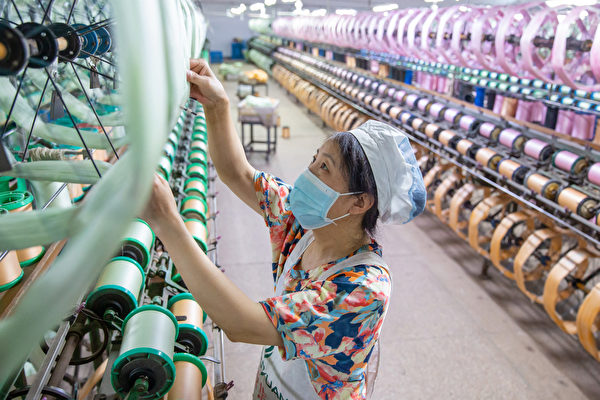
Recent Gilnews April 9, 2026 – In recent days, raw material prices in the textile industry in various areas of Zhejiang have doubled, while orders have decreased, significantly impacting business operations. Several industry insiders indicate that there is currently a discrepancy between costs and shipping prices. For example, materials that used to cost 1 million RMB have risen to 2 million RMB. Some factories are on the brink of shutdown, with plans to halt operations in mid-April.
Since the onset of the Iran conflict in February, shipping in the Strait of Hormuz has been restricted, severely affecting the supply of energy and petrochemical raw materials. Hu Haixing, a member of the Zhejiang Textile Industry Association, stated in an interview with reporters that the combination of reduced orders and rising raw material prices has increased pressure on companies. He mentioned, “The market conditions are currently unfavorable, with most enterprises being able to hold inventory for a maximum of only two months, and some factories having inventory that may last around 20 days.”
Hu Haixing pointed out that with the continuous increase in raw material prices, shipping prices have become unsustainable relative to costs. He emphasized, “It’s just not viable anymore; the more we produce, the more we lose, just like how pig feed can be more expensive than pork. As far as I know, some breeders have stopped feeding pigs.”
The textile industry in Huzhou, Zhejiang, is a traditional pillar industry in the region, encompassing a complete chain from raw materials and weaving to final household textiles. The local industry primarily focuses on silk and chemical fiber manufacturing, with Zhili Town in Wuxing District being a concentrated area for children’s clothing production, with annual sales approaching billions of RMB.
Mr. Liu, the head of a knitting fabric company in Huzhou, expressed, “Many people may not think that the Middle East situation is relevant to us, but it has a quite direct impact on the textile industry.” He explained that textile raw materials are dependent on the petrochemical system. “When crude oil prices rise, PTA, ethylene glycol, polyester fibers, and fabrics will all follow suit by increasing in price.”
He mentioned that these changes occur rapidly, providing little buffer room; when prices rise upstream, the pressure quickly trickles down to the factories, leaving little time for businesses to adjust.
Mr. Liu noted that once crude oil prices increase, related chemical products also rise. Despite Zhejiang being located along the coast, if shipping through the Strait of Hormuz is restricted, the prices of petroleum and its derivatives will still be affected. He stated, “At present, with the upstream increase in prices and the downstream reluctance to bear the costs, the pressure remains stuck in the middle.” He added, “This situation feels like being consistently under pressure.”
On the Douyin platform, a textile factory owner with years of experience also mentioned a similar predicament. He shared, “After so many years in business, this year has proven to be the most challenging, being caught in a tight spot from both ends.” He explained that companies without prepared materials before the New Year now face the dilemma of not daring to accept goods due to rising raw material prices, while those with stock are hesitant to start production without orders.
He further expressed that the significant increase in raw material prices, such as a jump of several thousand RMB, with 10 tons of raw materials rising to 2 million RMB, poses a considerable challenge. In such circumstances, by selling off raw materials, the profit could even surpass that of production running, saving expenses like monthly rent, million-RMB wages, and reducing risks.
Data indicates that Zhejiang is one of China’s significant textile industry clusters, with areas like Keqiao in Shaoxing, Zhili in Huzhou, and Haining in Jiaxing forming complete industry chains that supply products to the mainland and overseas markets. Due to the abundance of small and medium-sized enterprises in the region, their reactions to changes in raw material prices and orders are notably sensitive.
Hu Haixing highlighted, “Now, raw material prices fluctuate daily, while profits from finished products remain slim. Production leads to more losses as you do more; yet, if you cease operations, you still need to support workers, keep the factory running, incurring costs like rent, utilities, payroll, unavoidable.” He presented an example, “For instance, if raw materials worth 1 million RMB were imported in January, and by March, it’s risen to 1.5 million RMB, now it requires 2 million RMB, how can businesses manage?”
Another member of the Textile Association, Song Hao, mentioned that due to the restricted passage through the Strait of Hormuz, even with incoming orders, it’s risky to accept them. “Even if orders come now, I am cautious about taking on them easily. Some companies actively reduce orders to avoid further losses.”
According to reports, over the past four years, many clothing orders in Zhejiang have shifted to Vietnam, causing some raw material supplies to relocate. As the mainland’s low-price inventory diminishes gradually, businesses are compelled to deal with high-priced raw materials, leading to a back-and-forth contemplation between starting and halting production for many factories. Song Hao emphasized that April is a critical juncture for the textile industry in Zhejiang.