
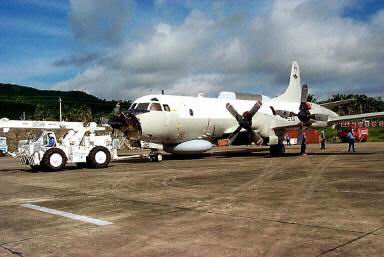
This year marks the 25th anniversary of the 2001 U.S.-China mid-air collision incident. It happened when Chinese pilot Wang Wei’s fighter jet collided with the propeller of a U.S. military plane, leading to the U.S. aircraft’s inability to return and resulting in an emergency landing at Lingshui Airport in Hainan Island, where the U.S. aircrew was detained by the Chinese authorities. The collision occurred on April 1, and after being detained by the Chinese government for 11 days, the 24 U.S. crew members were finally released.
On April 1, 2001, a U.S. Navy EP-3 propeller-driven reconnaissance aircraft was on a routine mission in the South China Sea when two Chinese J-8II fighter jets were sent to monitor it. In international airspace about 110 kilometers southeast of Hainan Island, Wang Wei’s J-8II fighter jet (with the serial number 81192) collided with the U.S. reconnaissance plane, resulting in the crash of the Chinese aircraft, with Wang Wei ejecting but going missing and later confirmed dead by the Chinese authorities.
The damaged U.S. aircraft made an emergency landing at Lingshui Airport in Hainan as it couldn’t return. The black box of the aircraft was taken by the Chinese, and the 24 U.S. aircrew members were detained for 11 days. The incident highlighted the missing Chinese pilot Wang Wei’s role, with the U.S. investigation attributing the collision to his tactical error of failing to maintain a safe distance during the surveillance operation despite the significant disparities in the aircraft models and weights between the two sides.
According to Dennis Wilder, the China Mission Director at the CIA, Wang Wei was known in aviation circles for showing off his skills and even once displaying his email address on the cockpit window to the crew of the EP-3 aircraft.
Wilder explained that Wang Wei’s action before the collision was a risky and not recommended maneuver known as a “thumping maneuver” where a pilot flies the aircraft quickly under the other plane and pulls up rapidly, creating an airflow void that disrupts the flight of the other plane. Shane Osborne, a U.S. military pilot at the time, recounted instances of close encounters by Chinese jets and described Wang Wei’s unstable flying behavior leading to the collision.
Wilder emphasized that Wang Wei’s use of the Chinese J-8 fighter jet, a technologically inferior aircraft, contributed to the collision due to its instability at low speeds. The incident was seen as an error by an individual pilot, not a premeditated action by Beijing.
Regarding the handling of the incident by the Chinese government, Wilder’s recollections were published as a cover story in the digital magazine “The Wire China.” He discussed the manipulation of public opinion by the Chinese authorities in attributing blame to the U.S. and portraying Wang Wei as a martyr to fuel anti-U.S. sentiments.
As the 25th anniversary of the event is marked, Wilder’s review and evaluation of the critical junctures post-collision shed light on the diplomatic challenges faced by both sides and the propaganda maneuvers deployed by the Chinese government to manage the situation internally and externally.
The public narrative in China shifted blame to the U.S., claiming the U.S. plane hit Wang Wei’s fighter jet, with staged testimonials supporting the Chinese version of events. President George W. Bush’s administration faced initial hurdles in communication with Chinese leadership, with Wilder noting Jiang Zemin’s calculated response to avoid escalating the incident.
In the aftermath, the absence of a formal apology from the U.S. government led to a letter of regret signed by the U.S. Ambassador to China, Clark T. Randt Jr, expressing sorrow for the loss of life and the destruction of the aircraft. The Chinese authorities spun the letter as an apology, facilitating the release of the U.S. aircrew members from China.
The issue of compensation for the incident remained unresolved as the U.S. and China disagreed on the amount, with China initially demanding $1 million but the U.S. citing a much lower reimbursement figure. The incident had significant implications on military reconnaissance operations in the South China Sea, restarting over a month after the collision.
The incident highlighted the intricacies of international relations and military encounters, underscoring the need for communication, restraint, and diplomatic maneuvering to prevent such mishaps in the future.