
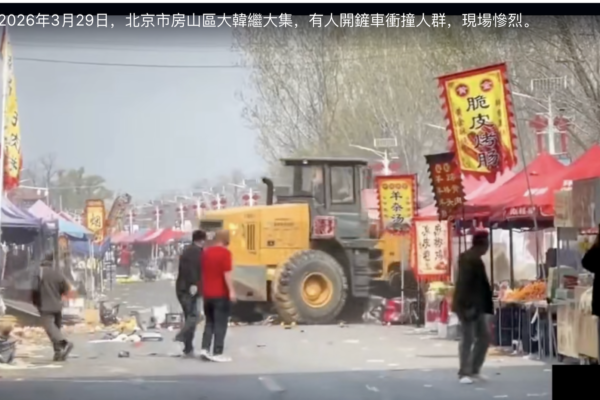
In Beijing’s Fangshan District, the tragic incident at the Dahangeji Market where a man driving a bulldozer indiscriminately rammed into stalls and crowds has left at least 13 people dead and 12 injured. It has been ten days since the incident occurred, yet there has been no official notification from authorities regarding the matter.
The incident, which took place on March 29th around 11 a.m., has had ripple effects on markets across Beijing, leading to emergency measures to halt operations for safety reorganization and enhancements.
Furthermore, not only have mainland media remained silent on the issue, but content related to the incident on social platforms such as Douyin (TikTok), Xiaohongshu, Weibo, and WeChat has been deleted, and keywords have been banned. Even searches for “Dahangeji Market” on Douyin yield no results.
According to previous reports by Dajiyuan, the driver responsible for the tragedy was from Liaoning and took drastic actions due to an unresolved grievance. After arriving in Beijing, he rented a bulldozer and strategically targeted the market during the lunchtime rush to maximize casualties.
Initial media coverage by a mainland outlet, “Urban Scene,” was quickly removed from circulation, exacerbating the lack of information surrounding the incident.
The Dahangeji Market, previously operational every Saturday and Sunday from 8 a.m. to 3-4 p.m., has since been shut down following the tragedy.
In response to the repercussions of the Dahangeji Market incident, several markets in Beijing have temporarily halted operations for safety improvements and reorganization.
For instance, the Pinggu Market suspended operations starting from April 2. A local stall owner urgently notified residents through a video message that the market would undergo upgrades to enhance infrastructure for a safer and more comfortable shopping experience, suggesting a temporary closure until completion.
One stall owner disclosed that the Dongpeng Saturday Night Market and Daliushu Tuesday and Thursday Night Markets in Beijing have been temporarily closed since April 3 for “the upgrade and renovation of market security facilities,” with no specific timeline for resuming operations, awaiting official instructions.
According to information revealed by stall owners on social media, the Chaoyang Jinzhan Market has also suspended operations for a month due to upgrades, while the Pinggu Kanshanji Market halted operations from April 5 onwards.
Moreover, the Zhangjiawan Market in Tongzhou, originally scheduled to commence operations on April 5, also abruptly ceased operations. Stall owners communicated receiving notifications and cautioned against visiting the market until further notice on its reopening.
Contrary to these closures, some markets like the Fengheying 246 Market and 135 Small Market in Beijing are currently open for business. The Beiwu Market still operates on Sundays and remains crowded with visitors.
Residents have noted enhanced security measures at the markets that are operational, with an increased presence of security personnel ensuring strict supervision.
A video uploaded by a netizen named “Beipiao” depicted security patrols in groups on Sundays at the operating markets, holding shields as they patrolled the marketplace, emphasizing their visibility and vigilance.
There are sentiments among some netizens that these indiscriminate retaliatory acts against society are not necessarily correlated with market security but rather rooted in societal injustices, severe violations of lower-class rights, and heightened animosity.
Recent events in mainland China have witnessed several instances of indiscriminate retaliatory acts. On March 31, a 44-year-old man in Wuhan’s Jiang’an District attacked people with a knife along Qingsong Road, resulting in injuries to four individuals, although reports circulating online suggest a higher toll of casualties beyond the official figures.