
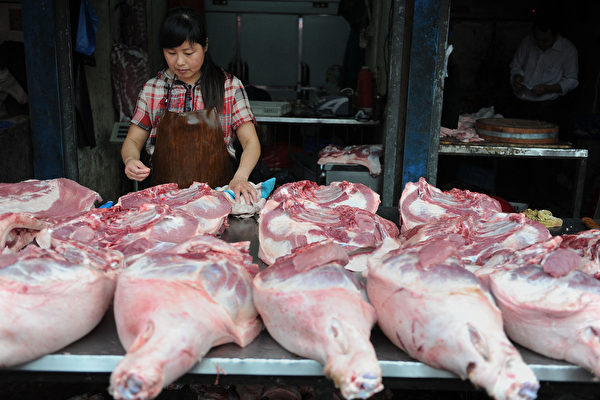
China’s live pig prices have fallen below a crucial psychological threshold at the beginning of 2026, hitting a new low in more than a decade. Currently, both live pig futures and spot prices are weakening simultaneously, with the industry as a whole facing deep losses, described by insiders as the “most difficult pig cycle in history.”
According to reports from multiple media outlets such as the Securities Times, China Fund Daily, and the Finance magazine, the main contract of live pig futures in China once dropped to 9,125 yuan per ton in intraday trading, setting a record low since its listing. In the spot market, the average price of live pigs nationwide has generally fallen below 5 yuan per half kilogram, with some regions approaching 4.5 yuan, marking the lowest levels since June 2018.
Compared to the historical peak of 40.38 yuan per kilogram in November 2019, the current price has plummeted by over 76%.
The downward trend in prices directly impacts breeding profits. Data from Shanghai Steel Union shows that in March 2026, it costs about 257 yuan per head for self-bred pigs to raise, and nearly 160 yuan for the purchased piglets-to-fattening model, with individual periods even exceeding 400 yuan. The industry’s average total cost still remains between 13 to 14 yuan per kilogram, creating a significant mismatch between prices and costs.
The hog-to-feed ratio, reflecting the industry’s business climate, continues to decline. In the third week of March, this ratio dropped to 4.40:1, hitting a new low since 2019 and falling below the first-level warning line of 5:1, triggering official regulatory mechanisms.
In the fourth week of March, monitoring by the Ministry of Agriculture and Rural Affairs showed that the wholesale price of pork per kilogram was 15.73 yuan (about 7.87 yuan per half kilogram), down by 24.4% year-on-year. In some areas, the price of pork has already fallen to the era of 4 yuan.
On the other hand, a report on Tuesday from a Chinese business news outlet states that out-of-season special vegetables such as spring bamboo shoots, Chinese toon, scallions, ginger, and garlic are retailing at 8-12 yuan per half kilogram, with some periods even higher than ordinary pork prices. For instance, pork belly in agricultural markets ranges from 8 to 13 yuan per half kilogram, while discounted areas are as low as 5-6 yuan per half kilogram.
The rising vegetable prices are directly impacting daily diets. According to data from the National Bureau of Statistics, in February 2026, the price of fresh vegetables increased by 6.9% year-on-year.
Analysts believe that the “vegetables more expensive than meat” phenomenon reflects the mismatch in production cycles between the two agricultural products. The production cycle of vegetables is short (30-60 days), so when prices rise, farmers can quickly expand production to stabilize prices. In contrast, the pig breeding cycle is much longer (around 10 months), and adjusting production in case of oversupply is slow, akin to a “huge inertia train.”
The deeper concern lies in the long-term “cheap prices hurt farmers” practice, severely dampening breeders’ enthusiasm and potentially leading to a reduction in future pork supply, which may trigger retaliatory price increases. Consumers may have to face the double dilemma of “expensive meat and expensive vegetables,” showcasing the typical negative effects of the pig cycle.
Moreover, Chinese media cited industry insiders’ analysis suggesting that the current decline in pig prices stems from structural changes on both the supply and demand sides.
On the supply side, after the African swine fever in 2018 caused a significant surge in pork prices, the industry underwent rapid expansion. As of the end of 2025, the national inventory of breeding sows still reached 39.61 million heads, and the annual output of live pigs was 71.973 million heads, a 2.4% year-on-year increase.
On the demand side, there is a trend of contraction. According to data from the Ministry of Agriculture and Rural Affairs, the per capita consumption of pork by Chinese residents in 2025 was 26.6 kilograms, down by 5.4% year-on-year, marking two consecutive years of decline.
In this context, the traditional logic of “reducing production leads to price increases” is being challenged.
The analysis from the Chinese business news outlet indicates that for pig breeders, the current “most difficult” pig cycle in history is a cruel survival test, mainly manifested in two aspects: industry-wide deep losses and small-scale breeders being forced to exit on a large scale.
Industry-wide deep losses: The industry has been continuously losing money for several months. In March 2026, breeders who raise pigs through self-breeding incurred an average loss of 257.53 yuan per pig sold, while those who purchase piglets faced a loss of 157.95 yuan per head. Based on the lowest market prices, some breeders may incur net losses exceeding 500 yuan per pig sold.
Despite prices falling below the cost line, the progress of capacity clearance is limited. Data from Zhuochuang Information shows that as of February 2026, the inventory of breeding sows in sample enterprises had only decreased by about 3.23% from the mid-2025 peak.
Industry insiders point out that the reason for this limited progress lies in multiple constraints brought about by changes in the industry’s structure. Firstly, the proportion of large-scale farming has risen to 73.2%, with leading companies leveraging financing capabilities and advantages in industry chain integration, possessing stronger risk resistance. Secondly, the industry is in a typical “prisoner’s dilemma”: if companies reduce production individually, they may lose market share; if production reduction is not widespread, prices will continue to be under pressure, leading to a difficult overall situation.
Analysts generally emphasize that a real turnaround in the cycle depends on substantial capacity clearance. Until then, industry adjustments will continue.