
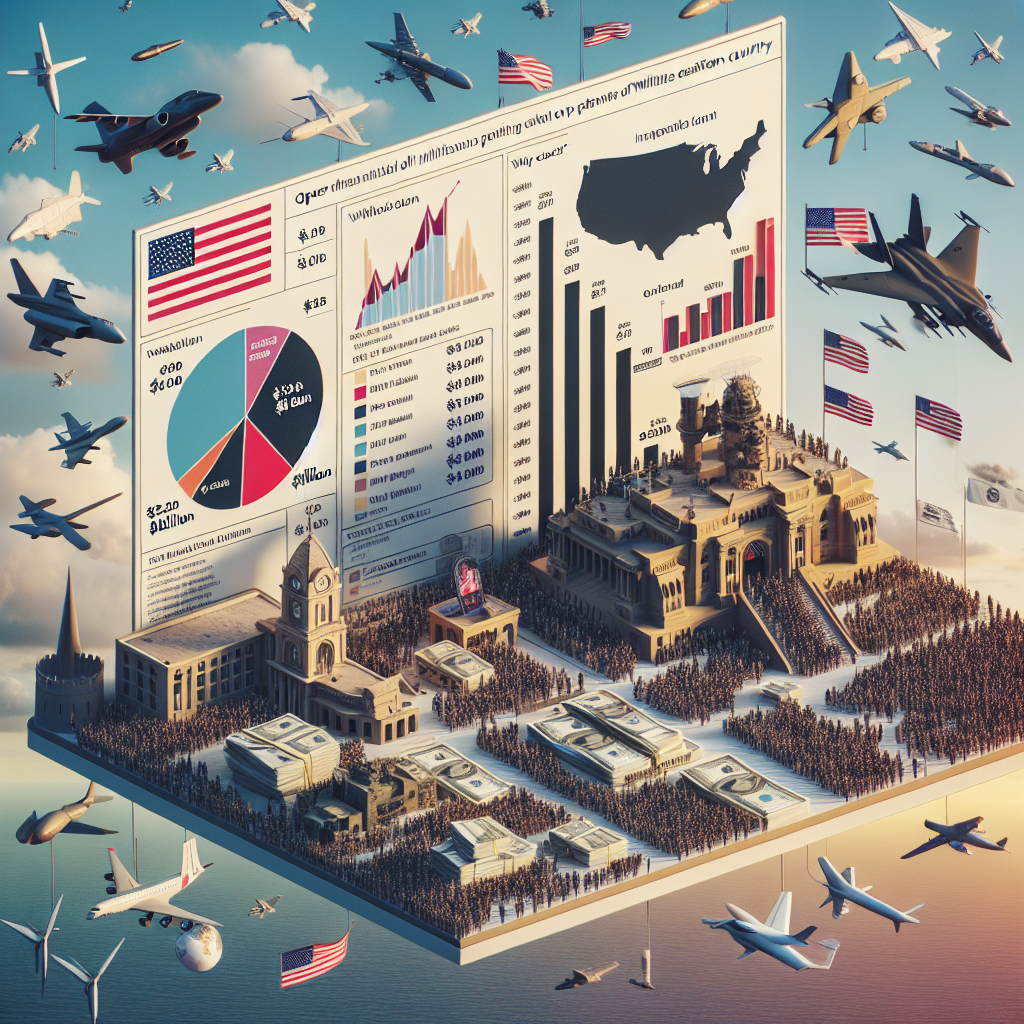
According to the latest forecast from the Penn Wharton Budget Model, military operations by the United States against Iran from the end of February to the end of April could reach $47 billion in expenses.
The prestigious Ivy League school estimates that the war has already cost approximately $27 to $28 billion in the first 32 days. The report adds that if the conflict continues through the end of this month (April), the “projected direct costs for the two months” will fall between $38 billion and $47 billion.
Furthermore, if funding is raised through fiscal deficits, there may be an additional approximately $5 billion in indirect costs or interest expenses.
Pennsylvania University’s analysis divides the conflict into four stages. The report indicates that during the first six days of military action from February 28 to March 5, the US government spent an average of about $2.1 billion per day.
In the subsequent two stages, costs significantly decreased: between March 6 and March 23, the estimated average daily expenditure was around $601 million; while in the remaining days of March, daily spending dropped to $500 million.
The model suggests that costs for the ongoing fourth stage of the conflict may continue to decrease. Researchers estimate that from April 1 to April 30, the daily expenditures by the US government will range between $350 million and $650 million.
The report emphasizes that the data is based on “government official data” and what researchers call “authoritative independent analysis.” However, the report does not make any predictions about the direction of the war beyond April 30.
Researchers from Pennsylvania University point out that the high costs in the first stage were due to the war then “mainly relying on expensive standoff munitions.”
They note that the Pentagon had reported to the Senate in mid-March that “at least $11.3 billion in spending was incurred in the first six days” primarily for “replenishing munitions.” Standoff munitions include advanced weapons like long-range missiles that allow the US military to launch outside enemy anti-aircraft ranges.
The report adds that moving into the second stage, the US military shifted to using cheaper munitions, such as the Joint Direct Attack Munition (JDAM) kits that can upgrade unguided bombs into precision-guided weapons. Meanwhile, Iran had lost most of its defense capabilities against the US military, reducing America’s operational costs.
According to the Pennsylvania University model, as Washington and Tehran engage in negotiations, the military operation transitions into a “lower intensity” third stage, further lowering daily spending costs to $500 million.
The analysis indicates that the benchmark for the fourth stage is based on assuming “sustaining the $500 million daily expenditure for all 30 days of April, totaling $15 billion.”
The report also explains, “If military operations are significantly reduced or a ceasefire is achieved early in the month, daily spending could decrease to $350 million; if the conflict escalates, daily spending could rise to $650 million.”
Following the release of this report, US President Trump issued a warning that if an agreement to reopen the key global trade waterway of the Strait of Hormuz is not reached, the US will bomb bridges and power plants in Iran.
On April 5, Trump further warned in a post that Tehran must compromise by 8 pm Eastern Time on Tuesday, April 7, otherwise its infrastructure will become targets for US military strikes.
A day later, on April 6, Trump stated during a White House press briefing, “We have a plan in place where every bridge in Iran will be blown up by midnight tomorrow because of the tremendous strength of our military.”
On the same day, Iran rejected a 45-day ceasefire proposal and expressed a desire to permanently end the war. Iran’s state-owned Islamic Republic News Agency (IRNA) reported that Tehran had conveyed this position through intermediaries, including Pakistan.
Iran’s diplomatic mission chief in Cairo, Mojtaba Ferdousi Pour, in an interview with the Associated Press on Monday, claimed, “We will only accept ending this war with an assurance that we won’t be attacked again.”
(Associated Press has also contributed to this report)