
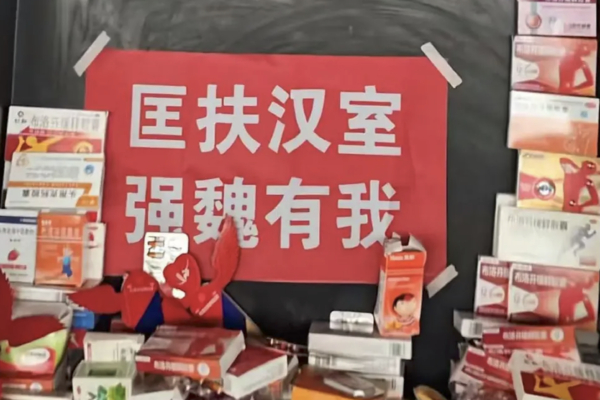
Around the time of Qingming Festival in 2026, there has been a surge of alternative offerings appearing in front of the tombs of historical figures throughout China. The tomb of Cao Cao is filled with boxes of ibuprofen (anti-inflammatory and pain reliever), Huo Qubing’s tomb is piled with potato chips and spicy snacks, and Zhang Juzheng’s tomb has hemorrhoid cream placed before it. Young people, following historical records, have been placing specific offerings in front of these ancient figures’ tombs, sparking discussions and debates online.
According to reports from various mainland Chinese media, the Cao Cao Mausoleum Museum in Anyang, Henan Province, saw a large influx of young visitors during this year’s Qingming holiday. The display cases inside the museum were almost overflowing with various brands of ibuprofen, with handwritten cards nearby containing messages like, “Prime Minister, it’s been 1800 years, still suffering from headaches?” and “After taking ibuprofen, remember not to drink alcohol.”
In addition to offering painkillers, some Chinese young people have also made cards with phrases such as “Supporting the Han Dynasty, Wei’s strength comes from me” and “Loyal servant of the Great Han,” as a gesture of respect to Cao Cao.
This alternative offering trend originated in April 2023 when a Three Kingdoms enthusiast from Guangzhou first placed a box of ibuprofen at the museum’s opening. Since then, it has become a trend that cannot be stopped.
Historical records show that Cao Cao suffered from severe headaches throughout his life, with modern medicine speculating that the cause of his illness may have been related to severe pulpitis. Visitors, making connections, have been bringing painkillers to “console” this eternal hero.
Reportedly, offerings have extended beyond ibuprofen, with some placing photos of the Martial Marquis of Wen (Zhuge Liang) and cards featuring famous Three Kingdoms generals, arranging a “meeting” for historical enemies. Others have brought dentist plush bears, advocating that “treating the root cause is the right path.”
Staff at the Cao Cao Mausoleum Museum stated on April 5th to multiple media outlets that during the Qingming period, there have been numerous visitors, with “new people coming to deliver ibuprofen every day.”
In fact, this trend of creative tomb-sweeping is not limited to Cao Cao’s tomb. According to summaries from media such as “China Newsweekly” and Observer Net, peculiar offerings tailored specifically to historical figures have appeared in front of tombs of prominent figures all over the country.
In front of Zhang Juzheng’s tomb, the most eye-catching offering is Ma Yinglong hemorrhoid cream. According to unauthorized historical records, this Ming Dynasty prime minister suffered greatly in his later years due to a botched hemorrhoid surgery, ultimately leading to his premature demise, prompting young people to express their “compassion” in this manner.
At the tomb of Huo Qubing, piles of potato chips and spicy snacks are placed. This Han Dynasty general passed away at a young age, only 23 years old. University students paying respects at his tomb realized that this general was just a young peer, likely fond of snacks as well.
Luoyang, due to its concentration of ancient tombs on Beimang Mountain, has become a popular destination for “communing with the ancients.” This has even led to the emergence of specialized “tomb-sweeping guides.”
Guide Wang Mian (pseudonym) told “China New Dimensions” that he has been receiving tomb-sweeping visitors since June of last year. The Qingming holiday was fully booked as early as March. He identified Luoyang’s top five popular tombs: Emperor Xiaowen of the Northern Wei Dynasty, the Southern Tang Dynasty’s later king Li Yu, Emperor Guangwu of the Han Dynasty Liu Xiu, Poet Sage Du Fu, and “Cao Pi Happy Pavilion.”
Moreover, several famous tombs in China have also become hotspots for tomb-sweeping: at the tomb of Li Bai in Dangtu, Anhui Province, visitors bring various fine wines such as white spirit and craft beer; in front of Zhuge Liang’s tomb, someone placed a high-speed rail ticket from Chengdu to Xi’an, symbolically completing the journey that this unfulfilled defender of the Shu Han had not finished; and in front of Sun Quan’s tomb, there is a certificate for the “Prefect of Hefei,” commemorating his historical attack on Hefei.
This alternative tomb-sweeping trend has quickly spread on the internet, with the Weibo hashtag “This generation’s tomb-sweeping is so cute” trending. Some people felt emotional, saying, “Seeing the phrase ‘sending ibuprofen to Cao Cao,’ for some reason makes me want to cry.”
Regarding the questioning of some people about this wave of alternative tomb-sweeping, Mighty Eye News quoted experts as saying that this is not disrespecting history but a kind of imaginative “recreation.” Young people are using their current life experiences to understand and converse with figures and stories from a thousand years ago, making it a case of “living history.”
Chinese Blue News commentator Yu Shumin wrote, “Blind to ancient moons, today’s moon has shone on ancient people.” Here, young people show deep feelings for history and invest in culture. When they are willing to feel sorry for a headache from 1800 years ago, raise a toast for the drinking pleasure from 800 years ago, history is no longer a distant other, but becomes a moment to embrace.